


Introduction
The Basel IV Framework
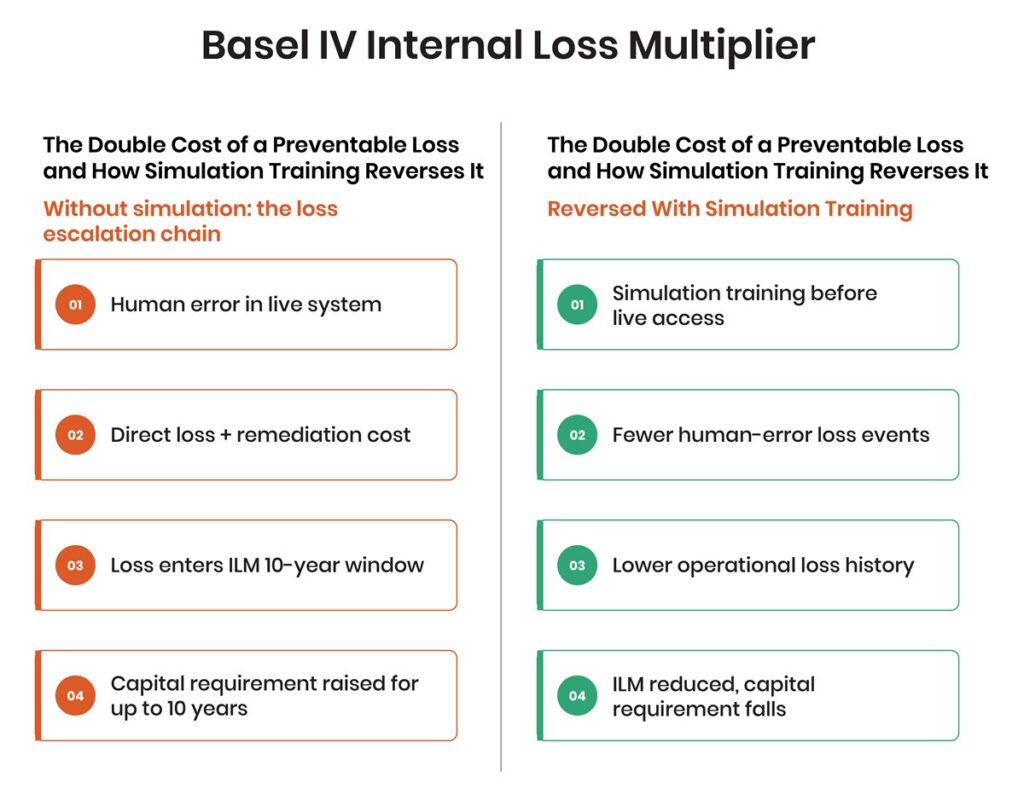
Basel IV’s Standardized Measurement Approach, which became mandatory for internationally active banks in January 2025, ties a bank’s regulatory capital requirement to its historical operational losses through the Internal Loss Multiplier. A preventable human-error loss does not just cost the loss amount. It raises the cost of capital for up to a decade after the fact.
This article argues a specific point: simulation training is an operational risk control. It reduces the human-error and process-execution loss events that drive op-risk exposure. It produces proficiency data that supports audit readiness. And through the Internal Loss Multiplier, it connects training investment to capital efficiency in language that belongs with the CRO and CFO, not just the L&D function. For Chief Risk Officers, Heads of Operational Risk, COOs, and L&D leaders in financial services, here is how that control works, which risk categories it addresses, and how to deploy it inside an ORM framework. For a look at how financial institutions specifically approach SAP training, see our SAP training simulation software for banking guide.
Operational Risk in Financial Institutions: The Human-Error Dimension
What Operational Risk Actually Is
Most risk conversations in financial institutions concentrate on credit and market exposure. Operational risk gets less strategic attention, despite generating some of the largest single-event losses in banking history. The Basel definition is precise: the risk of loss resulting from inadequate or failed internal processes, people, systems, or external events. Basel identifies seven distinct event categories, each with its own loss profile and control requirements.

Unlike credit or market risk, where accepting risk is a deliberate strategy tied to return, operational risk is pure downside. The goal is not to optimize it. The goal is to minimize it. And of the seven categories, two respond directly to the quality of employee training: “people” and “execution, delivery, and process management.”
Where Training Directly Reduces Risk
The “people” category covers human error and inadequate competency: the staff member who posts a transaction to the wrong account, skips a verification step under time pressure, or misapplies a product rule learned in a slide deck but never practiced in a real system. “Execution, delivery, and process management” covers failed transaction processing, settlement errors, reconciliation misses, and incomplete workflows. Together, these two categories generate a disproportionate share of operational loss events in most financial institutions.
The specific errors that populate these categories are mundane. An incorrect payment amount on a high-value wire. A trade posted to the wrong book. A client onboarding step skipped because the workflow wasn’t completed in sequence. None of these events make headlines individually. Cumulatively, they represent a meaningful share of most institutions’ operational loss registers. They are also preventable, not through more compliance certifications, but through genuine execution competency built through actual practice on the workflows where errors happen.
Why the Margin for Error Is Shrinking in 2026
Two forces compound the execution-risk picture in 2026. Regulatory supervision has tightened across every major jurisdiction, and examiners now expect training controls to be active and evidenced, not just documented. At the same time, digital transformation in banking has accelerated: core banking migrations, payment infrastructure overhauls, and cloud deployments mean staff constantly operate new or changed systems. System change is the highest-risk period for execution of errors, because it combines unfamiliar workflows with live financial consequences.
Most institutions train before go-live. Fewer can demonstrate that training produced genuine competency rather than awareness. Traditional training methods, including annual certifications, policy manuals, recorded webinars, and slide decks, satisfy the documentation requirements. They do not build the operational competency that prevents loss of events. That gap matters more now than it did five years ago.
Connecting Competency to Capital
The logic chain runs cleanly in both directions. Better training produces higher workflow competency. Higher competency generates fewer execution and human-error loss events. Fewer loss events lower the operational loss history feeding the Internal Loss Multiplier. A lower multiplier reduces required capital. Every link in that chain is traceable, and the CRO and CFO can see it.
That is why operational risk leaders should treat simulation training as a risk control that belongs in the ORM framework, not solely as an HR function. When training investment connects to capital efficiency in those terms, the budget conversation moves from the L&D review to the risk committee. That is where it produces the most organizational support.
The Complete Guide to SAP Training: From Planning to Optimization
How Simulation Training Reduces Each Operational Risk Category
Leading financial institutions have converged on a clear answer to one of the most practical questions in operational risk management: how do banks train employees on core banking and financial software effectively enough to actually reduce risk? The answer is simulation training, consisting of realistic and interactive replicas of the actual systems where loss of events happens, used to build genuine execution competency before those actions carry real consequences. Here is how that maps to each relevant Basel category.
Reducing “People” Risk: Building Genuine Competency
A policy manual tells staff what to do. Compliance certification records that they read. Neither one proves they can execute the workflow correctly under time pressure on a live system. Simulation does something different: it puts the employee inside a replica of the actual core banking system, executing the actual workflow, with the actual decision points where mistakes happen built directly into the scenario.
Repetition in a simulation builds familiarity, and familiarity builds speed. Speed achieved in a safe environment translates to fewer errors in production. The measurable output is not the completion rate. It is proficiency on exit. Can the employee complete the workflow correctly, without assistance, before they touch the live system? Simulation makes that question answerable and answering it converts “people” risk from an assumed control into a measured one. See also how simulation training reduces software errors in regulated environments.
Canadian Bank: When a major Canadian retail bank needed to train 2,500 branch staff and operations employees on a new 11-step SAP mortgage approval process, teams built every training exercise on system clones without accessing the live environment, cut training costs by an estimated $3 million compared to a traditional training client, and reached full workforce competency within six months. Read the full case study →
Reducing “Execution, Delivery, and Process Management” Risk
This is typically the highest-volume operational loss category in financial institutions. End-to-end process errors in settlement, reconciliation, payment processing, and client account management rarely happen because staff do not know the individual steps. They happen because staff cannot navigate the handoffs between systems, modules, and roles that live financial workflows require. The failure point is usually a junction, not a step.
Simulation training that preserves cross-screen and cross-module state trains exactly that full-process competency. A settlement reconciliation simulation that forces the trainee through both the initiation and the clearing steps, with a discrepancy built into the scenario, teaches the recovery behavior that prevents the near-miss from becoming a loss event. For context on how cross-application training coverage matters, see our guide to why single-screen training fails for cross-application SAP processes.
Supporting Fraud-Risk Controls
Simulation does not replace anti-fraud controls. What it does is reinforce the control-adherence behaviors that form the procedural layer of the anti-fraud environment. Staff who practiced the correct verification workflow in a simulation recognize deviation from it in the live system. Training on segregation-of-duty boundaries, exception escalation procedures, and authorization verification steps builds the pattern recognition that fraud detection relies on at the operational level. That behavioral layer matters inside any institution’s broader anti-fraud architecture.
Reducing Risk During Business Disruption and System Change
Core banking modernization and digital transformation in banking create a specific and predictable risk window: staff operating unfamiliar systems under live conditions before reaching competency. The traditional approach, train to go-live and then fix problems as they arise, keeps institutions in the elevated-error window for months after launch. That window is when loss events cluster.
Simulation built from staging environments changes that timeline. Staff reach competency before go-live, practicing the new system in a risk-free environment until they can execute every high-stakes workflow correctly and unassisted. After go-live, Assima In-App Search supports staff directly inside the live system for edge conditions that pre-launch simulation did not cover.
When npower trained 4,500 staff on a major SAP deployment, replacing classroom training with simulation-based exercises cut new-hire onboarding time from 33 days to 18 days, a 45% reduction in the high-error transition period, and reduced the staffing needed to deliver the full program by 80%. Read the full case study →
The Audit-Readiness Dividend
Regulators and internal audit want evidence of a functioning training control, not a training log. Attendance records prove someone completed a module. Simulation generates proficiency data: competency-gate pass rates, error-rate trends by workflow and role, time-to-competency by function. This is the evidence base that answers a supervisory examination with measured outcomes, not paperwork.
That distinction matters under current supervisory expectations. Documenting that staff completed training and demonstrating that staff can execute a critical workflow correctly are two different claims. Simulation evidence supports the second. Track these metrics under digital adoption KPIs and route them into the ORM reporting cycle to build the evidence base over rolling quarters.
Deploying Simulation Training as an Op-Risk Control
Map Training to Your Risk Register
The most effective starting point for a simulation training program in a financial institution is not the learning catalog. It is the operational risk register. Identify the workflows where your loss data concentrates.
Which processes have generated actual loss of events or near-misses in the past 24 months?
Which functions show elevated error frequency?
Which system transitions are coming in the next 12 months?
Those are the priority simulation targets. This alignment produces something a standard training budget request cannot: a direct line from training investment to documented risk exposure. When the Head of Operational Risk sees that simulation training covers the three workflow categories that account for 60% of the institution’s execution-related loss events, the investment belongs in the risk control discussion. For guidance on structuring that program design, see how to build a simulation training program.
Build Realistic, Compliant Simulations
Financial workflows involve sensitive data: customer records, account details, and transaction histories. Any simulation environment must use anonymized data. Irreversible anonymization keeps training content outside GDPR scope and removes it from the SOX audit footprint, without reducing workflow realism. Simulations must also require no access to the live production system at any stage, always protecting the production environment from training-related incidents.
For global financial institutions, multilingual delivery from a single content source ensures consistent competency standards across all jurisdictions without rebuilding content for each market.
Measure the Control, Report to Risk Governance
Track competency-gate pass rates by role and workflow. Monitor error-rate trends within the simulation environment over rolling quarters. Measure time-to-competency for each function. Then correlate those metrics with actual operational loss and near-miss data from the risk register.
These numbers belong to the ORM reporting cycle, not just the L&D dashboard. When the risk committee sees that the competency-gate pass rate for payments, processing improvs massively; that is control-effectiveness evidence in language that risk governance understands. Use the ROI Calculator to quantify the capital-efficiency case for simulation training at your institution and see how the systems training platform supports the full ORM control deployment.
Assima delivers simulation-based training for financial services: realistic enough to build genuine execution competency, fully compliant for sensitive financial environments, and measurable enough to report risk governance.
See Simulation Training as an Op-Risk Control in Action
Frequently Asked Questions
Let’s Answer Some of Your Questions.
Operational risk in financial institutions includes losses from human error and failed process execution, two of Basel’s seven risk categories that are directly training-addressable. Simulation training places staff inside realistic replicas of their actual core banking and financial systems, building genuine execution competency before those actions carry real consequences.
Fewer human-error and process-execution loss events translates to lower operational risk exposure. Simulation also generates proficiency data, including competency-gate pass rates and error-rate trends, that supports audit readiness. Under Basel IV SMA, reducing loss events over time can lower the Internal Loss Multiplier and reduce required regulatory capital.
The Basel Committee on Banking Supervision defines operational risk as the risk of loss resulting from inadequate or failed internal processes, people, systems, or external events. Basel identifies seven event categories: internal fraud, external fraud, employment practices and workplace safety, clients and products and business practices, damage to physical assets, business disruption and systems failures, and execution, delivery, and process management.
Unlike credit or market risk, operational risk carries no potential return. There is no spread on a missed payment and no yield on a reconciliation error. The “people” and “execution” categories are substantially preventable through competency-based training.
While cross-application training teaches end-to-end business processes that span many modules, module training concentrates on a single SAP module. The latter more accurately captures how workers utilize SAP on a regular basis.