

Introduction
Key Highlights
- Banking environments require highly accurate SAP usage because even small workflow errors can create financial and compliance risks.
- Traditional SAP training methods fail to prepare banking employees for real-world execution under pressure.
- SAP training simulation software enables employees to practice workflows safely without affecting production systems or financial data.
- Simulation-based SAP training improves onboarding, retention, user confidence, and operational accuracy in banking.
- Assima Train helps banks deliver scalable, compliance-ready SAP training with realistic simulations and in-app guidance.
This blog breaks down what that strategy should look like, where organizations most commonly go wrong, and how solutions like Assima Train are helping enterprises close the gap between system go-live and genuine workforce readiness.
Assima Train and other solutions allow banks offer SAP training based on simulations that lowers risk, makes it easier to use, and meets compliance needs.
Why SAP Training is Critical in Banking
Many banking operations depend on SAP systems. These systems help with workflows that need to be done correctly, from handling client transactions to keeping track of financial reports.
Banking settings are naturally complicated. Employees work with many modules and processes that are linked together and need to be done exactly right.
Key Reasons SAP Training Matters in Banking
- Complicated financial processes
There are many procedures and system interactions involved in banking processes include approving loans, settling debts, and reconciling accounts.
- Regulatory compliance requirements
Banks and other financial institutions have to follow tight rules about how they report, audit, and handle data. - High cost of errors
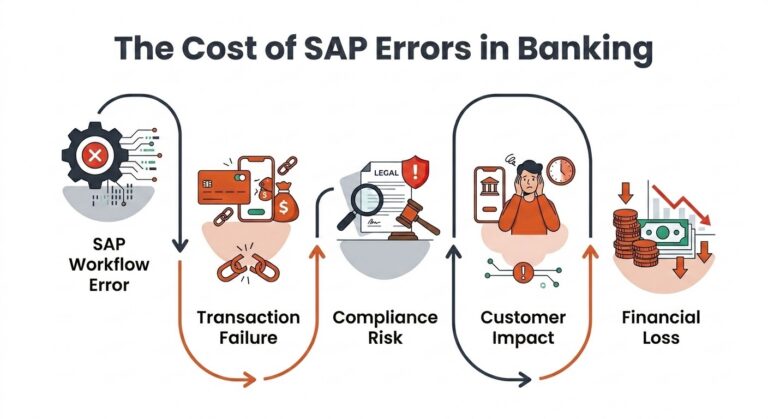
Errors in SAP systems can cause transactions to go wrong, cost money, or break the law.
For instance, a wrong posting in a financial transaction can change customer accounts and take a lot of time to fix. Also, mistakes in regulatory reporting can result in fines or audit results.
Banks need to make sure that their workers know how to utilize SAP systems correctly before they do live transactions because of these hazards.
Challenges of Traditional SAP Training
A lot of banks still use old-fashioned SAP training methods, but those approaches don’t always do a good job of getting workers ready to use the system in real life. When there is a gap between theory and practice, things get confusing, take longer, and mistakes happen.
- Classroom-based learning lacks real application
Most of the time, traditional training sessions are just about describing how a system works and its features. They don’t provide you any real-world experience. During training, employees might get the hang of things, but they might have trouble using them when they operate alone in real SAP environments.
- Limited hands-on experience reduces confidence
Users don’t get to know SAP interfaces unless they actually do things. Because they don’t practice enough, employees are hesitant, especially when they have to cope with complicated workflows or time-sensitive tasks in live banking systems.
- Difficulty in translating theory into execution
Employees usually know what has to be done, but they don’t always know how to perform it in the system step by step. This lack of communication makes tasks take longer to finish and makes people rely more on their coworkers or IT support teams.
- Sandbox environments are not always effective
Sandboxes do let you practice to some extent, but they have several problems, like limited access, extra work for maintenance, and no structured learning. Because they aren’t made for training, they don’t work as well.
Traditional training approaches give employees a good start, but they don’t fully educate them to use SAP in the real world. This is why a lot of businesses are increasingly moving toward learning methods that involve more hands-on activities and simulations.
Calculate how much your bank could save by reducing SAP training errors and support dependency.
What is SAP Training Simulation Software?
SAP training simulation software is a new way to learn that lets workers practice SAP procedures in fake settings.
Simulation platforms create digital copies of SAP interfaces and processes instead of using live systems or sandbox environments. Users can interact with the system as if they were doing real work.
This method is all about learning by doing.
How Simulation-Based Training Works
- Replicates real SAP interfaces and workflows
- Allows users to perform tasks step by step
- Provides safe environments where mistakes do not affect real data
- Enables repeated practice for better understanding
For instance, a bank worker can practice processing transactions or reconciling accounts in a fake environment before doing those things in real life.
Simulation-based training fills the gap between theory and practice by giving people real-world experience without putting them at danger.
Benefits of Simulation-Based SAP Training
For banks that work in risky circumstances, simulation-based SAP training has a number of benefits. One of the best things about it is that you may learn without taking any risks. Employees can rehearse procedures without messing up real client accounts or financial data.
Learning by doing also helps you remember things. People remember how to do things better when they actually do them instead of just reading the instructions. Training with simulations also speeds up the onboarding process. New staff can quickly learn how the system works by doing things.
Key Benefits of Simulation-Based SAP Training
Benefit | Impact on Banking Operations |
Risk-free learning | Protects financial data during training |
Improved retention | Employees remember workflows more effectively |
Faster onboarding | New hires become productive sooner |
Better user adoption | Employees use system features confidently |
Reduced errors | Fewer mistakes in live transactions |
This approach helps banks improve operational accuracy while reducing the risk associated with system usage.
How Assima Train Helps Banking Enterprises

Assima Train is a platform for simulation-based training that helps banks use corporate software.
The platform simulates real SAP systems, so employees can safely rehearse operations without messing up production data.
Simulation-Based Learning
Employees use realistic SAP simulations that are like real-life workflows. This lets them get real-world experience before working with live systems.
In-App Guidance
Assima Train also provides contextual guidance during workflows. Step-by-step instructions help users complete tasks accurately and reduce errors.
Scalable Enterprise Deployment
Banks often operate across multiple branches and regions. Assima Train enables organizations to deliver consistent training programs to large, distributed teams.
Compliance-Ready Training
Simulation-based training helps ensure that employees follow correct procedures. This supports regulatory compliance and audit readiness.
Reduced Training Costs
By eliminating the need for extensive sandbox environments, Assima Train reduces infrastructure costs while improving training efficiency.
Outcomes for Banking Organizations
- Lower operational error rates
- Faster employee onboarding
- Improved compliance accuracy
- Reduced dependency on IT support
These outcomes help banks strengthen operational performance while minimizing risk.
Best Practices for SAP Training in Banking
Organizations that see strong SAP S/4HANA adoption results share a consistent set of practices. These are not theoretical recommendations. They are patterns that show up in implementations that actually deliver.
Train users before go-live, not after. Waiting until the system is live to begin training puts users in the position of learning under real business pressure. Pre-go-live training with simulation tools gives employees the confidence to perform from day one rather than spending weeks finding their footing.
Make simulation-based learning the core method. Static content and classroom sessions have their place, but they should support simulation, not replace it. The hands-on experience of practicing in a realistic SAP environment is what actually prepares employees for the real thing.
Build role-based learning paths. Generic training wastes time and leaves critical gaps. Map training content to actual job responsibilities so every user learns what they need to know and nothing they do not.
Monitor adoption metrics after go-live. Transaction completion rates, error frequencies, support ticket volumes, and time-on-task data all reveal where adoption is working and where it is not. Organizations that track these metrics can respond quickly when problems emerge rather than discovering them months later.
Reinforce learning after deployment. Plan for ongoing training touchpoints in the weeks and months after go-live. Process refreshers, targeted support for users who are struggling, and updates as the system evolves all contribute to sustained adoption over time.
Conclusion
In banks, where accuracy and following the rules are very important, SAP training is quite important. Traditional training approaches sometimes don’t give employees the hands-on experience they need to be ready for real-world responsibilities.
SAP training simulation software is a safer and better option. Banks can lower mistakes, boost adoption, and boost compliance by letting workers rehearse workflows in real-world settings.
Platforms like Assima Train let you provide scalable, simulation-based training that gets staff ready for complicated SAP systems without putting production settings at risk.
Banks that want to get more people to use SAP and lower their operational risk should look into how Assima Train can help with their training plans.
If your organization is preparing for an SAP S/4HANA rollout or trying to improve adoption on an existing deployment, explore how Assima Train can help you build the workforce readiness your implementation actually needs.
Frequently Asked Questions
Let’s Answer Some of Your Questions.
Assima Train provides simulation-based learning, in-app guidance, and scalable training programs for enterprise teams.