

Key Highlights
- LMS, DAP, and simulation training solve different software adoption challenges.
- LMS manages learning, compliance tracking, and training program governance.
- Simulation training builds hands-on software proficiency before system go-live.
- DAPs provide real-time guidance directly within live enterprise applications.
- The strongest learning strategies combine all three technologies together.
- A Learn–Practice–Perform model supports adoption across the entire user journey.
Introduction
If you’re evaluating employee training software, you’ve probably come across three categories of tools: Learning Management Systems (LMS), Digital Adoption Platforms (DAPs), and simulation-based training platforms.
Here’s the simplest way to think about it:
| If you need to… | Use |
| Deliver and track training | LMS |
| Let employees practice software safely | Simulation-Based Training |
| Guide employees inside live applications | DAP |
The Modern Enterprise Learning Journey
Most software adoption initiatives follow three stages:
Learn
Employees are introduced to new systems, processes, and business requirements.
Practice
Employees gain hands-on experience and build confidence before using the software in production.
Perform
Employees complete real work inside live applications and need support when they encounter challenges.
Each stage requires a different type of tool.
Stage | Primary Tool |
Learn | LMS |
Practice | Simulation-Based Training |
Perform | DAP |
Understanding this distinction makes it much easier to build an effective training strategy.
What Is a Learning Management System (LMS)?
A Learning Management System (LMS) is the foundation of most corporate learning programs.
An LMS acts as a central hub where organizations deliver, manage, and track training content. Employees can access courses, complete assessments, earn certifications, and follow structured learning paths.
For decades, LMS platforms have been the backbone of corporate training because they provide the reporting and governance capabilities organizations need.
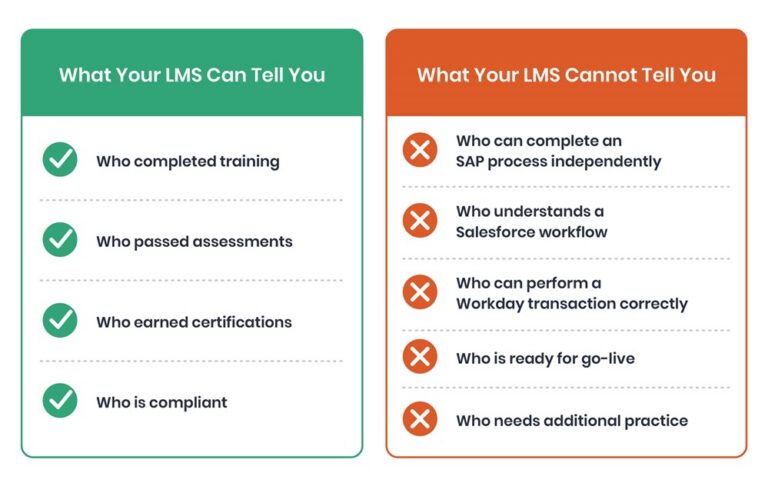
That’s why many organizations add simulation-based training before deployment and DAP support after go-live.
What Is Simulation-Based Training?
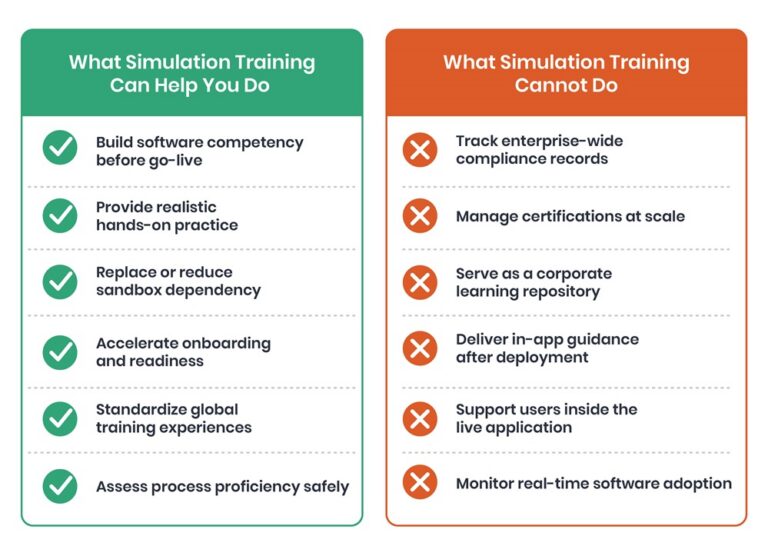
Simulation-based training allows employees to practice software processes in a realistic environment before using the live system.
Instead of reading documentation or watching videos, learners actively complete workflows, make decisions, and learn by doing.
This approach is particularly valuable during ERP, CRM, and enterprise software rollouts where mistakes in production systems can be costly.
What Is a Digital Adoption Platform (DAP)?
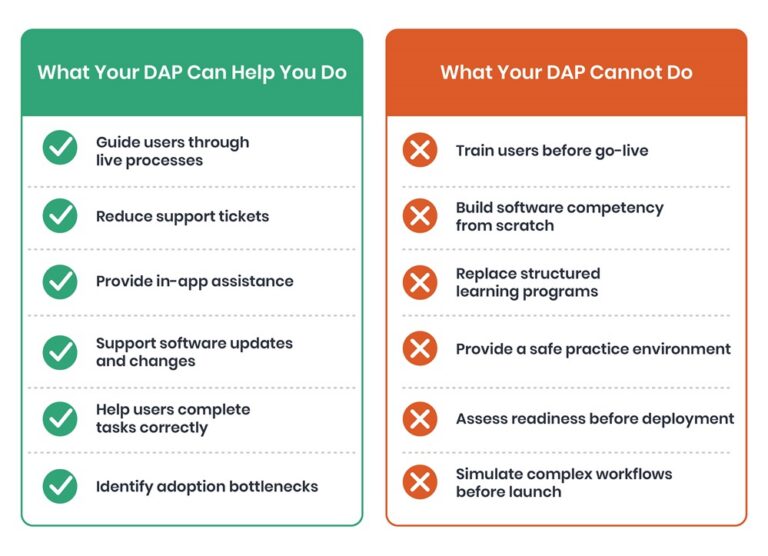
A Digital Adoption Platform (DAP) provides guidance directly inside a live application.
Rather than requiring employees to leave the system and search for help, the DAP delivers assistance at the exact moment it is needed.
Users receive contextual guidance while performing real work.
Which Tool Solves Which Problem?
| Business Challenge | LMS | Simulation | DAP | We need compliance tracking | ✓ |
|---|---|---|---|
| We need onboarding programs | ✓ | ||
| We need employees ready before go-live | ✓ | ||
| We need to replace expensive sandboxes | ✓ | ||
| We need users to practice safely | ✓ | ||
| Which Tool Solves Which Problem? | |||
| We need help after launch | ✓ | ||
| We need to reduce support tickets | ✓ | ||
| We need to improve software adoption | ✓ | ||
| We need a complete software learning strategy | ✓ | ✓ | ✓ |
Discover how leading organizations accelerate software ROI by improving user adoption, reducing training costs, and maximizing technology utilization.
Which Tool Should You Choose?
The answer depends on your organization’s challenge.
If You Need Compliance Training
An LMS is usually enough.
Compliance programs, certifications, and policy training fit naturally within a Learning Management System.
If You’re Rolling Out ERP or CRM Software
You will likely benefit from all three.
Employees need:
- LMS for foundational learning
- Simulation training for hands-on practice
- DAP support after go-live
Each tool addresses a different phase of the rollout.
If Your Software Changes Frequently
A combination of simulation training and DAP support is often the strongest option.
Employees can practice new processes before deployment and receive guidance after release.
If You Have a Global Workforce
Simulation-based training becomes particularly valuable because learners can practice independently, regardless of location or time zone.
The LMS tracks completion, while the DAP provides localized support after deployment.
The 2027 Tech Stack Recommendation
The future of enterprise software training is not LMS versus DAP versus simulation training.
It is LMS plus DAP plus simulation training.
Each tool owns a different part of the learner journey:
Organizations that treat these tools as complementary rather than competing are better positioned to accelerate software adoption, improve employee proficiency, and maximize the value of their technology investments.
The question isn’t which tool to choose.
It’s knowing which phase of the learner journey each one owns.
How Assima Fits Into the Picture
Assima complements existing training ecosystems rather than replacing them.
Assima Train addresses the practice phase by creating hyper-realistic software simulations using patented object-based cloning technology. Organizations can train employees on x, and other enterprise applications before go-live without relying on costly sandbox environments.
Assima Assist addresses the performance phase by providing support directly within enterprise applications, helping users complete tasks and find answers when they need them most.
Because Assima supports SCORM and LMS integrations, organizations can continue using their existing LMS while adding simulation-based training and digital adoption capabilities to create a complete software learning ecosystem.
Ready to See How It Fits?
Explore how Assima supports software adoption across the entire learner journey.
Frequently Asked Questions
Let’s Answer Some of Your Questions.
An LMS delivers, manages, and tracks training courses, certifications, and learning progress. A Digital Adoption Platform (DAP) guides users inside live software applications by providing real-time assistance and support. Simulation-based training creates realistic software environments where employees can practice workflows before go-live. Together, these tools support different stages of the learning journey rather than competing with one another.
Simulation-based training can significantly increase the value organizations receive from their existing LMS investment. By allowing employees to practice software processes before go-live, organizations can reduce training costs, accelerate software adoption, and improve learner readiness. In many enterprise environments, simulation training can also reduce reliance on expensive sandbox environments, which can cost hundreds of thousands or even millions of dollars annually to maintain. Assima customers have reported up to a 70% reduction in training costs and faster realization of software ROI. Organizations can also use an ROI Calculator to estimate potential savings based on their specific rollout plans.
Neither is inherently better because they solve different problems. An LMS is designed to deliver learning content, track progress, and manage compliance requirements. Simulation-based training focuses on building hands-on competency by allowing employees to practice real software processes before go-live. For complex ERP, CRM, and enterprise software implementations, organizations often achieve the best results by combining both. The LMS manages learning and governance, while simulation training ensures employees are prepared to perform confidently in the live system.