

Key Highlights
- Digital transformation initiatives are successful when employees adopt new technologies with assurance.
- One-time training sessions are less successful than ongoing, in-workflow learning.
- Organisations can scale software adoption across international teams and complex systems with the use of DAPs.
- Adopting digital technology effectively speeds up time-to-value, boosts productivity, and decreases errors.
Introduction
New software implementation is the first step. The true difficulty starts when employees are required to implement new procedures, systems, and methods of operation. Even the most efficient technology can fail to deliver results without adequate assistance. Digital adoption helps close this gap, and digital adoption platforms offer the resources required to accelerate and improve adoption by allowing users to learn, adapt, and work efficiently.
What Is Digital Adoption?
Digital Adoption is the process by which individuals and organizations switch from traditional methods to fully integrate digital tools and technologies. The idea entails a significant change in the way technology is adopted to improve business operations, going beyond mere usage.
It primarily focuses on making sure that users are proficient and comfortable with the new tools. Whereas digital transformation covers the strategy of accepting modern technology in general.
It’s important to know how digital adoption fits into larger digital transformation initiatives in order to properly comprehend its significance. Despite their close connection, the two ideas have different functions.
Digital Adoption | Digital Transformation |
The process by which users incorporate new digital technologies into their workflows to increase productivity and efficiency is known as “digital adoption.” It involves making optimal use of these technologies to attain desired goals. | The term “digital transformation” refers to a bigger idea that includes the entire strategy of integrating digital technologies into every aspect of an organization, radically altering how it functions and provides value to clients. |
Ready to transform your digital adoption strategy?
What makes Digital Adoption crucial for Business?
Today’s fast-paced world demands businesses to operate seamlessly, where employees are equipped with the latest advanced technology so they can be as productive and efficient as ever. This isn’t a distant future, it’s digital adoption. It is an essential component in the modern business world where technological advancement occurs at an incredible speed. It’s an important factor that determines whether a company succeeds or fails.
Businesses that effectively use digital adoption tools are more agile, competitive and better positioned to respond to changing market and customer demands.
According to Gartner, 67% of market leaders beat their competitors because of their advanced digital adoption strategies in place. It is the key component of modern business strategy since it facilitates employee onboarding, increases productivity, innovates, and streamlines processes.
The Common Challenges of Digital Adoption
Digital Adoption challenges come up despite its various benefits. Here’re a few listed below:
Resistance to Change
Change can be daunting and due to the fear of the unknown or concern about their ability to adapt to technology, employees resist new technologies. This can be mitigated through effective change management strategies that involve clear communication, employee engagement and demonstrating the tangible benefits of new software.
Inadequate Training
One of the biggest challenges of Digital Adoption is lack of training. Employee dissatisfaction and less productivity could result in their inability to use new software and technologies successfully without the right training. Therefore, comprehensive training programs tailored to the requirements of users are important for successful Digital Adoption.
Technical Difficulties
Digital Adoption might be hampered by technical obstacles like compatibility and software bugs. Maintaining a seamless adoption process depends on quickly resolving these issues with IT assistance and ongoing monitoring.
The Missing Piece of Successful Digital Adoption
It is crucial to train employees on new software, but training alone cannot guarantee adoption. Traditional training methods like lectures, webinars, and user manuals frequently impart knowledge before users need it, which makes it challenging for users to remember and use it in practical situations.
Successful digital adoption requires ongoing assistance beyond implementation and onboarding. Employees need assistance when they come upon new procedures, not weeks before a training session. Digital adoption platforms close this gap by providing in-context, real-time support right within enterprise applications.
So, how can organizations turn digital adoption goals into measurable results? The answer often lies in leveraging a Digital Adoption Platform (DAP). Let’s take a brief of digital adoption platform.
What is a Digital Adoption Platform?
Digital Adoption Platforms are innovative software that make it easier for people to understand and adapt digital tools and technologies. These are essential to ensure that users can fully utilise the features of diverse software applications without needing hands-on support, especially as the digital world grows more complicated.
Integrating these digital adoption platforms with other software applications gives users real-time assistance, training, and guidance, resulting in a more seamless and user-friendly interface.
How Digital Adoption Platforms Support Digital Adoption?
Digital Adoption Platforms (DAPs) assist companies in achieving actual user adoption by going beyond software deployment. DAPs allow users to learn and finish tasks without interfering with their workflow by offering contextual advice, in-app support, and learning resources right within workplace apps.
This helps workers become competent more quickly and lessens the need for conventional training and support teams. As a result, companies can optimize the return on their technological investments, boost software adoption, and enhance productivity.
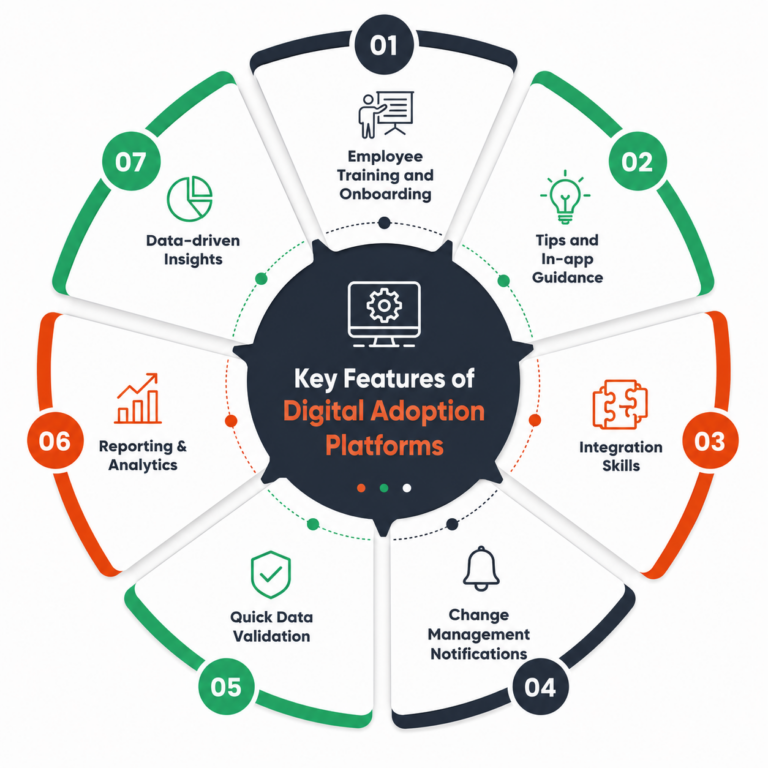
Key Features to Look for in Digital Adoption Platforms
Employee Training and Onboarding
DAP make the user onboarding process easier with interactive and customised training. This ensures that users can begin to use the software efficiently right away and quickly get used to it.
Tips and In-app Guidance
As users explore the software, real-time help is provided by in-app guidance. With this compatibility, users can solve many issues on their own and needs less outside assistance. Hence, increasing productivity and efficiency.
Integration Skills
The smooth integration of DAP with a variety of software programs is one of its main advantages. This ensures that customers get consistent help and direction from various resources, resulting in an integrated digital experience.
Change Management Notifications
DAP send change management notifications to oversee modifications to software programs or processes. In order to ensure a seamless transition and reduce disruption, these notifications notify users of upgrades and new features.
Quick Data Validation
This feature of DAP verifies the accuracy and prevents errors in real-time data entries. The crucial data validation feature maintains data integrity and cuts down on the time needed to fix errors.
Reporting & Analytics
DAP keep track of user activities and generate comprehensive data and analytics. By addressing pain areas and enhancing the user experience, it assists organisations in better understanding how users interact with the product. Analytics can also indicate areas that could require more assistance or training. These insights assist enterprises in identifying areas in need of optimization.
Leading Use Cases of Digital Adoption Platforms
Employee Onboarding
DAP simplify the new user onboarding process by offering personalised and interactive training. This ensures that newly hired employees can start using the software and adding value to the business right away.
Customer Training
Besides being useful for customer training, Digital Adoption Platforms enable customers to comprehend and make efficient use of the software. Hence, resulting in increased client loyalty and satisfaction.
Software Migration
DAP help users migrate seamlessly to the new system by offering them the direction and assistance they need during the software migration process. This guarantees a smooth transition and minimises disruption.
Process Optimization
DAP streamline business operations by offering real-time guidance and self-service support. Thus, enhancing overall efficiency and simplifying procedures.
How Assima Supports Digital Adoption?
Assima Digital Adoption Platform (DAP) is a complete solution designed to speed up the adoption process. It offers a wide range of digital adoption tools and features to support users in their digital journey. Let’s look at how three Assima solutions: Assima Train, and Assima In-app Search, Assima Assist, combined together make up for the perfect Digital Adoption Platform.
Assima Train
Assima Train is a comprehensive system training platform designed to equip users with the skills and knowledge required to use new digital tools successfully. This Digital Adoption Platform offers an immersive and engaging learning experience that ensures users are well-prepared for digital adoption. It helps users with:
- Interactive Training Modules
- Customizable Content
- Continuous Assessment
Assima In-app Search
Assima In-app Search is a powerful search tool that allows users to find information and resources without leaving their current application. It enhances productivity by providing quick access to the knowledge users need to perform their tasks effectively with:
- Integrated Search Functionality
- Comprehensive Knowledge Base
- Enhanced User Experience
Assima Assist
Assima Assist is a real-time, context-sensitive help digital adoption solution that guides users through their digital tasks. By providing immediate, in-the-moment support, Assima Assist reduces the learning curve associated with new technologies and minimizes user frustration. It offers:
- Real-Time Guidance
- Context-Sensitive Help
- Reduced Support Costs
Wrapping Up
Digital transformation becomes successful when businesses completely accept and embrace the technology they are provided. By bridging the gap between software implementation and user proficiency, digital adoption platforms enable employees to perform effectively and confidently. Assima uses a potent combination of in-app assistance, performance support, and simulation-based training to help enterprises accelerate digital adoption. The outcomes are faster onboarding, better software utilization, and higher ROI from enterprise applications.
Are you prepared to convert software expenditures into profitable outcomes?
Frequently Asked Questions
Let’s Answer Some of Your Questions.
Digital Adoption Platforms connect to other software systems through APIs (Application Programming Interfaces) and browser add-ons. This smooth integration makes sure that DAPs can offer contextual help and advice within the user's workflow. Hence, improving the software experience as a whole.
DAPs are particularly beneficial in remote work environments by offering on-demand, in-app guidance and remote training. This ensures that remote team members can access the support they need without relying on physical training sessions, promoting efficiency and productivity.
A lot of security features are built into DAPs, such as data encryption, user authentication, and access limits. These features ensure that sensitive information is protected and that only authorised users can access specific functions within the platform.
DAPs help in regulatory compliance by providing consistent and accurate guidance on compliance-related tasks. They ensure that users follow the correct procedures and maintain compliance with industry regulations, reducing the risk of non-compliance and related penalties.
The following KPIs can assess the effectiveness of digital adoption initiatives, including:
- Variations in productivity levels including the amount of time needed to finish a task or the quantity finished in a given amount of time.
- Increase in process effectiveness, including lower error rates or more efficient work processes.
- Feedback from employees about their impressions and contentment with the new technologies.
- Increases brought about by better service delivery in terms of ratings and feedback from customers.
- Financial measurements such as return on investment (ROI) evaluate the revenue and cost reductions associated with digital adoption