

Introduction
Key Highlights
- Adoption is more important to the success of enterprise transformation than technology.
- Low adoption, increased expenses, and a delayed return on investment are all consequences of poor training.
- In-app, simulation-based learning is essential for achieving tangible transformation results.
- Planning for 2027 should begin now due to the long and complex implementation cycles.
Initially, it may appear to be overplanning. However, the schedule becomes reasonable, even tight, when you take into account multi-year ERP rollouts, international operations, regulatory layers, and change management.
Why Should Businesses Schedule Transformation Years Ahead of Time?
Large-scale transformation is something you design over time rather than “executing” in a single year. Consider the steps involved in a typical business transformation:
- Implementations of SAP or ERP that require 18–36 months.
- Approvals of budgets in line with long-term financial cycles.
- Cross-regional regulatory and compliance checks
- Coordination of rollouts between nations
These tracks are closely related to one another. The program as a whole may suffer from a delay in one section. Additionally, there is the fact of internal alignment. Businesses are ecosystems. It takes time, iteration, and systematic planning to align leadership, IT, operations, and end users. That’s why, enterprise transformation strategy now focuses more on long-term planning than on responding to change.
What’s Missing in 2027 Transformation Plans?
This is where things start to go wrong. A few crucial holes consistently appear in transformation initiatives, even those that are well-funded and well-planned; these deficiencies are already apparent in many 2027 plans. The most common problems are as follows:
- Training is seen as a last step instead of a strategic pillar.
- Just system deployment plans, no explicit adoption roadmap
- Early employee exclusion causes resistance later on.
- Technology is given precedence over usability, which causes friction.
The outcome? An implementation that is technically sound but has operational issues. Strong company training strategies that address basic yet crucial questions are frequently lacking:
How are they going to learn? When will they find out? And how will that knowledge be used in day-to-day tasks?
Even the best systems fail to live up to expectations in the absence of clarity.
The Hidden Cost of Poor Transformation Planning
The repercussions quickly become apparent when adoption is not included in the plan. It initially appears in minor ways, such as staff hesitation, slowed workflows, and an increase in support tickets. However, the effects get considerably worse over time.
Companies begin to encounter:
- Low system uptake and underutilization of important features
- Productivity declines as workers struggle with new workflows, .
- Growing expenses for IT assistance due to ongoing troubleshooting
- ROI delays that can occasionally last months or years
And the truth is, a transformation is not just inefficient, it’s ineffective. They’re common transformation program challenges that stem from one root cause: planning that overlooks people.
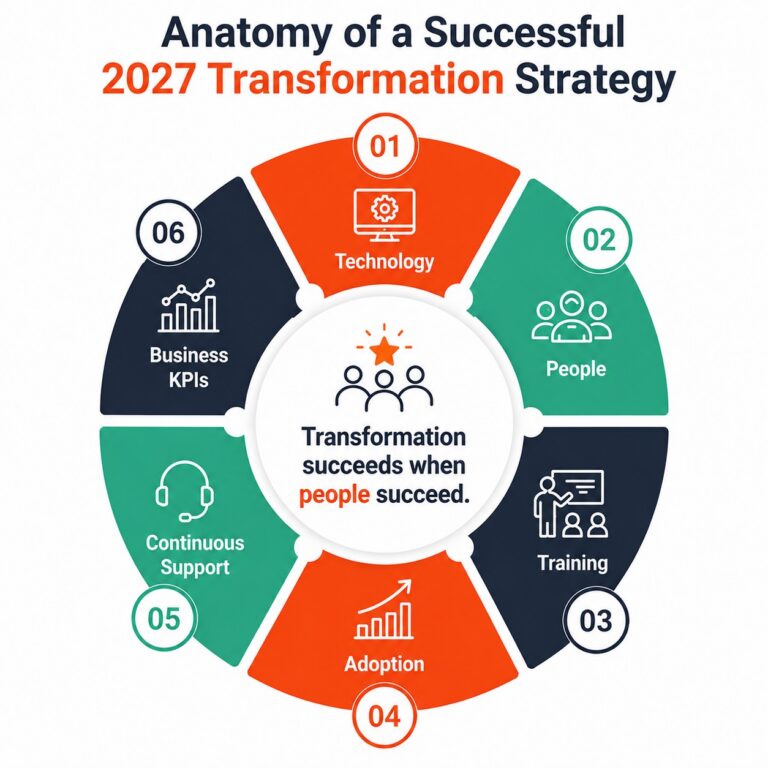
Why Training is the Foundation of Transformation Success?
Training is one lever that regularly enhances transformation outcomes, but not in the conventional sense. Enterprise training nowadays looks very different. It’s not about static manuals or one-time sessions. It involves ongoing, contextual, and hands-on learning. Today’s most successful strategies focus on:
- Role-based instruction that is customized for each user’s system interactions
- Learning while working, integrated into everyday chores
- Practical simulations that let users practice without taking any risks.
- Continuous assistance rather than merely pre-go-live planning
This change is significant since employees learn systems while performing their duties. A robust digital adoption platform is essential in this situation. It ensures that learning truly transfers into performance by tying training to practical application. In simple terms, good training doesn’t support transformation; it accelerates it.
How Assima Train Supports Enterprise Transformation?
Assima Train makes a significant impact. It emphasizes experience-driven learning, allowing users to practice, learn, and perform in realistic settings, rather than depending on conventional training techniques. This is what makes it unique:
- Training through simulation that mimics actual business systems
- Real-time, in-app assistance that helps users with tasks
- A scalable deployment is perfect for multinational companies
- Shorter training sessions and lower costs without sacrificing efficacy
In simple terms, employees do not just learn the technology. They gain confidence using it. In addition, it improves transformation outcomes, reduces dependence on support teams, and increases enterprise software adoption.