

Introduction
Key Highlights
- Traditional enterprise software training struggles to keep up with constantly evolving ERP, SAP, CRM, and HR systems.
- Microlearning delivers short, task-focused learning that supports employees directly in the flow of work.
- Bite-sized learning improves onboarding, retention, user confidence, and software adoption while reducing disruption.
- Microlearning works better than traditional training because it aligns with how employees actually learn and perform tasks.
- Assima Train enables simulation-based microlearning with in-app guidance, role-based delivery, and scalable enterprise training.
1. Why Enterprise Software Training Needs a New Approach
Enterprise software environments are no longer stable for long periods. Systems update frequently, business processes evolve, and compliance requirements shift. Training that worked once a year no longer works in a world of continuous change.
At the same time, employees have limited time for learning. Long training sessions disrupt productivity and are often forgotten by the time users encounter real tasks. This gap between training and execution leads to frustration, errors, and slower adoption.
Poor training has clear consequences:
- Users struggle to complete tasks confidently
- Errors increase in live systems
- IT and support teams handle repeated questions
- Software investments fail to deliver expected ROI
Conventional training techniques were designed for static systems. Today’s enterprise software need a more adaptable strategy that promotes continuous learning without impeding people’s progress.
Organizations want training that is flexible, integrates into regular tasks, and strengthens learning over time and this is exactly why microlearning in enterprise software training is gaining traction.. Businesses are adopting microlearning for software training—and more broadly, microlearning in enterprise training, as a result of this change, where learning takes place in brief, pertinent moments as opposed to big, disruptive events.
2. What Is Microlearning in Enterprise Software Training?
In workplace software training, microlearning is a method of instruction that provides brief, targeted courses centered around certain tasks or workflows. A single goal, such finishing a transaction, updating a record, or adhering to a compliance step, is the focus of each learning unit.
Microlearning divides instruction into digestible chunks that users may easily absorb, offering bite-sized learning for employees that can be applied immediately as opposed to covering a whole system all at once. The majority of microlearning activities only require a few minutes to finish.
Key characteristics include:
- Short duration: Designed to fit into busy workdays
- Task-based: Focused on real system actions
- Contextual: Delivered when users need it
- Repeatable: Available for reinforcement anytime
In enterprise software environments, common microlearning examples in software training often appear as:
- Step-by-step guidance inside applications
- Short simulations for specific workflows
- Quick refreshers before performing tasks
- Targeted practice for new features or updates
Think of microlearning like a quick reference guide instead of a full manual. You don’t read it cover to cover—you use it exactly when you need help.
This approach makes microlearning especially effective for ERP, SAP, and CRM training, where users perform complex tasks repeatedly and accuracy matters.
3. Key Benefits of Microlearning for Enterprise Software Training
Microlearning delivers clear advantages for enterprise organizations training users on complex systems.
Faster onboarding
New hires ramp up faster when training focuses on the tasks they perform most often. Instead of overwhelming users with full-system training, microlearning builds confidence step by step.
Higher retention
Short, focused learning improves retention because users apply what they learn immediately. Repetition through microlearning reinforces correct behavior over time.
On-demand access
Employees can access learning exactly when they need it—before, during, or after completing a task. This reduces hesitation and reliance on support teams.
Better scalability
Microlearning scales easily across roles, regions, and systems. Organizations can deploy consistent training globally without running repeated classroom sessions.
Reduced disruption
Because lessons are brief, employees learn without stepping away from work for long periods. Productivity stays intact.
For global enterprises, microlearning becomes a sustainable way to support continuous learning. As systems evolve, training updates can be delivered quickly without rebuilding entire courses.
In practice, microlearning helps organizations move from “train once and hope” to “support learning continuously.”
Learn how modern enterprises scale continuous learning across SAP, ERP, and CRM systems.
4. Microlearning vs Traditional Software Training
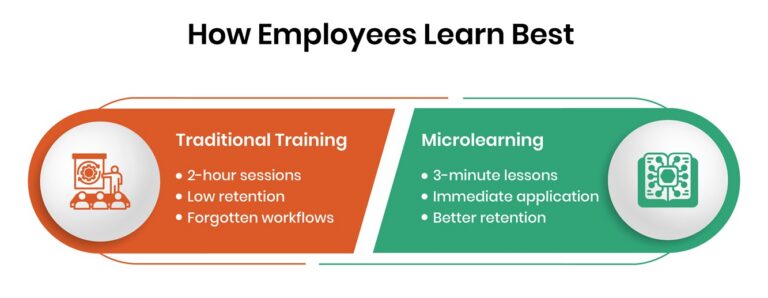
Traditional software training often relies on long sessions, heavy content, and one-time delivery. While it can introduce concepts, it struggles to support real execution in fast-changing enterprise environments.
Microlearning takes a different approach.
Traditional training:
- Requires significant time commitment
- Is often forgotten before real use
- Becomes outdated quickly
- Disrupts daily work
Microlearning:
- Fits into short time windows
- Supports learning in the flow of work
- Updates easily as systems change
- Reinforces learning continuously
Enterprise users don’t need to memorize entire systems. They need to perform specific tasks correctly, repeatedly, and confidently. Microlearning aligns better with how people actually work—learning by doing, not by sitting through long sessions.
This makes microlearning a more practical strategy for modern enterprise software training.
5. How Microlearning Supports Digital Adoption
Digital adoption depends on how quickly and confidently users can work inside systems. Microlearning supports adoption by removing friction from the learning process.
Instead of forcing users to leave applications to search for help, microlearning delivers guidance directly within workflows, enabling just-in-time software training. Users learn while completing tasks, which reduces errors and frustration.
This approach:
- Shortens time to proficiency
- Reduces common mistakes
- Lowers support ticket volume
- Builds user confidence
Microlearning also supports continuous adoption. As systems update, new microlearning modules reinforce changes without requiring full retraining. Like having a knowledgeable guide beside you, microlearning helps users move forward without stopping their work, this is how microlearning improves user adoption in enterprise systems.
6. How Assima Train Enables Microlearning for Enterprise Software
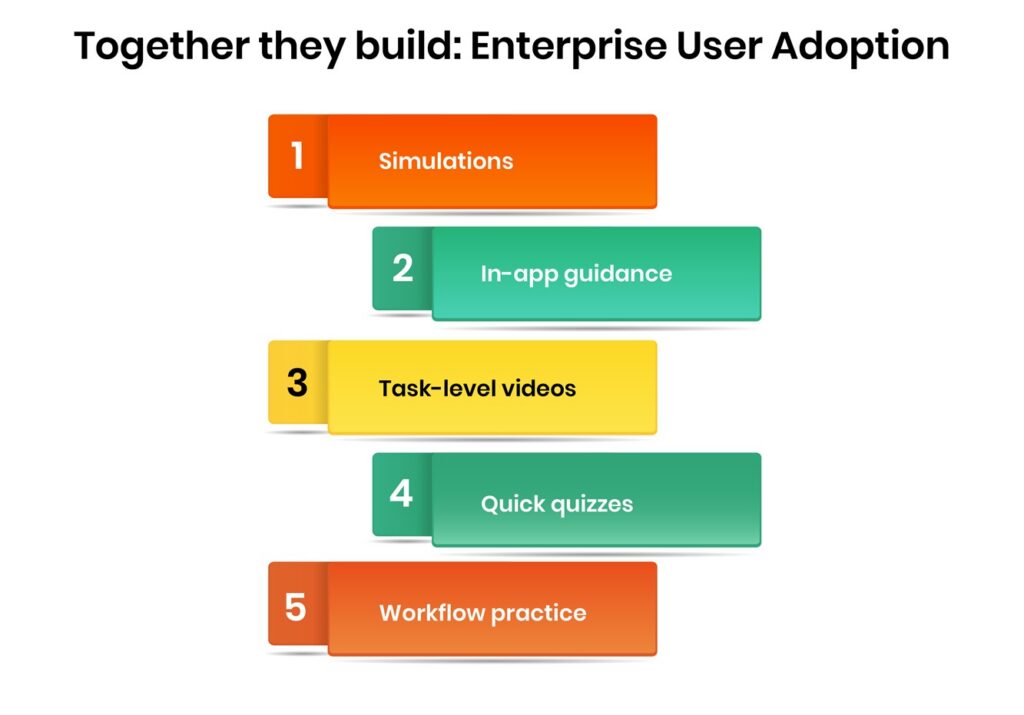
Assima Train enables microlearning by breaking enterprise software training into realistic, task-level experiences.
The platform allows organizations to create scenario-driven microlearning using high-fidelity simulations that mirror real systems. Users practice exact workflows without touching live environments or sensitive data.
Assima Train also delivers contextual, in-app guidance. Employees receive step-by-step support while completing tasks, reinforcing correct execution at the moment of need.
Key capabilities include:
- Task-level simulations for ERP, SAP, CRM, and custom systems
- Role-based microlearning aligned to real responsibilities
- Multilingual delivery for global teams
- Rapid updates as systems and processes change
Instead of static lessons, Assima Train turns training into an ongoing support layer that grows with enterprise systems.
7. Best Practices for Implementing Microlearning in Enterprises
To implement microlearning effectively, organizations should:
- Identify high-impact tasks and workflows
- Align microlearning with real business processes
- Focus on accuracy and repetition
- Track adoption, errors, and performance metrics
- Update content alongside system changes
Microlearning works best when it supports daily work—not when it exists separately from it.
Conclusion
In workplace software training, microlearning in enterprise software training tackles a real issue: how to effectively train users in dynamic contexts. Microlearning increases productivity, confidence, and memory by providing brief, task-focused instruction at the appropriate time.
Businesses can grow microlearning across systems, roles, and geographical areas with Assima Train while maintaining training’s accuracy, realism, and alignment with actual work. Microlearning is now required as enterprise software develops. It serves as a useful basis for long-term adoption.