

Key Highlights
- Cloud migration is more than simply an IT effort. It's a workforce change.
- Training needs to evolve at the same pace as cloud apps.
- Employees can be trained using safe, realistic simulations without depending on real systems or data.
- Proficiency is more important than completion, when assessing cloud adoption
Financial services cloud migration is much more than just an IT modernization project. In addition to preparing for AI, automation, quicker product development, and shifting consumer expectations, banks, insurers, and other financial institutions are shifting more workloads, apps, and data into cloud infrastructures.
However, the workforce must also migrate, which is a less obvious aspect of that change that needs far more attention. This entails picking up new software, procedures, controls, and frequently completely distinct methods of operation. Furthermore, cloud migration often ends when the new system goes live, in contrast to a regular system upgrade. Through regular releases, feature modifications, interface upgrades, and new integrations, cloud apps keep evolving.
This leads to a simple issue: your training cannot be static if your technology is always changing. According to a study by NTT DATA, 63% of banking decision-makers stated that generative AI is significantly easing the shift of banking apps to the cloud. Also, 80% of participants lacked a strategy framework for the implementation of generative AI and workforce upskilling.
Regulators continue to place a strong emphasis on change management, security, resilience, and effective governance in relation to technology and third-party cloud environments. For instance, governance, risk management, maintenance, and change management are emphasized in the FFIEC’s revised 2024 development, acquisition, and maintenance guidelines in an increasingly interconnected technological environment.
The Reasons Behind the Financial Services Industry's Accelerated Cloud Migration
Banks are shifting to cloud computing for a variety of reasons:
Governance and Resilience are driving Change
Security, third-party dependencies, access controls, data management, resilience, incident response, and operational duties are all raised by cloud environments. According to the FFIEC’s cloud guidance, financial institutions are still in charge of comprehending and controlling the risks connected with cloud services. In particular, governance, security management, contractual obligations, system updates, monitoring, and operational resilience are all covered in its guidelines.
Cloud resilience also emerged as one of the industry’s top priorities in the Federal Reserve’s 2025 cybersecurity and financial-system resilience study. The software alone does not make a new workflow successful. People must be able to utilize it regularly, safely, and correctly.
Cloud Migration is a Workforce Event
Imagine a bank switching from outdated on-premises setup to a modern cloud core, Workday, Salesforce, Oracle Cloud, Microsoft Dynamics, and cloud-based analytics tools. As far as the infrastructure team is concerned, this is a migration. For workers, it may seem like a totally other workplace. An Oracle Cloud employee working in finance might need to learn new screens and approval processes. Workday or SAP SuccessFactors could be used by an HR department.
In Salesforce, sales teams might operate differently. A contemporary cloud core banking platform can be used by operations teams. The fundamental business process may not alter significantly, but how personnel carry it out may. And this is exactly the point at which conventional training models start to falter.
The Assima content framework accurately pinpoints the fundamental problem: cloud migration is a workforce-enabling challenge rather than just an infrastructure program because employees’ daily activities and even job duties may change during a cloud trip. As a result, training must be planned around the new method of operation rather than just the use of technology.
Why Cloud Migration Disrupts Conventional Training?
The foundation of traditional workplace training was usually software that was rather dependable. There may be a significant improvement every few years. Instructional materials, screenshots, manuals, filmed demos, and e-learning modules could be produced by training teams and used for a long time. Cloud has changed this equation.
Cloud apps are always evolving
Workday, Salesforce, Oracle Cloud, Dynamics, and other SaaS platforms are examples of cloud apps that are built for ongoing development. You don’t have to wait for the next big on-premises upgrade to add new features. The firm will benefit from that but can be annoying for training teams.
A screenshot in a training manual can capture a particular moment in time. If a button moves, a field is changed, a process changes or a new step gets added, the training asset becomes erroneous. The issue is that the software has evolved. It is crucial to make that distinction. The cloud does not diminish the significance of training. It increases the perishability of training. This implies that companies require a distinct approach to training content maintenance.
Training is a continuous process
Cloud migration also modifies the training lifecycle. A conventional rollout could have been as follows:
Build → Train → Go live → Support
A cloud environment is equivalent to:
Build → Train → Go live → Update → Retrain → Adopt → Update again
New employees also join following installation. Current employees come across new features. Processes change, policies shift and integrations become dynamic. Even a successful migration leads to a skill gap if training ends at go-live. This is particularly crucial for companies with financial services companies because employees are learning more than just software buttons. They are carrying out procedures pertaining to clients, financial data, transactions, approvals, operational controls, and compliance needs.
The Need for Training Strategies in Financial Institutions
1. Switch from Static Content to Training that Keeps Pace
Training cannot rely on content that needs to be rebuilt after each release since cloud apps are constantly changing. Instead, make advantage of training that is readily updated from a single source. This is made possible by object-based simulation, which records application components as editable objects. It is possible to update relevant training materials when the interface changes without starting over. This aids in keeping training up to date with programs like Oracle Cloud, Workday, and Salesforce.
2. Transition from One-Time Training to Ongoing Support
Go-live is not the end of cloud migration. Training must continue because of new features, process modifications, and new hires. A reusable simulation library can support pre-migration training, go-live preparedness, onboarding new hires, and continuous updates. When employees experience updates in the live application, in-app coaching might offer extra assistance.
3. Switch to Safe-Practice Training
Realistic training is required for financial firms without disclosing private production data. Employees can practice realistic procedures without dealing directly with real financial data by using synthetic or anonymised data. This is especially helpful when teams work across several jurisdictions with disparate data needs.
4. Transition from Local-Based to Distributed Training
Training must be available to employees wherever they work in a geographically dispersed and hybrid workforce. Self-paced simulations can offer a consistent training experience across locales while multilingual capabilities enable international teams to learn the same procedures without developing entirely different training programs.
5. Transition from Completion to Proficiency
Even after completing a training module, an individual may not be able to execute the workflow effectively. Training analytics should demonstrate which workflows need more assistance and where employees struggle. L&D and transformation teams can find competency gaps with the aid of step-level insights and address them with specialized instruction or direction. The objective is clear: assess employees’ proficiency with the new cloud environment rather than just their training completion.
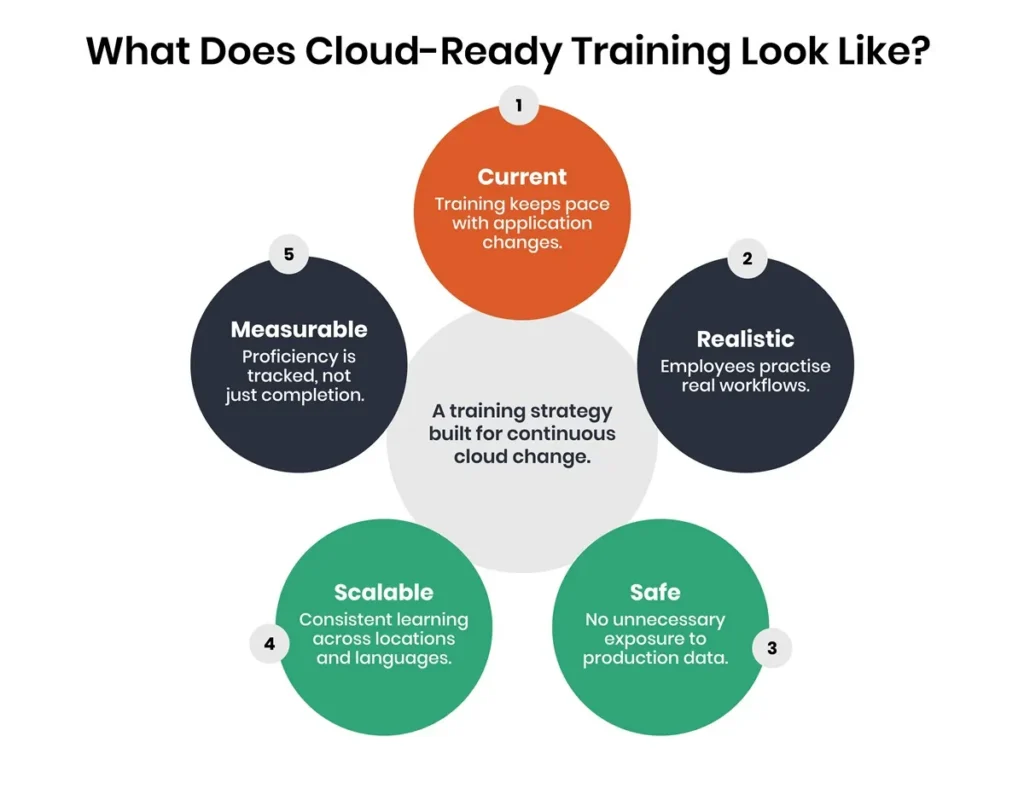
How Is a Cloud-Ready Training Approach Designed?
When you combine these five changes, the model begins to take on a completely new appearance. A training approach that is cloud-ready should be:
- Continuous – because cloud apps are always changing.
- Realistic – because workers must rehearse the tasks they will truly do.
- Safe – Financial institutions are unable to carelessly disclose production data.
- Scalable – because hundreds or thousands of employees require training across locations.
- Maintainable – because cloud releases cannot be kept up with training that takes months to update.
- Measurable – because managers require proof of workers’ abilities rather than just their attendance.
This is how employee enablement and cloud migration are actually related. When the workload is operating on the cloud, the technological migration may be deemed finished. The business transformation is finished until employees are able to operate in the new setting with confidence.
How Assima Helps Close the Cloud Training Gap?
Assima assists financial organizations in creating repeatable, realistic training for cloud applications without the need for live production systems. Training can be updated from a single source whenever the application changes, enabling it to keep up with ongoing cloud releases. its object-based simulation approach help teams to capture systems like Workday, Salesforce, Oracle Cloud, Dynamics, and cloud-based banking platforms as editable simulations.
Assima assists employees prior to migration, during go-live, and as apps continue to change with anonymized data, multilingual training, in-app coaching, and proficiency metrics. The end product is a training approach created for the cloud’s reality: ongoing adoption, learning, and change.
Conclusion
Lack of training isn’t always the biggest training risk in cloud migration. The training it has is already outdated. A cloud application can change while a training team is still awaiting screenshots, amending manuals, re-recording videos, obtaining approvals, and posting updated courses. Every release causes that gap to widen. The solution is not to put in more training. The goal is to develop a training plan that is intended for ongoing modification. The shift to the cloud is migrating, your training plan must go at the same pace.
See how Assima keeps cloud training in step with every release—without touching production data. Book Your Demo.
Frequently Asked Questions
Let’s Answer Some of Your Questions.
Make use of realistic simulations of new cloud applications and workflows before and during migration. After go-live, training should continue as procedures and applications change.
Cloud apps are always evolving. When interfaces, features, or workflows change, static training materials can easily become out of date.
Use training materials that are easily updated when apps evolve. Rebuilding training from scratch can be minimized with the aid of object-based simulation.
Employers can practice procedures without disclosing critical production information by using synthetic or anonymized data in realistic simulations.
Evaluate adoption and proficiency rather than merely course completion. Step-level analytics can show where employees are having difficulty and where further help is required.