


Introduction
Key Highlights
- Most SAP S/4HANA projects fail not because of the system, but because users are not ready to work in it.
- A strong SAP S/4HANA adoption strategy goes beyond deployment and focuses on user readiness, training, and sustained change.
- Role-based, simulation-based training consistently outperforms traditional classroom or slide-deck methods.
- Digital adoption platforms reduce IT dependency and speed up post-go-live productivity recovery.
- Assima Train helps enterprises build workforce readiness at scale through hyper-realistic SAP simulations.
There are substantial financial obligations, lengthy deadlines, and high leadership expectations. However, a startling percentage of businesses go-live only to find that the technology was never the most difficult aspect.
Why SAP S/4HANA Adoption Matters
SAP’s end-of-mainstream maintenance for ECC is pushing organizations toward S/4HANA faster than many planned. The migration window is narrowing, and enterprises that have been on the fence are now actively building their transition timelines.
However, an important point to consider is: what truly affects the success of a S/4HANA project?
The system configuration is not the solution. The integration architecture is not the problem. Not even the project methodology is to blame.
But we should rather think about whether the system can be effectively used by those who utilize it on a daily basis.
Compared to ECC, SAP S/4HANA offers a very different user experience. Although it is foreign, the Fiori interface is cleaner. A change has been made to the underlying data model. Employees’ long-memorized workflows now seem and function differently. When the system they are familiar with is drastically changed, even users who identify as “SAP people” may experience confusion.
| What Organizations Tend to Focus On | What Actually Drives SAP Success |
|---|---|
| System configuration and architecture | User readiness and confidence |
| Integration with other platforms | Role-based training effectiveness |
| Data migration accuracy | Adoption rates post-go-live |
| Go-live milestone | Time-to-competency for end users |
| Technical testing | Behavioral change and workflow fluency |
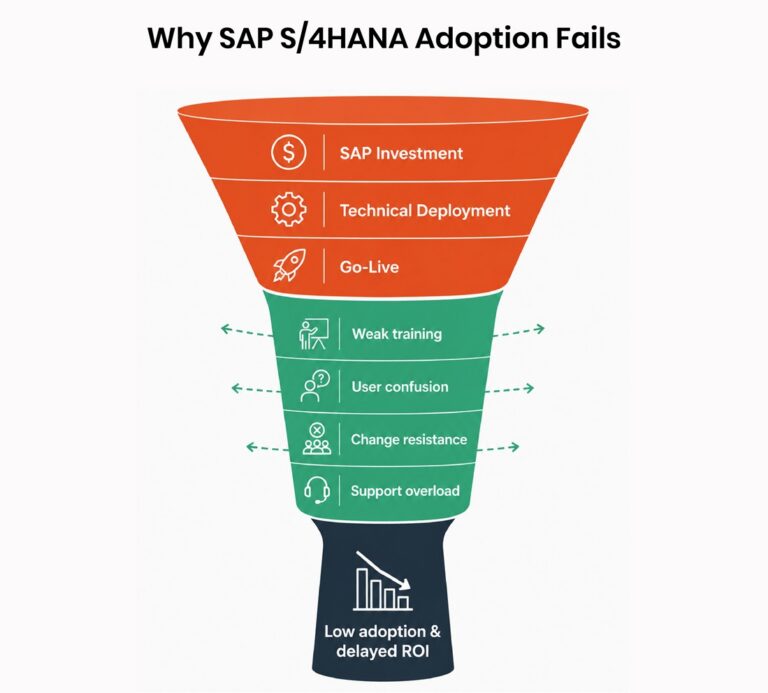
Common Challenges in SAP S/4HANA Adoption
The first step in developing a strategy that truly works is identifying the obstacles. Regardless of sector or company size, these four issues are present in all SAP S/4HANA projects.
- Complex Workflows
There is a learning curve associated with SAP S/4HANA’s power. Workers who spent years honing their muscle memory in ECC now work in a setting where some procedures operate completely differently, familiar transaction codes have changed, and navigation has changed.
This is not a minor change. It significantly interferes with people’s ability to perform their jobs. When the company can least afford it, this complexity leads to confusion in the absence of organized preparedness.
- Change Resistance
People do not resist change because they are difficult. They resist it because change introduces uncertainty. Workers who have been confidently carrying out their jobs for years feel like novices once more. Pushback, a reluctance to participate in training, and a propensity to find workarounds rather than master the new system are all manifestations of this uncomfortable sensation.
Compared to organizations that merely announce a go-live date and assume compliance, those that recognize this fact and directly address it through communication, involvement, and sincere support consistently achieve superior adoption outcomes.
- Training Gaps
This is perhaps the most widespread challenge in enterprise SAP rollouts. Organizations invest heavily in the technical side of the implementation and then underfund, underplan, or simply run out of time for training.
When training does occur, it’s frequently of the incorrect kind. While concepts are introduced in class, employees rarely have the practical confidence they need to operate a live system under actual strain. Workers complete hours of training, pass an exam, and then show up on the first day of the live system with no idea where to click.
Knowledge without practice fades fast. And when it fades, the support team pays the price.
- Global Rollout Challenges
Big businesses don’t train a single crew. Thousands of users from various nations, languages, time zones, and business functions are trained by them, frequently in a short amount of time. It is a real logistical problem to maintain training quality consistency across all of those groups while adjusting to local language and procedure needs.
Businesses that don’t prepare for this scale suffer from fragmented operations, inconsistent adoption across regions, and data quality problems that take months to fix.
| Challenge | Why It Happens | Impact on Adoption |
|---|---|---|
| Complex workflows | New interface and redesigned processes disrupt muscle memory | Slower task completion, more errors |
| Change resistance | Employees feel uncertain and fear making mistakes | Low engagement, workarounds, poor data quality |
| Training gaps | Training is deprioritized, rushed, or too passive | Users arrive at go-live unprepared |
| Global rollout complexity | Inconsistent delivery across regions and languages | Uneven adoption, fragmented results |
Core Components of an Effective SAP S/4HANA Adoption Strategy
A strong SAP S/4HANA adoption strategy is built on four pillars. Each one matters. When organizations skip one, the others cannot fully compensate.
Change management is not a communication plan. That is a common misconception. Communication is part of it, but it is the foundation, not the entire structure.
Effective change management frequently begins months in advance of the launch. It determines which segments of the workforce will be most impacted, increases awareness of the reasons behind the change, and establishes channels for workers to voice concerns and get genuine responses.
It also entails finding champions within the company—individuals who are well-liked by their colleagues, truly interested in the new system, and prepared to promote the change in their daily interactions. Compared to top-down announcements, those champions do more to promote adoption.
Compliance is not the aim. There is a sincere hope that the new method would improve productivity. It is not an automatic belief. It must be earned via openness, participation, and persistent leadership.
Not every employee in a company utilizes SAP in the same manner. The training requirements of a procurement specialist processing purchase orders or a warehouse operator overseeing inventory movements are entirely different from those of a finance analyst conducting month-end closure procedures.
In an attempt to cover everything, generic training ultimately fails to adequately prepare anyone. Each user is focused on the particular workflows and transactions pertinent to their profession through role-based learning pathways. Training becomes far more effective, efficient, and relevant.
This type of focused, role-specific learning is precisely what Assima Train is designed to facilitate. To ensure that the training experience accurately mirrors the real work that employees will perform once the system goes live, organizations might design customized simulations for each user group.
This is the piece that most traditional training approaches miss entirely.
Employees can practice actual SAP procedures in a secure setting that replicates the live system thanks to simulation-based learning. Without endangering production data, they use the genuine interface, carry out real transactions, make mistakes, and learn from them. By the time they take a seat at the live system, it feels more like home than unfamiliar.
Consider it similar to a flight simulator. Without hundreds of hours of simulator training, no airline would place a pilot in the cockpit of a commercial aircraft. Complex enterprise software follows the same reasoning. One is not prepared to perform under pressure by reading a guidebook. Practice makes perfect.
Continuous Support
Training that ends at go-live is not enough.
As soon as they begin utilizing the system in their day-to-day job, employees come across new situations and edge cases. People who have access to responsive support channels, contextual assistance, and refresher content adjust more quickly and maintain improved performance over time.
Those who don’t frequently build backlogs of support tickets, devise workarounds, and subtly underuse the same features that the system was intended to provide.
Planning for the post-go-live phase with the same intentionality as the pre-go-live phase is known as continuous support. Productivity indicators and user confidence scores explicitly demonstrate the benefits of that planning.
The Role of Digital Adoption Platforms
Digital adoption platforms have become a practical necessity for enterprise SAP rollouts, and the reason is straightforward. They close the gap between training and real-world usage in a way that traditional methods simply cannot.
A digital adoption platform sits within the software environment itself and provides in-app guidance to users as they work. Instead of consulting a manual, calling IT, or submitting a support ticket, employees receive step-by-step prompts and contextual help right inside the SAP interface, exactly when and where they need it.
The downstream effects of this are significant.
| Benefit | What It Means in Practice |
|---|---|
| In-app user guidance | Employees get help without leaving the system |
| Faster onboarding | New users reach competency in less time |
| Reduced IT dependency | Fewer support tickets for routine process questions |
| Improved productivity | Users work with confidence rather than hesitation |
| Scalable delivery | Consistent guidance across thousands of users globally |
| Better knowledge retention | Learning happens in context, not in isolation |
How Assima Train Supports SAP S/4HANA Adoption
Assima Train was built specifically for the user enablement challenges that define enterprise SAP implementations. It is not a general-purpose training platform adapted for SAP. It was designed from the ground up with complex enterprise software in mind.
Hyper-Realistic SAP Simulations
Assima Train’s simulation capabilities are its key feature. Assima Train generates simulations that are functionally identical to the real SAP environment using unique cloning technology. Every input field, workflow, and screen appears and functions just like it does in the actual system.
This degree of fidelity is important. The transfer from simulation to live system is nearly flawless when training closely resembles the real experience. Users are already aware of what they are going to experience when they arrive at go-live.
Training Without Live System Risks
One of the ongoing challenges in SAP training is the infrastructure needed to support it. Conventional methods necessitate the creation, upkeep, and alignment of sandbox environments with production, which requires time, resources, and continuous IT involvement.
Assima Train removes this requirement by allowing organizations to capture their real SAP workflows and transform them into interactive simulations that employees can practice on without the need for any sandbox infrastructure at all. This lowers the cost and complexity of providing high-quality SAP end user training at scale, which is crucial when you are preparing thousands of users on a short notice.
Scalable Enterprise Training
Assima Train delivers consistent training programs across global teams without requiring each region to build its own content from scratch. Localization support means simulations can be adapted for different languages without recapturing every workflow. Every user group, regardless of location, receives the same quality of preparation.
Improved Knowledge Retention
Passive training methods produce passive learners. Assima Train’s simulation approach requires employees to actively engage with SAP workflows, which changes how the learning lands and how long it sticks.
When employees practice rather than observe, they build both the procedural knowledge of how to complete a task and the confidence of having already done it. That combination is what closes the gap between training completion and actual on-the-job performance.
| Assima Train Capability | Problem It Solves |
|---|---|
| Hyper-realistic simulations | Employees practice real workflows without sandbox infrastructure |
| No live system dependency | Removes infrastructure cost and IT overhead |
| Role-based learning paths | Ensures each user trains on what is relevant to their job |
| Global deployment | Consistent quality across regions and languages |
| In-app guidance | Ongoing support embedded in day-to-day SAP usage |
| Analytics and progress tracking | Identifies gaps before and after go-live |
Discover how simulation-based SAP training improves adoption, retention, and post-go-live productivity.
Best Practices for SAP Adoption in 2026
Organizations that see strong SAP S/4HANA adoption results share a consistent set of practices. These are not theoretical recommendations. They are patterns that show up in implementations that actually deliver.
Train users before go-live, not after. Waiting until the system is live to begin training puts users in the position of learning under real business pressure. Pre-go-live training with simulation tools gives employees the confidence to perform from day one rather than spending weeks finding their footing.
Make simulation-based learning the core method. Static content and classroom sessions have their place, but they should support simulation, not replace it. The hands-on experience of practicing in a realistic SAP environment is what actually prepares employees for the real thing.
Build role-based learning paths. Generic training wastes time and leaves critical gaps. Map training content to actual job responsibilities so every user learns what they need to know and nothing they do not.
Monitor adoption metrics after go-live. Transaction completion rates, error frequencies, support ticket volumes, and time-on-task data all reveal where adoption is working and where it is not. Organizations that track these metrics can respond quickly when problems emerge rather than discovering them months later.
Reinforce learning after deployment. Plan for ongoing training touchpoints in the weeks and months after go-live. Process refreshers, targeted support for users who are struggling, and updates as the system evolves all contribute to sustained adoption over time.
Conclusion
SAP S/4HANA is a serious investment. The organizations that get the most out of it are not necessarily the ones with the best technical implementation. They are the ones that treated user readiness as a strategic priority from the very beginning.
Training determines adoption. Adoption determines ROI. And in 2026, when the pressure to migrate off ECC is only growing, getting the adoption strategy right matters more than ever.
Assima Train gives enterprises the tools to do exactly that. Through hyper-realistic SAP simulations, role-based learning paths, and training programs that work without the overhead of sandbox environments, Assima helps workforces arrive at go-live genuinely prepared rather than just technically trained. And beyond go-live, Assima’s in-app guidance and analytics capabilities ensure that adoption does not just spike on launch day and then fade. It sustains.