


Key Highlights
- The appropriate SAP digital adoption platform increases SAP ROI and speeds up user competency.
- Hands-on SAP learning is made possible through simulation-based training, which eliminates the risks and costs associated with sandbox environments.
- User mistakes, reliance on help, and interruptions to productivity are all decreased with real-time in-app guidance.
- Adoption platforms that are scalable and analytics-driven assist firms in consistently improving the results of SAP training.
Introduction
Training methods, such as classroom instruction, static documentation, or generic eLearning, frequently fall short in preparing users for SAP activities in the real world. This is just the point at which a SAP digital adoption platform (DAP) is necessary.
What is a Digital Adoption Platform?
A solution created to assist users in learning, navigating, and efficiently using SAP systems in real time is known as a SAP digital adoption platform. A DAP provides contextual, on-screen assistance and help by integrating directly with SAP applications, in contrast to traditional training tools. It works in three ways:
Training environments: Simulated or live practice systems
In-app guidance: Step-by-step instructions within SAP screens
Performance support: Help at the point of need
The purpose of a DAP solution is to provide interactive simulations for users to learn before using the live environment, and then support users, at the point of need, in the live application. Users learn through guided execution rather than remembering procedures. This represents a substantial change, which frequently depends on theoretical knowledge or out-of-date screenshots compared to typical SAP training.
The Importance of Choosing the Right SAP Digital Adoption Platform
The cost of implementing SAP is high. International businesses frequently spend millions on deployment, customization, and licenses. However, research continuously reveals that a significant portion of digital transformation projects fall short of the anticipated return on investment, mostly because of low user acceptance. When employees face issues using SAP:
- Productivity drops
- Errors increase
- Support tickets surge
- Business processes slow down
In fact, companies claim that user mistakes or inadequate training account for up to 30–40% of SAP-related support inquiries. It’s an adoption issue, not a system issue. Hence, choosing the best digital adoption platform for SAP is a crucial business decision.
A sophisticated SAP DAP can:
- Accelerate onboarding
- Reduce training time
- Improve process accuracy
- Lower support costs
In turn, using a technology with limited capabilities, such as a lack of scalability or simulations, can make matters worse rather than better.
Calculate the business impact of improving SAP adoption, reducing errors, and accelerating employee productivity.
The Essential Features of a SAP Digital Adoption Platform
Simulation-Based Training
This is the one feature you should never cut corners on. Through simulation-based training, users can practice SAP procedures in a realistic, risk-free setting without affecting operational systems.
Why it matters:
- Users learn by doing, not memorizing
- No risk to production data
- Faster skill development
In contrast to conventional sandboxes, advanced simulations accurately mimic SAP screens and procedures, making training both secure and efficient.
Multilingual Training Support
Your training should be global, just like SAP. A platform that supports several languages and localization is necessary for organizations that operate beyond geographical boundaries. This guarantees that employees can learn in the language of their choice, enhancing understanding and memory.
Key Benefits:
- Better user engagement
- Faster adoption across regions
- Consistent training quality worldwide
Without multilingual support, global rollouts often face delays and inconsistencies.
Real-Time In-App Guidance
Users shouldn’t have to leave SAP to learn how to use it. A robust SAP DAP offers contextual, real-time guidance right within the program. This implies that consumers get detailed instructions at the precise moment and location that they require them.
Some benefits are:
- Reduced errors during transactions
- Faster task completion
- Lower reliance on support teams
This is especially important in high-volume settings because even little errors can have expensive repercussions.
Role-Based Learning
It is not necessary for every user to be an expert. Personalized learning journeys based on jobs, departments, or responsibilities should be possible for enterprises with a strong SAP user adoption platform.
For example:
- Finance teams focus on reporting workflows
- HR teams learn employee management processes
- Procurement teams handle vendor transactions
This targeted approach ensures:
- Faster onboarding
- Reduced cognitive overload
- Higher engagement
Scalability for Enterprise Teams
Your SAP DAP has to expand along with your company. The platform should provide a reliable, superior experience at scale, regardless of the number of people being trained, whether 500 or 50,000.
Scalability is:
- Supporting large user volumes
- Handling multiple SAP modules
- Enabling global deployments
As your business grows, a scalable enterprise digital adoption platform guarantees that training stays effective.
Analytics & Performance Monitoring
If you don’t measure, you can’t improve. A contemporary SAP training platform should offer comprehensive data on:
- User progress
- Training completion rates
- Common errors
- Adoption trends
These observations help organisations
- Identify skill gaps
- Optimize training programs
- Measure ROI
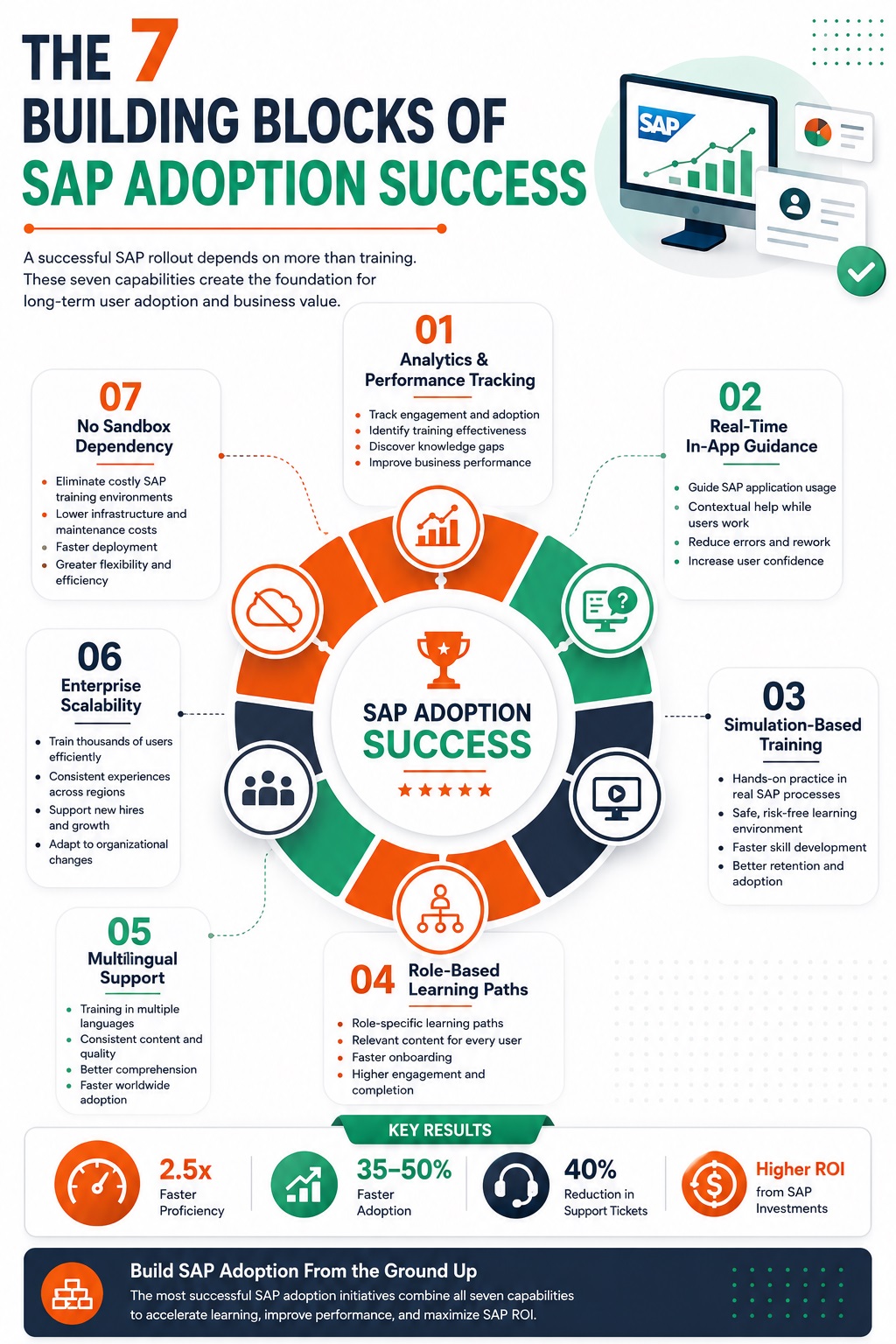
How Assima Train Meets All These Conditions?
Assima Train closely complies with all seven of the mentioned essential qualities and is designed especially to overcome the practical difficulties associated with SAP adoption. Its main component is a potent simulation engine that records SAP procedures and transforms them into interactive, practical training opportunities. Because these simulations are dynamic rather than static, users can practice processes just like they would in the real system.
In contrast to numerous programs that mostly rely on overlays or simple walkthroughs, Assima allows:
- High-fidelity simulations without risk to live systems
- Real-time guidance embedded within workflows
- Training without sandbox dependency
This method improves training efficacy while drastically lowering infrastructure expenses. Additionally, Assima facilitates role-based learning paths, guaranteeing that users only receive training pertinent to their duties. It becomes an effective solution for multinational organisations when combined with multilingual capabilities.
Assima Assist, provides in-application support for users once they have been trained using simulations provided by Assima Train. In addition to providing access to the training content, in the live application, you can:
- Create real time guidance that follows you through a process
- Provide note-based information at an object level
- Provide dynamic information based on information displayed in the live application
In terms of scalability, Assima is designed for enterprise use, supporting thousands of users in various locations with reliable performance. Most significantly, it offers comprehensive data that lets businesses monitor uptake, spot gaps, and keep refining their training plans.
Conclusion
One of the most crucial choices you’ll make along your SAP journey is selecting the appropriate SAP digital adoption platform. It has a direct effect on total ROI, system efficiency, and user productivity. You can make sure your investment produces significant results by concentrating on the seven essential aspects, particularly simulation-based training and real-time advice.
Empowering users should be the ultimate goal, not just training. Use this checklist as a standard for assessing solutions, and think about investigating Assima Train to see how an advanced, simulation-driven strategy can revolutionize SAP adoption.
See how Assima Train reduces SAP rollout risk and lowers enterprise training costs at scale.
Frequently Asked Questions
Let’s Answer Some of Your Questions.
Key features include in-app guidance, simulation-based training, role-based learning, multilingual support, scalability, analytics, and no sandbox dependency.
Yes, it dramatically reduces total training expenses by doing away with the requirement for sandbox environments, lowering support requests, and speeding up user onboarding.