

Introduction
Accounts Payables teams need realistic practice on the most sensitive workflows in the enterprise, but those workflows run on live vendor data, real bank details, and real payment runs. Here is how to train on FB60, MIRO, and F110 without creating SOX or GDPR exposure.
SAP Accounts Payable teams execute some of the most consequential workflows in any enterprise.
- Vendor invoice posting
- Three-way matching
- GR/IR clearing and
- Payment runs
They move real money to real vendors through real bank accounts. Building genuine competency in those workflows requires genuine, hands-on practice.
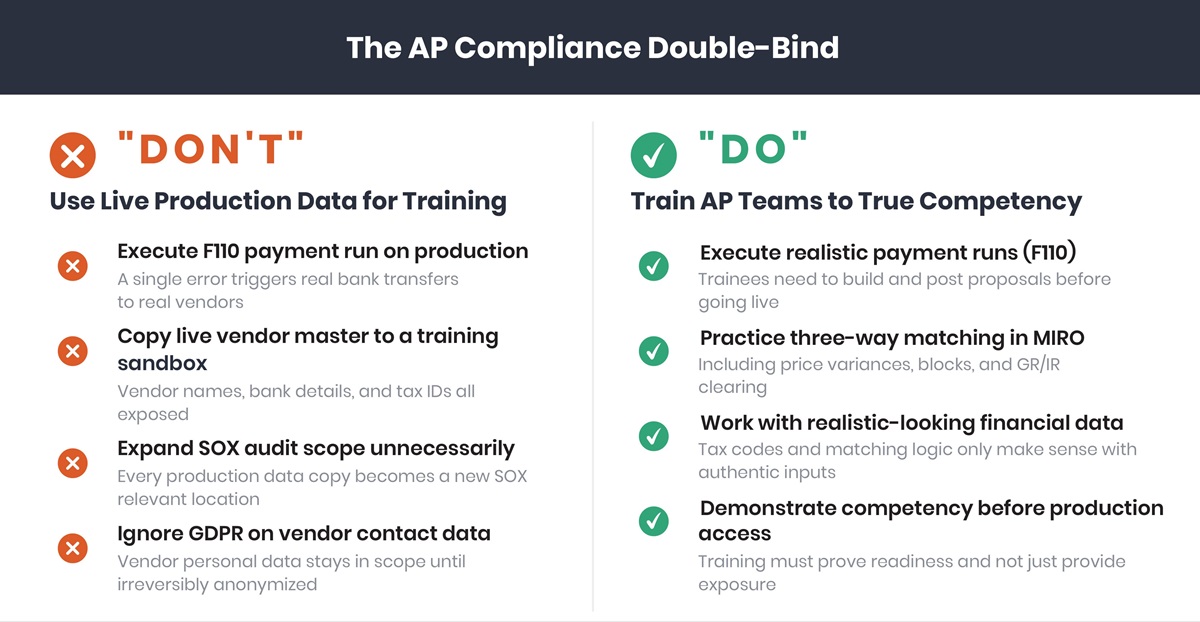
That creates an immediate problem. You cannot let a trainee execute a payment run (F110) on the production system. One mistaken payment proposal executed against live vendor data creates a real financial event. And you cannot copy real vendor master data (names, bank details, tax IDs, and invoice amounts) into a training environment without creating SOX and GDPR exposure. The traditional approach of refreshing a sandbox from production spreads the very data that compliance frameworks exist to protect.
This is the AP training double-bind: the need for realistic, workflow-level practice runs directly into the legal requirement to keep sensitive financial data out of lower-security environments. An AP error is not a minor inconvenience. It is a duplicate payment, a fraud exposure, a misstated liability, or a SOX control failure. Training has to produce genuine competency, which means genuine practice on workflows that look and behave like the real thing.
The answer is simulation-based training on anonymized replicas of your actual SAP AP screens, realistic enough to build true competency, with zero live financial data and no production access at any stage. This article covers the compliance constraints on AP training data, how data anonymization resolves the double-bind, how to build workflow-specific simulations for each core AP transaction, and how to roll training out across a SOX-controlled finance function. This article is aimed at Finance Systems Managers, SAP AP leads, GRC and IT leaders, and L&D partners who support finance operations.
For the broader SAP training curriculum, see our complete guide to SAP training
Why AP Training Is a Compliance Problem, Not Just a Training Problem
AP Workflows Touch the Most Sensitive Data in the Enterprise
Most enterprise systems hold sensitive data in some form. Accounts Payable is different in kind, not just degree. The vendor master contains complete legal names, registered addresses, tax identification numbers, and bank account routing details for every vendor an organization pays. Invoice records carry exact amounts, payment terms, and document dates. And the payment run (F110) translates all of that data into actual cash movement.
This data sits simultaneously under GDPR (vendor contacts with personal identifying information qualify as personal data) and at the center of SOX financial reporting controls. Regulators and auditors track who can access this data, who can change it, and in how many separate environments it exists.
The traditional sandbox approach takes that carefully guarded data and copies it into a separate environment with a broader user base, weaker security controls, and no guarantee that training activity stays isolated from real-world impact. SAP data-privacy specialists identify production-to-sandbox data copying as a recognized compliance exposure that finance organizations need to actively manage (SAP-PRESS, Enov8, 2026). For sector-specific examples, see how SAP training simulation addresses financial-sector compliance.
You Cannot Practice a Payment Run on Production
The payment run is the apex AP workflow. F110 generates a payment proposal, allows that proposal to be edited, and then posts payments to vendors, triggering real bank transfers. No training program can safely direct trainees to practice that full sequence on a live system.
Even workflows that seem lower-risk carry hidden hazards on production. Navigation that appears read-only can still create document locks, trigger downstream events in connected modules, or result in accidental postings when a trainee makes a mistake. The practical consequence is that AP teams consistently receive minimal hands-on practice on exactly the workflows that carry the highest financial and compliance stakes, because no safe practice venue exists for them.
The SoD Constraint Complicates Training Further
SOX Segregation of Duties (SoD) works from a core principle: no single user should be able to both create a vendor and approve a payment to that vendor. That specific combination, the ability to add a fraudulent vendor to the master and then issue a payment to it, is the canonical toxic combination that SOX controls exist to prevent (Onapsis, 2026).
A shared training sandbox that grants trainees wide system access to practice the full procure-to-pay workflow can generate SoD violations that auditors flag during a controls review. Broad training permissions in a sandbox look identical to real SoD breaches from an external auditor’s perspective. Simulation sidesteps this entirely. Trainees practice the full end-to-end workflow in an environment that sits completely outside the production authorization model. Trainees hold no conflicting access rights in the live system at any point during training.
The Compliance Rules That Govern AP Training Data
SOX – Controls, Audit Trails, and Financial Data Integrity
The Sarbanes-Oxley Act requires that access to sensitive financial data (the ability to view, create, and edit it) stays limited to authorized individuals, with a complete audit trail documenting every change (Onapsis, 2026). Every additional environment that holds production-equivalent financial data creates a new location that auditors must account for during a controls review.
Training environments built from production data expand that SOX footprint. They require the same controls, documentation, and audit coverage as the systems they replicate. Simulation training with synthetic data resolves this by keeping SOX-relevant financial data confined to production. The training environment never enters the controls audit scope for financial data.
GDPR – And Why Anonymization Specifically Matters
Vendor master data frequently contains personal data as defined under the General Data Protection Regulation. Contact names qualify as personal data, and for sole traders, the entire vendor record can be personal in nature. GDPR applies to all of it.
GDPR Recital 26 draws a specific and highly relevant boundary: data that is irreversibly altered so that individuals can no longer be identified from it no longer qualifies as personal data and falls outside GDPR scope entirely. That carve-out is the legal basis for using anonymization as a training data strategy. The operative word is irreversibly . Anonymization is not the same as masking, and that distinction is not technical minutiae. It is a compliance boundary.
Anonymization vs. Masking vs. Encryption – The Distinction That Matters
For AP training environments, the correct standard is irreversible anonymization of all vendor names, bank account numbers, invoice amounts, and tax identifiers, while keeping the data realistic enough that workflow logic (tax codes, matching rules, payment terms) functions correctly in the simulation.
Anonymization permanently removes the link between data and any identifiable individual. Once complete, the data exits GDPR scope. Masking obscures data but often preserves a relationship to source records and can, in many implementations, be reversed, which reduces risk but does not remove the data from GDPR obligations. Encryption protects data in transit and at rest but remains fully reversible with the correct key, meaning encrypted training data is still personal data under GDPR. The comparison below makes the distinctions clear.
The Price of Inaccurate Cross-Application Training
The effects extend beyond user annoyance when employees comprehend specific SAP screens but not the entire workflow. Productivity, process effectiveness, and company results are all impacted.
According to SAPinsider research, 40% of businesses still manually process invoices, and 70% of businesses have trouble integrating accounts payable and procure-to-pay (P2P). Even with contemporary SAP systems, process execution is still difficult, as seen by the typical 20-day invoice-to-payment processes. Among the most prevalent problems are:
- Inadequate comprehension of procurement operations results in approval delays.
- Mismatches between purchase orders, goods receipts, and bills can lead to invoice blocks.
- Mistakes in goods receipts can result in inventory and financial disparities downstream.
- Support requests have increased as a result of users’ ignorance of how earlier or later process steps impact their own duties.
These are frequently training deficiencies rather than system issues. Employees may be able to finish transactions on their own, but they don’t have the context to resolve problems across several modules. Organisations can increase user confidence, decrease errors, speed up process execution, and assist staff in making better decisions throughout the whole workflow by switching from screen-based training to end-to-end SAP process training.
Discover how leading enterprises scale SAP training, accelerate user adoption, and reduce support costs across complex rollouts
How Anonymized Simulation Resolves the Double-Bind
Realistic Screens, Synthetic Data
Object-based simulation captures the exact SAP AP transaction screens (FB60 for vendor invoice posting, MIRO for invoice receipt and three-way matching, F110 for the payment run, and FBL1N for vendor line item reporting) as fully interactive replicas. Trainees navigate actual menus, tab through actual fields, and make the same decisions they will make in production.
The data inside those screens is synthetic. Vendor names, bank account numbers, invoice amounts, and tax IDs are replaced with realistic but fabricated values that preserve the shape of real data. The tax code logic applies because the amounts and categories look authentic. The matching rules function because the quantities and prices are plausible. The workflow behavior is identical to production. The data is not. Trainees experience a workflow that looks, behaves, and challenges them exactly like the production environment, including the decision points where the costliest errors happen, with no live financial data in the simulation at any point. For a direct comparison of simulation against conventional sandbox environments.
One-Click Anonymization – Why It Matters Operationally
The conventional barrier to anonymized training environments is the effort required to anonymize. A European financial institution reported requiring more than 40 field-level masking rules for a single masking project (SAP-PRESS, 2026). Apply that manually across every training content refresh and you create a resource bottleneck, an ongoing error risk, and an IT dependency that stalls training updates.
Assima’s data anonymization replaces all sensitive financial fields across an entire simulation in a single operation: no field-by-field mapping project, no recurring IT dependency, and no residual re-identification risk. Because the anonymization is irreversible, the training content falls outside GDPR scope and reduces the SOX audit footprint without requiring compliance team involvement on every content update. For full capability details, visit the systems training platform page.
No Live System, No Real Transactions
Simulations build from a staging or demo environment, not from production. Trainees never log into the live system to practice. A trainee can execute a complete F110 payment run in the simulation, building a payment proposal, editing that proposal, blocking and unblocking specific invoices, and posting the run, with zero risk to real vendors or real bank accounts.
That distinction matters at the highest level of the organization. Mistakes in the simulation are learning events that instructors can debrief in context. Mistakes in production are financial incidents with real remediation costs, potential audit implications, and real impact on vendors and cash flow.
The SoD Advantage in Simulation
In a simulation, a trainee can practice creating a vendor, posting an invoice against that vendor, and running a payment for that vendor in a single training session, to understand how the complete P2P process connects. That same sequence in production would constitute an SoD violation. In simulation, it constitutes effective whole-process learning.
Production SoD stays clean throughout. Trainees build process-wide understanding that makes them more effective within their actual, appropriately constrained roles in the live system.
$3M
2,500
Staff trained in six months
0
Production access required during development
Canadian Bank: 2,500 Staff Trained on SAP Without Live System Access
A major Canadian retail bank needed to train more than 2,500 staff on SAP CRM across a new 11-step mortgage approval workflow, under a demanding timeframe. Building a dedicated training client was prohibitively expensive, and the live system changed constantly during the project, making any static training approach immediately obsolete.
The bank deployed Assima’s object-based cloning technology to build approximately 20 interactive training exercises covering four loan application types. Development teams built and refined all exercises on system clones, without accessing the live SAP environment during content creation. Sensitive data in the clones could be modified and replaced at any stage, keeping production data entirely out of the training environment. The multilingual capability proved critical: the bank used Assima to deliver consistent training in both English and French across a geographically distributed workforce.
Building AP Simulation Training, Workflow by Workflow
For guidance on structuring the overall training program, see how to build a simulation training program. This section focuses specifically on the AP workflow coverage that every simulation must include, and the specific errors each workflow should force trainees to confront.
Core Workflow 1 – Vendor Invoice Posting (FB60)
FB60 is the entry point for most AP clerks. Simulation training here needs to cover correct GL account and cost center assignment, tax code selection, payment term entry, the difference between document date and posting date, and how to identify a duplicate invoice before posting.
The high-risk errors to simulate: duplicate invoice posting, incorrect tax code selection, and wrong cost center assignment. All three create financial misstatements that SOX controls catch, and they are far more expensive to correct after the fact than to prevent through competent training. Synthetic vendor names and amounts keep the simulation fully realistic while removing all live financial data from the exercise.
Core Workflow 2 – Invoice Receipt and Three-Way Match (MIRO)
MIRO is where the AP function intersects with materials management. Simulation training needs to cover matching the invoice to both the purchase order and the goods receipt, recognizing and handling quantity and price variances, understanding invoice blocking rules, and executing GR/IR clearing correctly.
The errors that matter most in MIRO: releasing a blocked invoice without authorization, missing a price variance that triggers a control failure, and clearing GR/IR incorrectly in a way that misstates liabilities on the balance sheet. This is the workflow where cross-application context matters most. The simulation should preserve goods receipt state from the purchasing step to make the three-way match realistic. For more on training across SAP application boundaries, see our guide to cross-application SAP processes.
Core Workflow 3 – The Payment Run (F110)
F110 is the workflow that cannot be practiced on production under any circumstances. Simulation is the only safe environment for it. Full stop.
Training needs to cover building the payment proposal, editing that proposal (blocking specific invoices, adjusting payment methods), handling exceptions, confirming the correct house bank selection, and reviewing the output before posting. The simulation should force trainees to encounter a blocked invoice inside the payment proposal and make the correct decision to exclude it, because that exact scenario is the most common F110 control failure in practice, and it is one that teams only learn to handle correctly through direct experience.
Core Workflow 4 – Vendor Master and Exception Handling
Vendor master training under the Business Partner concept covers the full lifecycle: creating and modifying vendor master records, verifying bank details, handling disputed invoices, credit memos, and recurring entries. Training on this workflow should make the SoD boundary explicit. The role that creates and modifies a vendor record is not the role that approves a payment to that vendor, and the simulation should actively reinforce that control boundary, not just teach the mechanics of the transaction.
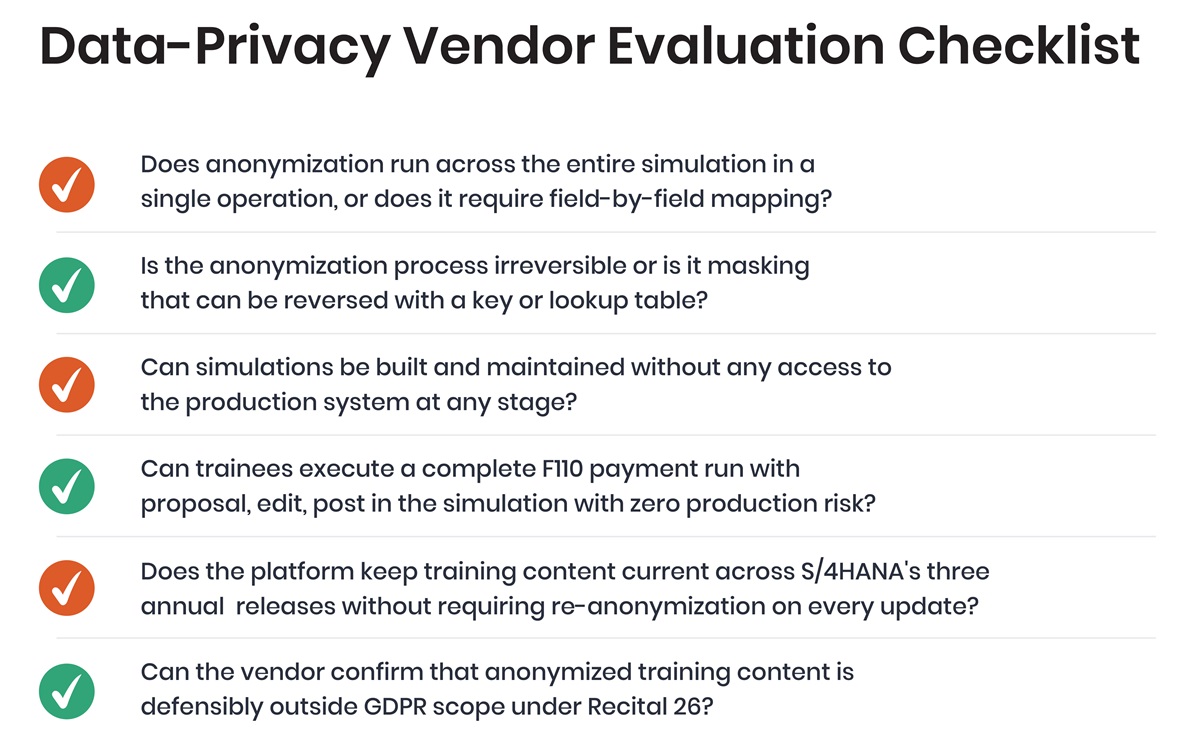
What to Ask a Simulation Vendor: Data-Privacy Checklist
Finance Systems Managers evaluating simulation training platforms for AP need clear answers on data privacy before committing. These questions separate genuine anonymization from weaker masking approaches and should form the basis of any vendor evaluation conversation. For context on where this checklist positions Assima relative to alternatives.
Rolling Out Compliant AP Training
Role-Based Paths and Competency Gates
The AP Clerk path runs FB60, MIRO, GR/IR clearing, and exception handling in sequence. The competency gate requires the trainee to complete a three-way-match invoice that contains a price variance, resolve the resulting block, and post the transaction, error-free and unassisted, before receiving production access. That gate produces documented, verifiable evidence of competency that audit teams can reference if they question the training program’s rigor.
The AP Manager path extends the clerk path to include F110 payment run creation, proposal review, and release authorization. The gate requires executing a payment run that correctly identifies and excludes a blocked invoice. New hires complete their role-specific simulation path and pass the relevant gate before they access the production system. That sequence (simulate, demonstrate competency, then access) keeps SOX audit evidence clean and confirms readiness before any real financial data enters the trainee’s hands.
Keep It Current – and Keep It Compliant
S/4HANA releases three updates per year. Each release can change transaction screens, field layouts, and workflow logic. Object-based simulations update from a single source edit. The change propagates across dependent lessons rather than requiring each affected screen to be recaptured. That maintenance efficiency, estimated at 10x compared to screenshot-based tools, means training stays accurate across all three annual release cycles without the usual recapture overhead. For a deeper look at managing content across releases.
Re-anonymization is not required on every content refresh because the synthetic data lives inside the simulation itself. It was never tied to production data after the initial capture. The anonymization step happens once, and it persists across all subsequent content updates that change workflow logic or screen layouts.
After go-live, Assima In-App Search supports AP teams directly inside the live system for exception cases and edge conditions that simulation training did not cover, keeping performance support fully aligned with training content without duplicating the maintenance effort. Use the ROI Calculator to estimate the cost reduction from replacing sandbox-dependent AP training with anonymized simulation, and see how Assima delivers compliant SAP AP training on the SAP training and adoption platform.