

Key Highlights
- M&A synergies depend on two workforces becoming competent on one unified system.
- Software enablement must start during diligence, not after the deal closes.
- Role-based training addresses different starting points while creating one shared standard.
- Realistic simulations build competency before systems are fully integrated.
- Measure proficiency and workforce convergence instead of relying on training attendance.
- Scalable enablement helps protect productivity, retention, and deal value during integration.
Introduction
M&A synergies live or die on whether two workforces can operate competently on one system. Here’s how to get them there fast.
M&A integrations most often fail on the people and software side because deal teams plan the systems merger in detail and treat software enablement as a checkbox. Two workforces then land on one unfamiliar platform, and the organization absorbs a 50% productivity dip right after close.
Every merger is sold on synergies: combined scale, shared systems, less redundancy. Those synergies only show up when the two organizations actually operate as one, which means both workforces working competently in one unified set of systems. That’s exactly where most deals stumble.
Post-merger integration planning obsesses over data migration and systems architecture. But you aren’t training one workforce on a new system. You’re training two workforces, from two different starting points, to operate as one. This article explains why that’s uniquely hard and how software enablement done right protects the deal’s value.
Why M&A Value Leaks Through the People Layer
Integration Failures Are Execution, Not Strategy
Post-merger research keeps landing on the same conclusion: deals rarely fail because the strategy was wrong. They fail in execution. The deal thesis usually holds up. The value leaks out while two organizations try to become one.
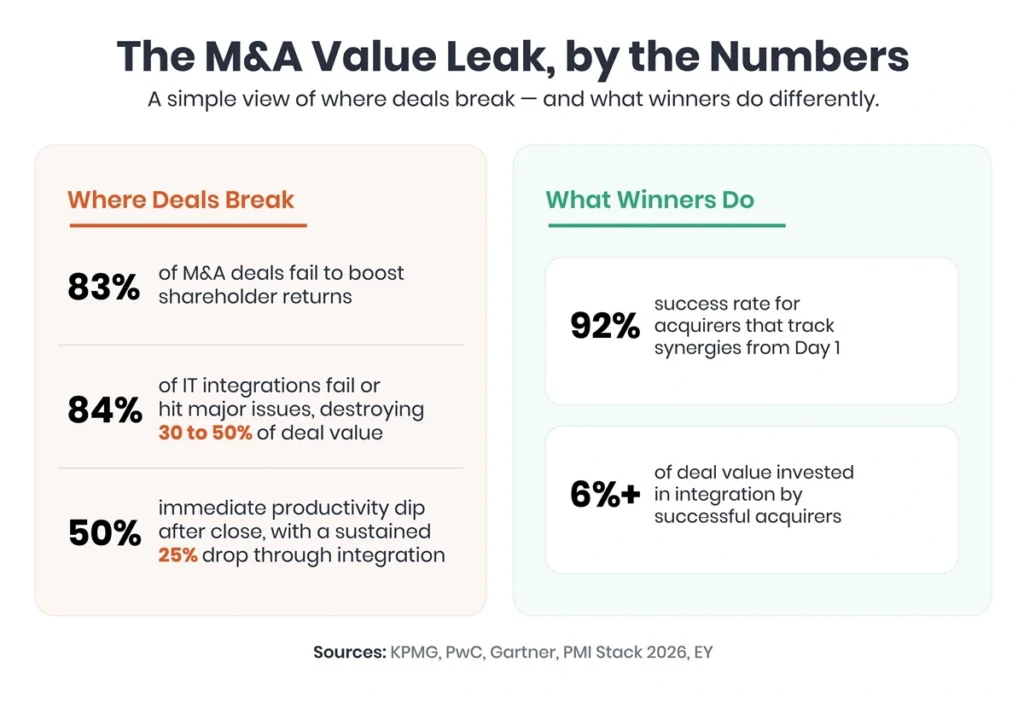
Technology alone doesn’t close that gap. With 84% of IT integrations running into serious trouble, and fewer than one in five acquirers actually improving IT costs after close, system consolidation on its own rarely delivers the promised synergy. A unified platform only creates value when people can use it well.
The Productivity Dip Is a People Problem
Servers don’t cause a 50% productivity dip. People do, when they’re navigating unfamiliar screens, unclear processes, and real uncertainty about their roles. Every task takes longer. Every exception becomes an escalation.
Here’s the uncomfortable part. The employees responsible for delivering synergy are the same employees most anxious about their futures. When leaders don’t answer that anxiety with clarity and capability, the best performers leave first. HR Daily Advisor reports that 40% of employees who receive poor training leave within their first year.
Enablement Is the Lever Everyone Underfunds
The winners behave differently. PwC research shows successful acquirers invest 6% or more of deal value in integration, and acquirers that track synergies from Day 1 achieve a 92% success rate. Disciplined enablement belongs inside that spend.
Instead, software enablement often gets squeezed first, reduced to a line item that reads “provide training.” Tools and checklists don’t create capability. Structured enablement does.
Why Training Two Workforces as One Is Uniquely Hard
A standard software rollout is hard enough. M&A enablement adds five complexities that ordinary user onboarding never has to solve.
1. Two Different Starting Points
In a typical rollout, everyone starts in roughly the same place. Not in a merger. The acquirer’s staff may already know the surviving system, while the acquired company’s staff work in a completely different legacy system and face a total change.
One-size-fits-all training fails both groups. It’s redundant for one and overwhelming for the other. Enablement has to meet each workforce where it actually is.
2. The Clock Is the Enemy
Synergies are time-bound, and the productivity dip hits hardest in the first 100 days. A leisurely twelve-month training program won’t work. Both workforces need to reach competency on the unified system fast, because every week of drift costs value the deal model already counted.
3. Terminology and Process Clash
The two companies used different terms, different processes, and different workarounds for the same tasks. One team’s “account” is the other team’s “customer record.” Unifying them on one platform is a change-management problem, not just a software one. Training has to reconcile two ways of working into one standard and make the case for giving up the familiar.
4. Retention Is on the Line
Acquisitions already drive 47% year-one turnover through uncertainty and stress. Poor training makes it worse, and every departure takes institutional knowledge and customer relationships out the door. Good enablement works as a retention tool: employees who feel capable and supported are far more likely to stay through the transition.
5. Often No Shared Training Environment
The two workforces are usually spread across sites and sometimes countries. The unified live system may not even be available during integration. So you need a way to train both groups on the target system before, and independently of, full technical integration, without a shared live environment to practice in.
See how enterprise teams measure the success of their digital adoption platform.
How to Train Two Workforces as One
Start Enablement Planning During Diligence, Not After Close
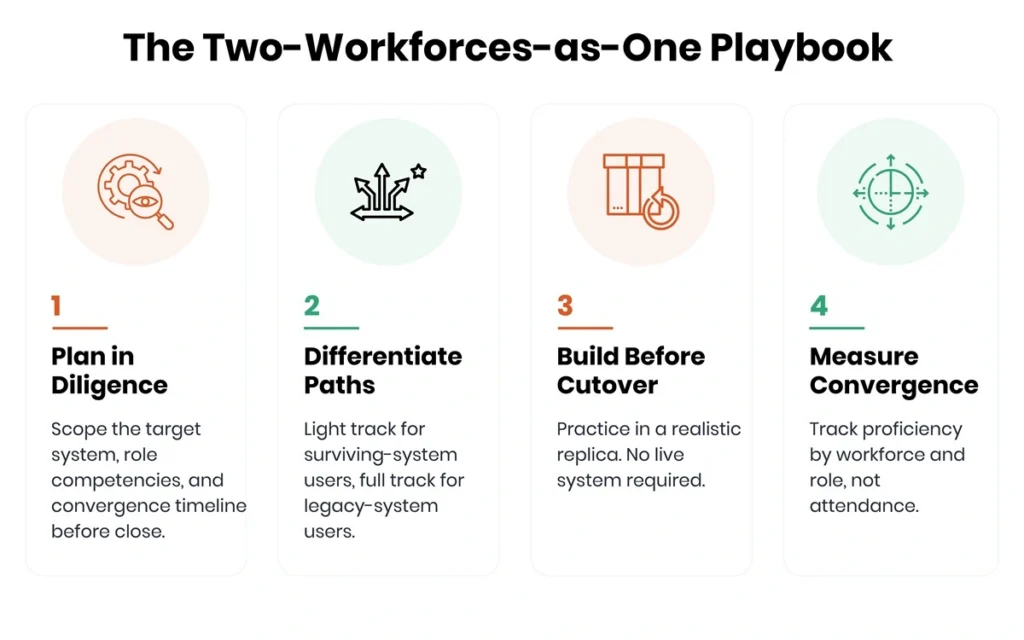
The acquirers hit 92% success plan integration during diligence, so the roadmap exists before the deal closes. Scope enablement in that same window instead of improvising after Day 1. Define the target system, the role-based competencies each workforce needs, and the convergence timeline up front. If you’re asking how to train staff after a merger, the honest answer is that the work starts well before it.
Differentiate by Starting Point, Unify on the Target
Build Competency Before the Systems Are Fully Integrated
Since the unified live system may not be ready, give both workforces a realistic replica they can practice in independently. Competency-building starts early and doesn’t wait on the technical integration timeline. That attacks the productivity dip directly: staff arrive at cutover already competent instead of learning live. Teams that cut ERP go-live failures with simulation follow the same logic.
When npower trained 4,500 staff on a new SAP deployment, replacing classroom training with simulation cut onboarding from 33 days to 18.
Measure Convergence, Not Attendance
How Assima Enables Two Workforces to Become One
Each Assima capability maps to one of the five complexities that make M&A enablement so hard.
Train Distributed Employees Without a Shared Training Environment
Assima’s object-based simulation builds a realistic replica of the target system from a staging environment. Both workforces practice the unified system before and independently of full technical integration, from any location, with no shared live environment required. Anonymized data keeps each company’s sensitive information protected during a legally and commercially delicate period.
Role-Based Paths That Meet Each Workforce Where It Is
Role-based simulation paths let you differentiate by starting point while converging everyone on the same target-system workflows. Acquired-company staff get the depth they need. Acquirer staff skip what they already know. Both learn the unified process, which turns two ways of working into one standard.
Speed and Scale for the 100-Day Window
Thousands of users across both organizations can train concurrently, with no sandbox bottleneck, so you can train your entire combined workforce before the new system goes live. Content is built and updated fast from a single source, which keeps enablement in step with an aggressive integration timeline. Multilingual delivery covers cross-border deals, and teams migrating from UPK or other legacy tools can consolidate onto one modern platform.
Schneider Electric rolled out consistent training to 130,000 users across 18 countries, eliminating 30 separate training clients and cutting training costs by 30%.
Retention and Sustained Adoption
Employees who reach competency quickly feel supported and capable, which eases the anxiety that drives post-merger attrition. Step-level analytics show leadership exactly how fast the two workforces are converging. After cutover, Assima In-App Search gives users instant answers inside the live system, so adoption holds once formal training ends.
The result: two workforces operating as one on the unified system, fast enough to protect the deal’s synergies. See how Assima’s systems training platform enables two workforces to become one during M&A.
Turn Two Workforces Into One, Faster
Frequently Asked Questions
Let’s Answer Some of Your Questions.
Because deal value depends on two workforces operating as one on unified systems, and that enablement is the variable for most integrations underfund. 83% of deals fail to boost shareholder returns, and 84% of IT integrations hit major issues, yet the failures come from execution, not strategy. When training is a checkbox, the workforce never converge, and the synergies never arrive.
Standard rollout training assumes none of these 5 things:
- The two workforces start from different points, so one-size-fits-all training fails both.
- The clock is unforgiving because synergies are time-bound, and the productivity dip peaks in the first 100 days.
- The companies used different terminology and processes that must merge into one standard.
- Retention is at risk, with 40% of poorly trained staff leaving in year one.
- And there's often no shared live environment to train in during integration.
Plan enablement during diligence so the roadmap exists before closing. Build role-based paths that meet each workforce where it starts, lighter for staff who know the surviving system and comprehensive for those coming off a different legacy platform, while converging both on the same target-system competencies. Use a realistic replica so both groups build skills before the systems are fully integrated. Then measure convergence by proficiency and role, not attendance, and target support wherever either group lags.
Use object-based simulation to build a realistic replica of the target system from a staging environment. Both workforces can then practice the unified system before and independently of full technical integration, with no shared live environment required.
Anonymized data keeps each company's sensitive information protected during a legally delicate period. Competency-building starts early instead of waiting on the integration timeline, so employees arrive at cutover already competent rather than learning live, which directly counters the post-close productivity dip.
As early as possible, ideally during due diligence rather than after close. Acquirers that track synergies and plan integration from Day 1 achieve 92% success, and the productivity dip is worst in the first 100 days, so every week of delay costs value.
Scope the target system, the role-based competencies, and the convergence timeline before the deal closes. Then start building competency as soon as integration planning allows, using a simulated replica, so training never waits on the technical schedule.
Yes. The Total Language Localizer translates entire lessons without recapturing the process, so one authored simulation can be published across regions and languages from a single source, rather than rebuilt market by market.