

Key Highlights
- Poor user adoption is one of the biggest causes of enterprise rollout failure.
- Productivity loss, support costs, and delayed ROI create significant hidden risks.
- Traditional training often fails to prepare users for real-world workflows.
- Simulation-based learning helps employees build confidence before go-live.
- Scalable training infrastructure reduces ERP and SAP rollout risk at scale.
- Organizations that prioritize enablement achieve faster adoption and stronger ROI.
Introduction
For organizations investing heavily in ERP platforms like SAP, the stakes are even higher. A delayed rollout or poor user adoption can impact customer experience, compliance, reporting accuracy, and overall business performance.
This is why enterprises are now rethinking how they approach ERP rollout risk and employee enablement. The focus is shifting from traditional training toward scalable, simulation-based learning environments that help users build confidence before go-live.
Why Enterprise Rollouts Fail
A failed enterprise rollout is rarely caused by poor software capabilities. In most cases, technology works exactly as intended. The challenge lies in how employees interact with it.
Here are some of the biggest reasons enterprise rollouts fail:
Inadequate Training
Many organizations still rely on static documents, recorded walkthroughs, or one-time training sessions. These methods do not prepare employees for real-world workflows.
Employees may understand concepts during training, but once they enter the live environment, uncertainty appears. This slows productivity and increases dependency on support teams.
Rushed Onboarding
Implementation timelines are often aggressive. Enterprises focus heavily on deployment milestones while compressing onboarding timelines.
As a result, employees are expected to learn complex workflows in a short period of time. This creates confusion during the most critical phase of adoption.
Lack of Realistic Practice
Users need hands-on experience before interacting with live enterprise systems. Without realistic practice environments, employees make mistakes that impact business operations.
This is especially common in SAP rollout training initiatives where workflows involve multiple systems, approvals, and compliance-sensitive tasks.
Poor Change Management
Even the best enterprise platforms fail when users resist change. Employees often continue relying on legacy processes because they feel more familiar and less risky.
Without continuous guidance and support, adoption rates remain low long after implementation.
The Hidden Costs of Failed Enterprise Rollouts
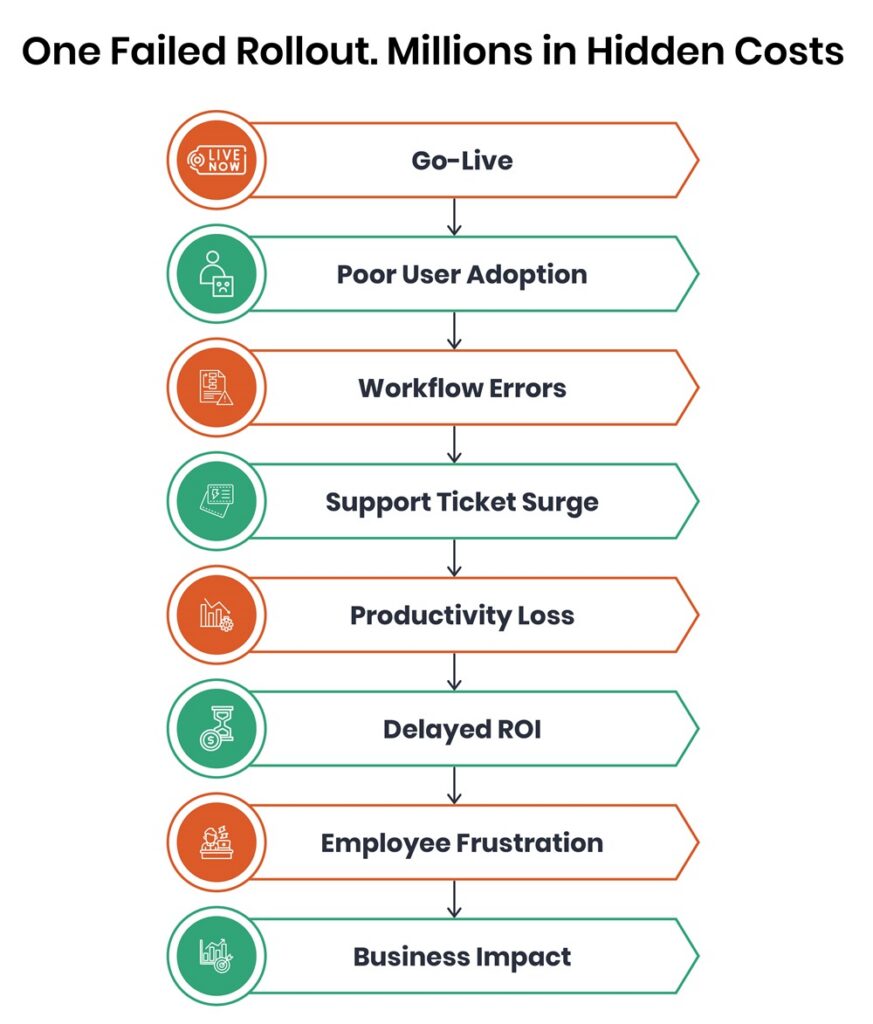
The financial impact of a failed enterprise rollout goes far beyond implementation expenses. The real costs often appear after deployment.
Productivity Loss
When employees struggle to complete workflows efficiently, overall productivity declines.
Tasks that once took minutes can suddenly take hours due to confusion, system errors, or process uncertainty. Across hundreds or thousands of employees, this creates substantial operational losses.
For example:
- 1,000 employees losing 30 minutes daily
- Average hourly cost: $35
- Daily productivity loss: $17,500
- Monthly productivity loss: Over $350,000
This is one of the largest contributors to enterprise rollout failure cost.
Increased Support Costs
Poor adoption increases pressure on IT and support teams.
Employees submit more tickets, request repeated guidance, and rely heavily on administrators to complete routine workflows. This increases operational overhead while slowing issue resolution.
Support teams become reactive instead of strategic.
Delayed ROI
Most ERP investments are justified through long-term efficiency gains. But when adoption is slow, organizations fail to realize expected value within projected timelines.
Delayed ROI impacts budgeting, executive confidence, and future transformation initiatives.
Employee Frustration and Burnout
Repeated workflow failures create frustration among employees.
When workers lack confidence using enterprise systems, morale declines and resistance to future technology changes increases.
This emotional impact is often underestimated, but it directly affects retention, productivity, and organizational culture.
Learn why software investments fail to deliver value and how digital adoption closes the gap.
How to Calculate Enterprise Rollout Failure Cost
Organizations often underestimate the financial risk associated with poor adoption. A structured estimation framework helps leaders understand what is truly at stake.
Productivity Loss Formula
Use this formula:
Productivity Loss = Number of Employees × Time Lost Per Day × Hourly Cost × Working Days
Even small inefficiencies create massive financial impact at enterprise scale.
Support Cost Estimation
Estimate:
- Number of additional support tickets
- Average resolution time
- Cost per support interaction
This does not include indirect costs like slower innovation and IT resource diversion.
- Delayed ROI Estimation
If your ERP transformation was expected to generate $5 million in annual efficiency savings, but adoption delays realization by 12 months, that delay becomes a measurable business risk.
Delayed value realization affects:
- operational planning
- digital transformation goals
- executive stakeholder confidence
- Retraining Costs
Organizations often underestimate how expensive retraining becomes after go live.
Consider:
- trainer costs
- employee downtime
- content updates
- repeated onboarding sessions
Retraining costs multiply quickly when documentation becomes outdated after software updates.

Why Traditional Training Approaches Fail
Traditional enterprise learning models struggle because they were not designed for modern enterprise systems.
Static LMS Content
Most LMS platforms focus on passive learning. Employees watch videos or read documents without interacting with realistic workflows.
Knowledge retention remains low because users are not actively practicing tasks.
Outdated Documentation
Enterprise applications evolve constantly. Process documentation becomes outdated quickly after updates or workflow changes.
Employees lose trust in training materials when instructions no longer match live systems.
Sandbox Limitations
Many organizations rely on sandbox environments for SAP rollout training. While sandboxes provide access to the system, they come with limitations:
- expensive infrastructure requirements
- limited scalability
- risk of accidental changes
- inconsistent user experiences
Sandboxes also require ongoing maintenance, making it difficult to scale across global teams.
One-Time Training Models
Training should not end at go-live.
Employees need continuous support as workflows evolve, and new features are introduced. Traditional training methods fail because they treat learning as a single event instead of an ongoing process.
What Successful Enterprises Do Differently
Organizations that successfully reduce ERP rollout risk approach enablement strategically.
They Prioritize Simulation-Based Learning
Instead of relying solely on documentation, they give employees realistic simulations that mirror live systems.
This allows users to:
- practice workflows safely
- build confidence before go live
- reduce workflow errors
- learn through repetition
Simulation-based learning improves retention because employees actively engage with processes instead of passively consuming information.
They Build Scalable Enterprise Training Infrastructure
Successful enterprises design training environments that can scale across departments, regions, and languages.
This ensures consistent onboarding experiences regardless of team size or location.
They Support Continuous Learning
Enterprise systems evolve constantly. Leading organizations provide ongoing learning support instead of relying on one-time onboarding sessions.
Continuous enablement improves long-term adoption and reduces retraining efforts.
How Assima Helps Reduce Enterprise Rollout Risk
Assima helps enterprises reduce SAP implementation risk through simulation-based training designed for real-world adoption challenges.
Instead of static learning content, Assima creates realistic SAP simulations that replicate live workflows without requiring a live environment.
This enables organizations to:
- accelerate onboarding
- reduce support dependency
- improve user confidence
- lower retraining costs
- scale training globally
One of the biggest advantages is that simulations can be updated quickly as enterprise systems evolve. This helps organizations maintain accurate training content without rebuilding entire learning programs after every software update.
Enterprises using Assima reduce training costs by up to 50% while improving user readiness and adoption outcomes.
For organizations focused on reducing enterprise rollout risk mitigation challenges, scalable simulation training creates measurable operational impact.
Enterprise Rollouts Are Ultimately Adoption Projects
Ready to Reduce Enterprise Rollout Risk?
If your organization is preparing for an SAP implementation, ERP transformation, or large-scale software rollout, training strategy should be part of the rollout plan from day one.