

Key Highlights
- Discover the five stages of enterprise training maturity and identify where your organization stands.
- Learn why traditional training struggles to keep pace with continuous software updates and evolving business processes.
- Explore how simulation-based learning helps organizations move from reactive training to scalable workforce enablement.
- Build a strategic training infrastructure that improves software adoption, accelerates onboarding, and reduces support dependency.
Most Organizations Don't Have a Training Problem. They Have a Maturity Problem.
Employees take twice as long as expected to get productive. The support team is buried in the same basic questions for weeks. Managers who should be managing end up as the department’s unofficial IT helpdesk. And software adoption quietly stalls out, even after the project team has wrapped up and moved on to the next thing.
Here’s the uncomfortable truth: enterprise platforms like SAP, Workday, Oracle, and Microsoft Dynamics aren’t static. They update constantly. Business processes shift throughout the year. And yet a lot of training programs are still designed as though employees only need to learn a system once and then they’re set for the next three years. Training is treated like a checkbox, not a capability.
That’s the gap the enterprise training maturity model is meant to address. Rather than asking how much training an organization does, it asks a better question how ready is your workforce to actually perform when the software, the process, or the team changes around them?
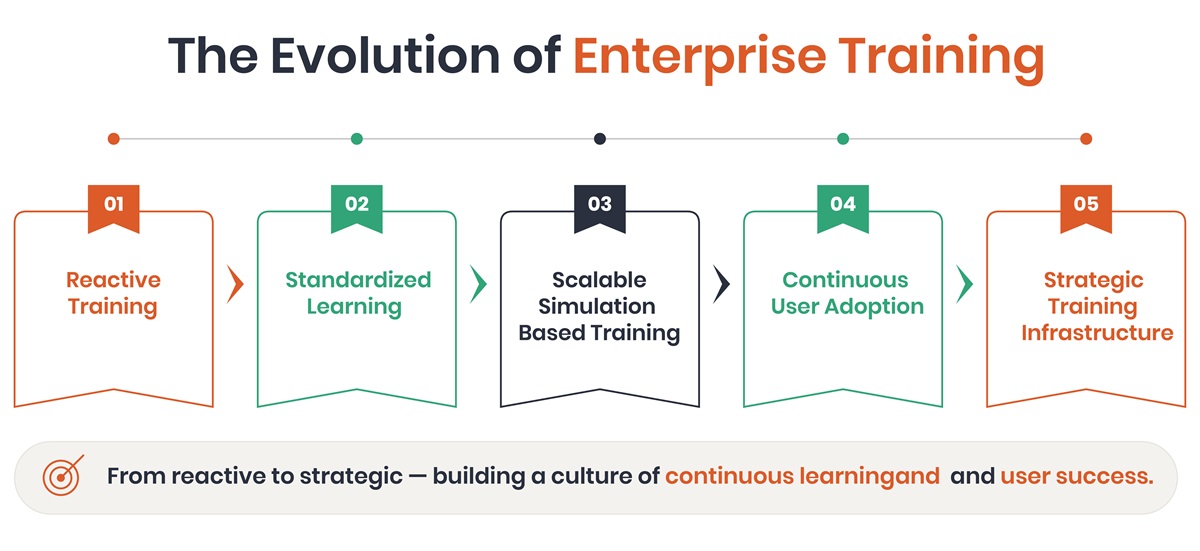
5 Stages of Training Maturity – Quick Reference
| Stage | What It Focuses On | Where It Falls Short |
|---|---|---|
| 1. Reactive Training | Learning built around immediate needs | Inconsistent, impossible to scale |
| 2. Standardized Training | Centralized LMS, structured paths | Completion rates ≠ actual competency |
| 3. Scalable Digital Training | Simulation-based, hands-on practice | Often still tied to go-live timelines |
| 4. Continuous User Adoption | Reinforcement well past deployment | Takes real sustained commitment |
| 5. Strategic Training Infrastructure | Training as a reusable business capability | Requires governance across projects |
Why Traditional Training Has a Hard Time Keeping Up
Training programs built for large enterprises were designed in a world where a major software implementation was a once-every-few-years event. You’d roll it out, run employees through a classroom session or two, maybe add an online course, and things would largely stay stable long enough for people to figure out the rest on the job.
That world doesn’t exist anymore, and hasn’t for a while.
Cloud platforms push updates on a monthly or even weekly basis now. Companies are running multiple digital transformation workstreams at the same time. Processes that were locked in during a go-live last spring might look completely different by the fall. In that environment, a one-time training event isn’t just inefficient it’s structurally unable to keep employees current.
And yet a lot of organizations are still running that same playbook: build the training content before go-live, send employees through a workshop or eLearning module, check the attendance box, and move on. The implicit assumption is that finishing a course equal being ready to work.
It doesn’t. Watching a demo of a procurement workflow inside SAP is a very different experience from actually completing that workflow yourself on a Tuesday afternoon when the system behaves slightly differently than the demo, your manager is asking for an update, and you can’t remember which field you’re supposed to skip. Awareness and competency are not the same thing, and training programs that treat them as the same thing will always disappoint.
The situation gets messier when the software changes after training has already been delivered which happens constantly. A single interface update or a revised approval process can make entire course modules outdated. Training teams then face a familiar and exhausting cycle:
- Rebuild the slide decks, re-record the video walkthroughs
- Redo every screenshot that references the old UI
- Rewrite documentation, then re-translate it into six languages
- Do all of this while also supporting the live rollout that’s currently happening
Multiply that across regular software update cycles and you start to understand why enterprise training is so expensive to maintain. It’s not that the content is bad it’s that the whole system is built to handle a one-time event, not an environment that keeps changing.

What the Maturity Model Actually Measures
An enterprise training maturity model gives organizations a structured way to evaluate not just how much training they’re doing, but how well the whole training ecosystem functions. Think of it less like a report card and more like a diagnostic tool.
Traditional training metrics like completions, attendance, quiz scores, etc. tell you whether people sat through the training. The maturity model asks different questions:
- How quickly do new hires actually become productive in the system?
- When the software changes, how fast can training content reflect that?
- Are employees in different offices or departments getting the same quality of preparation?
- After go-live, how much do people still rely on managers and support teams for basic guidance?
Organizations at the lower end of the scale tend to be reactive; training gets built when something breaks down, onboarding varies wildly depending on which team someone joins, and the knowledge that actually exists in the organization lives in the heads of a few experienced employees rather than in any documented process.
As organizations move up the scale, training stops being a collection of disconnected activities and becomes something closer to a real operational capability, one that can scale, update, and run across multiple business units without requiring a complete rebuild every time something changes. The business impact of that shift is measurable:
- Employees reach full productivity faster because they get a consistent, well-designed learning experience
- Training teams spend significantly less time rebuilding content from scratch
- Support teams handle fewer repetitive tickets from confused users who weren’t properly prepared
- Software updates don’t trigger an emergency training effort every single time
Put simply, training maturity isn’t really a learning metric. It’s a business readiness metric.
Stage 1: Reactive Training
Every organization starts here, more or less. Reactive training isn’t a failure it’s just what naturally happens before anyone has built something more intentional.
At this stage, learning happens when someone needs something. A new hire shows up, gets handed a folder of documents and a list of LMS courses to complete, and is pointed toward a coworker when questions come up. The coworker becomes the real onboarding program. If they’re helpful and patient, the new hire figures things out reasonably quickly. If they’re not, or if they’re busy, the new hire struggles longer than necessary.
The problem isn’t any individual piece of this it’s that nothing is coordinated. As the organization grows, each department builds its own version of onboarding. Experienced employees develop their own personal workarounds. Institutional knowledge accumulates in email threads, old slide decks, and the memories of people who’ve been there the longest. When those people leave, significant chunks of operational knowledge leave with them.
The business consequences aren’t just a training problem:
New employees take longer to contribute because they’re learning through trial and error
Support teams get overwhelmed fielding the same basic questions week after week
Managers lose hours every week to clarifying things that onboarding should have covered
Business processes that depend on unwritten tribal knowledge become fragile and hard to hand off
Reactive training can work well enough in a small, slow-moving organization. The moment the company starts growing quickly, updating systems frequently, or expanding into new locations, it stops working at the scale the business needs.
See how healthcare organizations are building scalable training programs that accelerate software adoption.
Stage 2: Standardized Training
Standardization is usually what organizations reach for once reactive training becomes obviously unsustainable. An LMS gets selected or expanded. Learning paths get defined. Everyone goes through the same onboarding courses regardless of which office they’re in or which manager they report to. Completion gets tracked, and training leaders finally have data to show leadership.
This is genuinely progress. Consistency improves. Reporting becomes easier. There’s a repeatable process that can grow with headcount. For compliance training especially, standardization is essential.
But most organizations that reach this stage eventually notice something uncomfortable: completion rates go up, and adoption still isn’t where it needs to be. People finish the courses and still flood the helpdesk with questions. Managers still end up re-explaining workflows. Productivity still ramps up slower than projected.
The reason is that watching a video of a process and being able to execute that process inside a real enterprise system are two completely different cognitive experiences. Standardized eLearning is good at building awareness and conveying information. It’s not particularly good at building the kind of muscle memory that comes from actually doing the work. Employees who check all the boxes in an LMS can still feel completely lost when they open the live system for the first time.
This is the gap that Stage 3 is designed to close.
Stage 3: Scalable Digital Training
The shift that happens at Stage 3 is more significant than it might look from the outside. It’s not just about adding better content or more interactive courses it’s a change in what training is fundamentally trying to accomplish.
Stages 1 and 2 are primarily focused on delivering information. Stage 3 is focused on building capability. That difference matters enormously when you’re preparing employees to work in complex enterprise systems.
Instead of relying solely on videos, slide decks, or live instructor sessions, organizations at this stage introduce simulation-based learning environments where employees can actually practice doing the work before they ever log into the production system. They can make mistakes, get immediate feedback, repeat steps until they’re comfortable, and build real confidence rather than just theoretical familiarity.
This is where a solution like Assima Train fits naturally. Rather than pointing employees at screenshots or recorded walkthroughs, Assima Train builds editable simulations that closely replicate the actual application. Employees work through real workflows in a safe environment. Training teams can update the simulation when the software changes without rebuilding entire courses from scratch.
That updatability matters a lot in practice. For a global enterprise managing ongoing ERP changes, role-based simulations across multiple languages, the old model of rebuilding everything after every update is financially and operationally unsustainable. Simulation-based training doesn’t eliminate maintenance work, but it makes it dramatically more manageable.
During large ERP implementations especially where hundreds or thousands of employees need to be trained in a compressed window this approach proves its value. Classroom sessions don’t scale well to those numbers. Generic eLearning doesn’t capture the complexity of the actual workflows. Simulations give employees the hands-on experience they need without requiring the production system to be touched at all.
At this stage, training stops being an onboarding event and starts becoming an actual operational capability.
Stage 4: Continuous User Adoption
Go-live is not the finish line. For most employees, it’s actually when the real learning starts and that’s the part a lot of organizations aren’t prepared for.
Once the implementation project wraps up, the project team typically moves on. Training is considered delivered. Employees are expected to grow into the system on their own through day-to-day use. On paper this sounds reasonable. In practice, it means employees are encountering unfamiliar scenarios without support, developing workarounds no one ever intended, and quietly becoming more dependent on their most experienced coworker than on the system itself.
Organizations that reach Stage 4 maturity recognize this and build for it. Rather than delivering learning once and hoping it sticks, they build reinforcement into the employee experience over time. That looks different at different organizations, but common approaches include contextual help embedded directly in the workflow, searchable knowledge bases that answer specific process questions without requiring a support ticket, structured refresher training when major updates ship, and role-based job aids employees can actually use at their desk rather than printed materials that end up in a drawer.
The business case for this investment is pretty clear. Employees recover faster after software updates. Support teams field fewer repeat questions. Formal retraining cycles become less frequent and less disruptive. And the organization doesn’t have to choose between slowing down and leaving employees behind every time something in the system changes.
The organizations that genuinely sustain software adoption over the long term not just at launch, but a year and two years out are almost always operating with this kind of ongoing learning infrastructure in place.
Stage 5: Strategic Training Infrastructure
Stage 5 is where training becomes part of how the business actually operates rather than a service attached to projects.
Organizations here aren’t starting from zero every time a new system rolls out. They have reusable frameworks. Scalable platforms. Governance that ensures content gets maintained and updated rather than drifting into obsolescence. Processes built for how software actually changes, not for how it changed a decade ago. As a result:
- New implementations can leverage existing training infrastructure instead of rebuilding it
- Content updates happen faster and with significantly less effort per update
- Onboarding is consistent whether someone joins in London, Chicago, or Singapore
The financial impact of this shows up in ways that are easy to measure lower onboarding costs, shorter time-to-productivity, reduced support volume and also in ways that are harder to quantify but just as real, like employees who feel confident using the systems they’re supposed to use and don’t quietly work around them.
This matters most for organizations that are managing continuous change: ongoing ERP modernization, rolling cloud migrations, global workforce expansion. When you treat every implementation as a standalone training project, you pay the full cost every single time. When training is a shared organizational capability, each new project gets cheaper and faster to support.
Success at this stage isn’t measured by course completions or attendance. It’s measured by adoption rates, productivity timelines, and whether the business is actually getting value from the technology it’s investing in.
How to Assess Where You Stand
No formal assessment needed to get a rough read on your training maturity. These questions tend to surface the honest answer pretty quickly:
- When the software gets updated, how long does it take your training content to reflect that change?
- Do employees have any chance to practice workflows before they’re working in the live system?
- If someone joins a team in a different office, do they get the same onboarding experience?
- How much are managers and support teams still fielding basic process questions 60 or 90 days post go-live?
- Are you tracking whether employees can actually do the work, or just whether they completed the course?
Multiple “no” answers suggest the organization is still operating closer to Stage 1 or 2. That’s not a condemnation — it’s a useful starting point for figuring out where to focus.
How Assima Train Supports the Journey
Getting from reactive training to something more strategic isn’t mainly a content problem. It’s an infrastructure and tooling problem. You need technology that supports realistic practice, handles content updates without requiring a full rebuild, and can deploy consistently across global workforces.
Assima Train addresses that through editable, simulation-based learning built to replicate enterprise applications without involving production systems at all. Employees practice real workflows. Training teams can maintain and update simulations as the underlying software evolves. The same platform supports multilingual content, role-based learning paths, and large-scale deployment which matters when you’re preparing a global workforce across multiple business units simultaneously.
The practical results speak for themselves:
| Customer | Project | Outcome |
|---|---|---|
| Npower | Major SAP transformation | Reduced onboarding time by 50% |
| Leading Dutch retailer | ERP rollout | Employees hit full productivity on day one |
Explore how Assima supports software adoption across the entire learner journey.
Frequently Asked Questions
Let’s Answer Some of Your Questions.
Organizations can assess their training maturity by evaluating factors such as onboarding consistency, training scalability, content update speed, employee readiness, and dependence on support teams after go-live. A mature training strategy focuses on continuous learning rather than one-time training events.