

Introduction
“The average cost of non-compliance is $14.8 million, nearly three times the cost of maintaining compliance.”
– Ponemon Institute
But still many organizations are relying upon outdated compliance training for regulated industries.
- Annual certification.
- Static manuals.
- Slide-heavy sessions.
Knowing a policy is one thing.
Applying it correctly inside a live system is another.
From working closely with enterprise training programs, one pattern becomes clear: compliance failures rarely stem from intent. More often, they happen in moments of uncertainty. An employee selects the wrong field. A required step is skipped. Documentation is incomplete.
Small mistakes escalate quickly in regulated environments.
Research from the Ponemon Institute shows that the average cost of non-compliance is nearly three times higher than the cost of maintaining compliance. The financial impact is significant, but the operational and reputational consequences can be even harder to recover from.
This is where modern training must evolve.
Assima Train enables organizations to move beyond passive instruction and toward practice-based learning. Through realistic simulations, employees rehearse workflows safely before performing them in production systems.
Instead of hoping people remember procedures, organizations create an environment where correct execution becomes second nature. Compliance stops being theoretical. It becomes operational.
Why Compliance Training Is Critical in Regulated Industries
After years of working with regulated sectors, one thing is clear that compliance is not a supporting function. It is part of daily execution.
Every transaction, update, approval, and record must align with defined standards. When processes break down, the consequences reach far beyond internal inefficiencies. We have seen a single missed checklist item turning into a regulatory scrutiny leaving lasting reputational damages.
Non-compliance can trigger:
- Financial penalties
- Regulatory investigations
- Operational shutdowns
- Loss of public trust
- Long-term reputational damage
Think of compliance like air traffic control. When systems operate as expected, everything moves safely and efficiently. But even a minor miscommunication can create serious risk.
The same principle applies to enterprise systems.
Employees must not only understand policies but also know exactly how to execute them within the tools they use every day.
Consider these common scenarios:
- A healthcare administrator exposes patient privacy by entering incomplete patient data.
- A transaction is incorrectly classified by a finance analyst, conflicting with regulatory reporting.
- A government employee’s audit defensibility is weakened when they omit a documentation step.
None of these mistakes are intentional. Most happen because training did not fully prepare the user for the moment of action.
This is why effective compliance training acts as a first line of operational defense.
When employees practice real workflows, understand dependencies, and recognize risk points, they make better decisions under pressure. Training shifts from a theoretical requirement to a practical safeguard.
For organizations operating under strict oversight, that shift is not optional. It is foundational to resilience.
Key Compliance Training Challenges Across Sectors
Organizations increasingly seek scalable compliance training solutions to keep pace with regulatory change. Despite its importance, compliance training often struggles to keep pace with modern enterprise environments.
Complex workflows and regulations
Industries operate within layered regulatory frameworks that evolve constantly. Employees must interpret policies while navigating sophisticated software systems.
It is similar to assembling furniture with changing instructions. Even experienced employees can make mistakes when steps shift unexpectedly.
Frequent system and policy updates
New regulations, updated reporting requirements, and software changes demand continuous learning.
For example:
- Banks adjust workflows to meet updated financial reporting rules.
- Hospitals adopt new privacy standards.
- Public agencies implement revised documentation processes.
Without scalable compliance training solutions, employees rely on outdated knowledge.
Manual training gaps
Static documentation quickly loses relevance. Manuals describe processes, but they rarely show how those processes behave in live systems.
Imagine learning to swim by reading instructions but never entering the water. Confidence does not develop until practice happens.
Audit readiness and proof of training
Auditors expect evidence that employees were trained and can perform procedures correctly. Tracking completion alone is not enough. Organizations must demonstrate proficiency.
These challenges explain why many leaders are shifting toward digital adoption for compliance. Training must move from passive instruction to active preparation.
When employees practice realistic workflows, organizations gain stronger audit readiness and reduce operational risk.
Compliance Training Best Practices That Work
Effective compliance training best practices focus on preparing employees for real execution rather than theoretical understanding.
Scenario-based training
Scenario-based learning recreates real compliance workflows so employees can practice decisions before they matter.
For instance:
- A nurse verifies patient identity before medication entry.
- A financial controller reviews a flagged transaction.
- A procurement officer validates vendor documentation.
This approach works like a flight simulator. Pilots rehearse high-risk situations so they respond calmly under pressure.
Role-based learning
Compliance responsibilities vary widely. Training should reflect those differences.
A data privacy officer needs deeper regulatory context than a frontline employee entering records. Tailored learning prevents overload and improves retention.
Think of it as preparing athletes by position. Training becomes effective when it aligns with actual responsibilities.
Real-time guidance
Even well-trained employees benefit from support during execution.
Guidance delivered inside systems helps prevent mistakes before they happen. A simple prompt can stop an incorrect submission or missing approval.
It resembles using GPS while driving through an unfamiliar city. Directions appear exactly when needed, reducing hesitation.
Continuous reinforcement
Maintaining compliance is a continuous process. Systems change, laws change, and procedures get better.
Practice activities, targeted updates, and quick refresher courses can help maintain employee alignment. When you see training as an ongoing competency rather than an annual event, your organization will become more resilient. Combining these strategies makes compliance a proactive strategy rather than a reactive obligation.
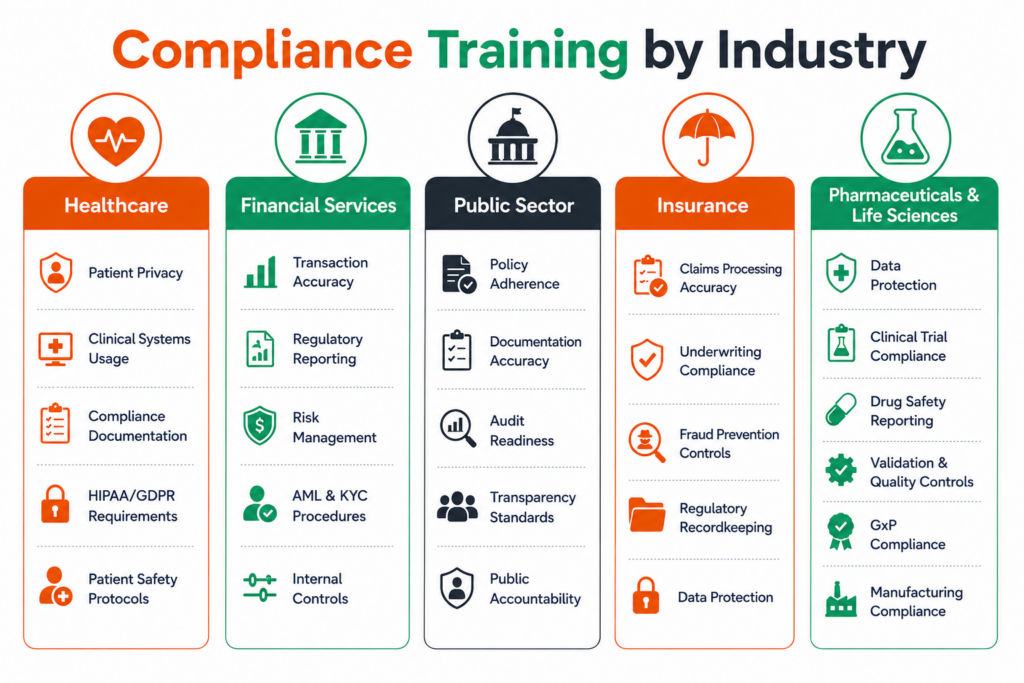
Sector-Specific Compliance Training Considerations
Every regulated sector faces distinct risks that shape training priorities.
Healthcare compliance training
Accuracy directly affects patient safety and privacy.
Key focus areas include:
- Correct clinical system usage
- Complete regulatory documentation
Training here is similar to surgical preparation. Precision is non-negotiable.
Finance compliance training
Financial institutions operate under intense scrutiny. Transaction errors or reporting gaps can trigger investigations.
Training should emphasize:
- Transaction accuracy
- Regulatory reporting workflows
- Risk management procedures
Much like air traffic control, consistency ensures safe outcomes. This is why many institutions invest in structured financial services regulatory training.
Public sector compliance training
Government organizations must demonstrate transparency and accountability.
Training priorities often include:
- Policy adherence
- Standardized processes
- Documentation accuracy
Think of it as maintaining a public record archive. Every detail must withstand review.
While requirements differ, one principle remains constant. Training for compliance-heavy industries must prepare employees for real operational conditions, not ideal scenarios. Effective government compliance training ensures processes withstand public scrutiny.
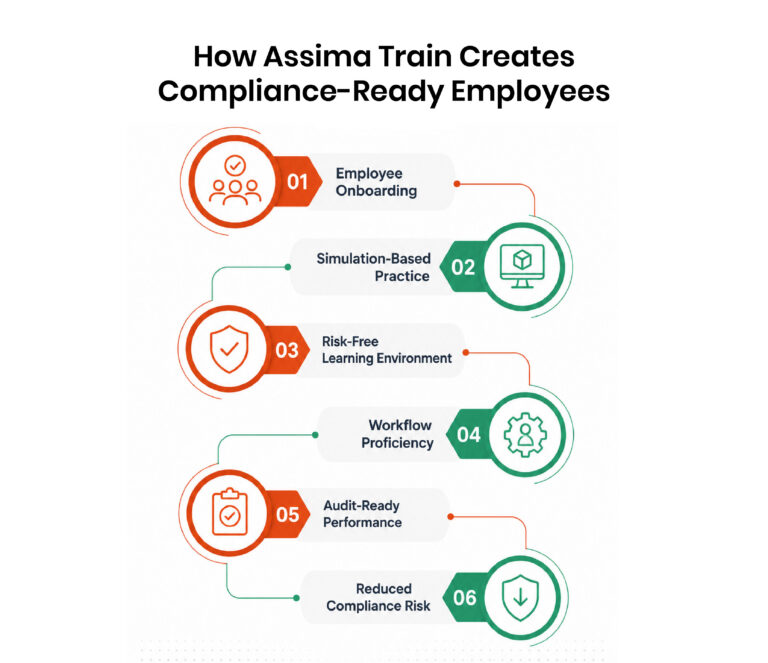
How Assima Train Enables Compliance-Ready Training
Assima Train helps organizations deliver risk-free compliance training that prepares employees without exposing live systems.
Simulation-based learning
The platform recreates real applications so users practice workflows safely. Employees gain experience without affecting production data.
It works much like a driving simulator. Learners build confidence before entering real traffic.
Standardized training for audit consistency
Assima Train ensures every employee receives the same structured experience. This consistency simplifies audit preparation and supports documentation requirements.
Scalable delivery
Global organizations often struggle to maintain training quality across locations. Assima Train allows teams to create content once and deploy it everywhere.
For example:
- A multinational bank trains analysts across regions.
- A hospital network prepares staff before a system rollout.
- A government agency standardizes onboarding.
Faster onboarding with compliance built in
New employees learn correct procedures from the start, reducing risky trial-and-error behavior.
By combining simulation, structure, and scalability, Assima Train compliance training supports organizations that must operate with precision every day.
Measuring Compliance Training Effectiveness
Strong training programs rely on measurable outcomes rather than assumptions.
Organizations should monitor:
- User proficiency and task accuracy
- Reduction in compliance-related errors
- Audit readiness indicators
- Lower dependency on compliance support teams
Think of these metrics as a health check for your training strategy. They reveal whether employees are truly prepared.
Analytics also highlight patterns. If multiple users struggle with the same workflow, training can be refined before issues escalate.
Conclusion
In regulated industries, effective compliance training empowers workers to perform confidently while shielding companies from preventable risk. Teams are rarely prepared for the complexity of current systems using traditional methods. Practical, scalable training is now crucial.
Employees can practice safely, improve accuracy, and maintain alignment when rules change thanks to simulation-based learning. Reactive compliance gives way to operational readiness for organizations. Assima Train gives businesses the framework they need to grow learning across departments and geographical areas, enable audit readiness, and standardize training.
When your employees know exactly how to work, compliance becomes a competitive advantage rather than a burden.
Explore how Assima helps teams stay compliant, confident, and audit-ready.
Frequently Asked Questions
Let’s Answer Some of Your Questions.
Assima Train uses simulation-based learning so employees can practice real workflows safely. It standardizes training, supports scalability, and provides analytics that help organizations track readiness.