

Introduction
Key Highlights
- A robust digital adoption strategy boosts user confidence, decreases reliance on IT, and speeds up the results of digital transformation.
- With simulation-based and in-app training, employees can adapt to enterprise software more quickly and with fewer mistakes.
- When choosing a digital adoption platform, consider factors such as scalability, integrations, analytics, and multilingual support.
- The right digital adoption platform directly impacts enterprise productivity, software ROI, and employee experience.
Digital Adoption Platforms (DAPs) can help with it. The hitch is that not every DAP resolves the issue. Some provide clarification. Some simply add a new layer. If you’re assessing one, the questions you ask up front will make a difference. Let’s go over the eight that are very important.
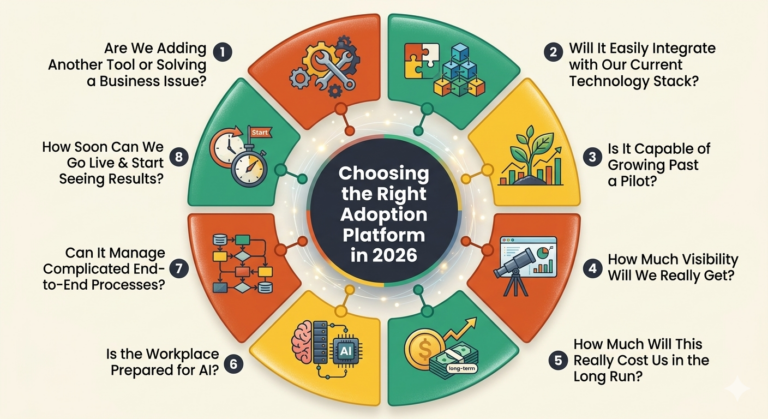
1. Are We Adding Another Tool or Solving a Business Issue?
Features like tooltips, walkthroughs, and pop-ups can easily become annoying. However, if it doesn’t make a difference, none of it matters. Before you do anything else, consider:
What issue are we aiming to resolve? Is the onboarding process slow? high rates of error? Low uptake of the system? Gaps in compliance?
A good DAP should not only increase “engagement,” but also actively address such problems. Because improved performance isn’t always correlated with more clicks.
It’s worthwhile to reevaluate the platform if it can’t be directly linked to results like quicker work completion or fewer errors.
2. Will It Easily Integrate with Our Current Technology Stack?
3. Is It Capable of Growing Past a Pilot?
A lot of DAP projects get off to a great start before stalling. Why? Because what is effective for one team may not be effective for the entire company. New difficulties are brought forth by scaling:
Different roles require different kinds of direction.
Localized experiences are necessary for global teams.
Different departments have different complex workflows.
Thus, the actual query is: Will this platform be able to expand with us, or will complexity cause it to fail? Seek out adaptability. Not only in terms of technology, but also in the ease with which your teams can produce, maintain, and oversee large amounts of information.
4. How Much Visibility Will We Really Get?
A DAP should educate you about the workings of your company in addition to providing users with guidance. You must be able to assess, at a minimum:
Where do users fail to complete tasks?
Which tasks take longer than anticipated?
The most frequent places for errors. But there’s more to the true worth. Is it able to explain the reasons behind those problems? Can it assist you in swiftly fixing them? Because without action, insights don’t really advance.
5. How Much Will This Really Cost Us in the Long Run?
6. Is the Workplace Prepared for AI?
AI is now integrated into daily tasks and is no longer experimental. Employees are interacting with intelligent technologies more than ever before, from AI copilots to automated recommendations. A DAP’s role has been changed as a result. These days, it goes beyond simply directing clicks. It’s about assisting users:
- Recognize the results of AI
- Have faith in automated judgments
- Make responsible use of AI tools
If your DAP is not evolving with AI, it’s already lagging.
7. Can It Manage Complicated End-to-End Processes?
8. How Soon Can We Go Live & Start Seeing Results?
Some DAPs take months to implement, yet they appear fantastic in demos. Long deployment cycles actually reduce internal momentum and delay impact. Ask:
- What is the schedule for implementation?
- Do pre-made accelerators or templates exist?
- When will we be able to launch our first use case?
In 2026, speed is crucial. It is easier to promote adoption within the company if you provide value more quickly.
What Can You Learn From All of This, Then?
Selecting a Digital Adoption Platform involves more than simply software choices. It’s a calculated move. Because, this is fundamentally about people, not tools. It’s about ensuring that the systems you’ve invested in are truly used by your staff. It’s about making daily job less stressful. And more and more, it’s about assisting your employees in keeping up with the speed of change, particularly as AI transforms the nature of work.
The proper DAP is more than just a software add-on. It functions silently in the background, simplifying, speeding up, and improving intuitiveness. When you do it correctly, something interesting happens: employees completely lose interest in the technology. They just get the job done.