

Key Highlights
- Training employees directly in SAP production systems creates operational, security, and compliance risks.
- SAP training without production access enables employees to practice workflows safely without affecting live business data.
- Simulation-based SAP training improves retention, user confidence, and workflow accuracy through hands-on learning.
- Traditional SAP training methods often struggle with outdated materials, expensive sandbox systems, and inconsistent learning experiences.
- Assima Train provides scalable simulation-based SAP training environments that reduce risk and accelerate user readiness.
Introduction
Enterprise operations depend heavily on SAP systems. SAP platforms are used by businesses to handle important tasks like managing finances, purchasing, supply chains, human resources, and more.
So, training is necessary before people start using the system. Employees could make mistakes that hurt the business if they don’t get structured training.
One good way to train people is to give them SAP training without letting them access production. Organizations offer safe training environments where employees can learn workflows without putting real business data at risk, instead of letting new users practice directly in live systems.
This method lets users gain confidence and learn useful skills before doing tasks in real-world settings. Assima Train and other platforms help businesses offer SAP training without any risk by using simulation-based learning that safely mimics real workflows.
Why SAP Training Is Essential for Enterprise Success
SAP platforms are strong, but they are also hard to use. A single SAP environment can have many modules, like finance, procurement, logistics, and managing human capital.
Because these modules are linked together, a small mistake in one process can have an effect on other departments.
So, employees are very important to making sure that SAP systems work well. Users can learn how workflows work and how their actions affect larger business processes through proper training.
When companies don’t train their employees, a lot of problems can happen.
Impact of Poor SAP Training
- Employees struggle with unfamiliar workflows
- Data entry mistakes increase across departments
- Productivity declines due to inefficient system usage
- IT support teams receive frequent help requests
So, giving users the tools they need to succeed is a big part of SAP’s success. Companies that pay for structured SAP training programs often see that their employees learn the software faster and that their operations run more smoothly.
Training teaches workers not only how the system works, but also how it helps them do their jobs every day.
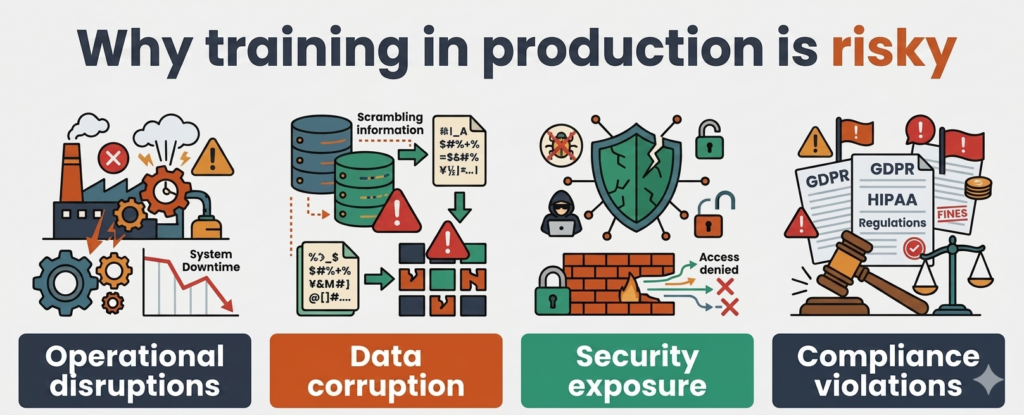
The Risks of Training Users in Production Systems
Some companies let their employees practice tasks right in the production environment. This method may seem easy, but it comes with a lot of risks.
Production systems contain real business data and support live operations. Training activities in these environments can therefore affect critical processes.
Operational Risk
When users practice tasks in production systems, they might accidentally start real transactions or workflow actions. These actions can mess up how things work across departments.
Data Integrity Issues
Errors made during training can change employees, inventory, or financial records. The administration may have to do more work and make changes to the system to fix these mistakes.
Security and Compliance Concerns
Sensitive information that is often found in production environments includes financial records and personal data about employees. If trainees are allowed to use these environments, there is a greater chance that data will be accidentally exposed.
Key Risks of Training in Production
Risk | Potential Impact |
Operational disruptions | Training activities may trigger real workflows |
Data corruption | Mistakes can alter financial or operational data |
Security exposure | Sensitive information may become visible |
Compliance issues | Regulatory standards may be compromised |
Because of these risks, organizations increasingly avoid using production systems for training purposes.
What SAP Training Without Production Access Means
SAP training without production access refers to providing employees with safe learning environments that replicate system functionality without affecting live operations.
These environments may include simulation platforms, cloned systems, or training replicas that mimic real SAP interfaces.
Users interact with these systems just as they would in production environments, but their actions do not impact real data.
Common Training Environments
- Simulation environments
Interactive systems that replicate real SAP workflows.
- Cloned training systems
Copies of SAP environments designed for learning.
- Training replicas
Dedicated systems created specifically for user training.
These settings let workers do tasks one step at a time while getting real-world experience.
Safe places to learn also encourage trying new things. Users can make mistakes, repeat workflows, and improve their understanding without worrying about how it will affect their work.
Key Features to Look for in Digital Adoption Platforms
Providing safe training environments offers several advantages for organizations implementing SAP systems.
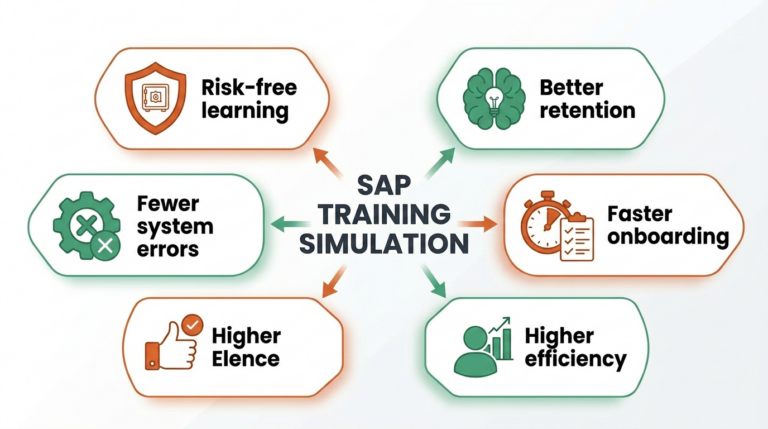
Risk-Free Learning
Users can practice workflows without affecting operational systems or business data. This approach protects enterprise processes while supporting user education.
Faster Knowledge Retention
Learning by doing helps you remember and understand better. Users remember things better when they do things instead of just reading instructions.
Reduced System Errors
People who practice workflows before working in a production environment are less likely to make mistakes. This makes it less likely that operations will be disrupted after the system goes live.
Higher User Confidence
Training environments allow employees to explore system features and workflows freely. As a result, users feel more comfortable performing tasks in live systems.
Key Risks of Training in Production
Benefit | Business Impact |
Risk-free learning | Protects operational systems during training |
Improved retention | Hands-on practice strengthens learning |
Reduced errors | Employees perform tasks accurately |
Higher confidence | Users feel prepared for real workflows |
Organizations that adopt simulation-based SAP training often experience faster user adoption and smoother system rollouts.
Learn how enterprises build scalable SAP training environments without relying on costly sandbox systems.
Challenges Enterprises Face in Traditional SAP Training
Despite the importance of safe training environments, many organizations still rely on traditional training methods that present limitations.
One common challenge is the cost of maintaining sandbox environments. These systems require infrastructure, system updates, and ongoing maintenance.
Training documentation can also become outdated quickly. As SAP systems evolve through configuration changes or upgrades, training materials may no longer reflect current workflows.
Limited system access creates additional challenges. Organizations may restrict training environments to protect operational data, which reduces opportunities for hands-on practice.
Common Limitations of Traditional SAP Training
- Expensive sandbox systems that require maintenance
- Training materials that become outdated quickly
- Limited access to practice environments
- Inconsistent learning experiences across teams
These challenges often prevent organizations from delivering effective SAP training programs.
How Assima Train Solves SAP Training Challenges
Assima Train helps businesses deal with these problems by giving them training environments for SAP systems that are based on simulations.
The platform makes realistic simulations that copy real SAP workflows without needing access to production systems. Employees can learn how to do things step by step while using systems that act like real applications.
Learning through simulation
Assima Train lets workers do real work in simulated SAP environments. These simulations look like real interfaces but are completely safe.
Hands-On Practice
Users don’t just read documentation during training; they also do things. This method makes people more interested and helps them learn better.
Scalable Global Training
Large enterprises often need to train thousands of employees across multiple regions. Assima Train supports scalable training programs that deliver consistent learning experiences across global teams.
Faster SAP Adoption
Employees who practice workflows before the system goes live get more done faster. This speeds up the process of getting new employees up to speed and makes the business run more smoothly.
Key Outcomes with Assima Train
- Reduced system errors during SAP rollouts
- Faster employee onboarding
- Improved user confidence
- Consistent training across global teams
Through these capabilities, Assima Train enables organizations to train employees effectively without risking production environments.
Best Practices for SAP Training Without Production Access
Organizations implementing risk-free SAP training strategies should follow several best practices.
Training programs should focus on practical learning experiences rather than purely theoretical instruction.
Recommended SAP Training Practices
- Use simulation-based learning environments
- Provide role-based training programs for different users
- Offer continuous learning resources after system rollout
- Deliver contextual guidance during workflows
These practices help employees develop the skills required to navigate complex SAP environments confidently.
Conclusion
SAP training without access to production is very important for businesses that want to use enterprise software. Letting employees practice workflows in live systems adds unnecessary risks that could hurt business processes and operational data.
Learning environments that use simulations are a safer and better option. Organizations can help employees remember what they’ve learned, make fewer mistakes in the system, and get users to adopt it faster by letting them practice tasks in controlled settings.
Assima Train and other platforms make it possible to give SAP training that is both scalable and realistic without affecting production systems.
Companies that want to improve their SAP training strategies should look into how Assima Train makes learning safe and speeds up the process of getting workers ready.
See how Assima Train reduces SAP rollout risk and lowers enterprise training costs at scale.
Frequently Asked Questions
Let’s Answer Some of Your Questions.
SAP training without production access refers to training employees in simulated or replicated environments instead of live operational systems.
Training in production environments may affect real data, disrupt workflows, and expose sensitive information.
Simulation-based training environments allow users to practice workflows safely without affecting operational systems.
Assima Train creates simulation-based environments that replicate real SAP workflows while protecting production systems.
Simulation training improves knowledge retention, reduces operational errors, and prepares employees before system rollout.