

Key Highlights
- Centralized, scalable, localized enterprise training techniques are taking the place of fragmented regional training in multinational enterprises.
- Effective enterprise training must take into account local workflows and operational realities; translation alone is no longer sufficient.
- Organizations can increase SAP adoption, lower support tickets, and speed up onboarding worldwide by using simulation-based learning.
- Businesses can provide consistent multilingual software training while lowering maintenance effort at scale with platforms like Assima.
Introduction
Assima can help you overcome any such challenge and make your digital transformation plans a success.
What Modern Enterprises Need for Training?
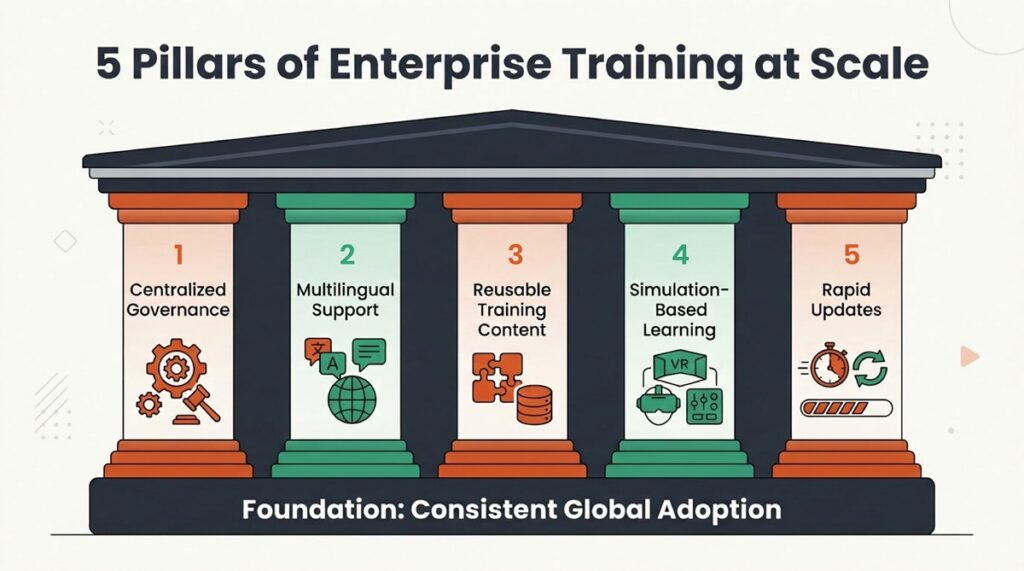
Businesses nowadays look for training systems that are scalable, as are the software platforms they support. This involves shifting toward centralized, flexible learning ecosystems rather than dispersed regional training methods. Training for modern global enterprises needs:
Centralised Infrastructure
For content management training, organizations require a single source of truth. This enables worldwide consistency in workflows, governance, upgrades, and learning standards.
Localisation at Scale
Without starting from scratch, training must swiftly adjust to languages, geographical areas, operational variations, and compliance requirements.
Reliable User Experiences
Workers should be able to observe workflows that are relevant to their local operations while also receiving the same level of training across countries.
Quick Content Updates
Enterprise systems are always changing. Training materials must be updated quickly without having a total redesign for each location.
This change is completely changing the way businesses see learning. Training is more than just instructional material these days. It is a functional infrastructure.
How Assima Train Makes Localized Business Training Possible
Platforms such as Assima are assisting businesses in modernizing the training worldwide. Assima Train is designed especially to facilitate extensive enterprise software training in multinational organisations. Businesses can employ a single content infrastructure that enables scalable localization and reusable simulations in place of managing diverse training assets across organisations globally. Key components include:
- Single-source content management
- Faster multilingual localization
- Reusable SAP and ERP simulations
- Workflow-specific training experiences
- Reduced content maintenance effort
- Consistent training governance
This generates significant operational benefits for businesses overseeing worldwide software rollouts. The benefits include:
- Faster onboarding
- Reduced support burden
- Improved user confidence
- More consistent adoption
- Lower long-term training costs
- Faster rollout readiness across regions
Wrapping Up
Global businesses can no longer afford to use fragmented training approaches. Training needs to become more operational, localized, and scalable as corporate systems become more interconnected. Discover how Assima Train reduces maintenance work and improves adoption outcomes while assisting enterprises in providing uniform multilingual SAP training across areas.
Ready to See How It Fits?
Explore how Assima supports localized training at scale.
Frequently Asked Questions
Let’s Answer Some of Your Questions.
Scaling multilingual SAP training becomes challenging because businesses frequently handle different content, translations, workflows, and trainers across regions, resulting in duplication and uneven learning opportunities.
Organizations can lower their global training expenses by centralizing content management, reusing simulations, reducing the production of duplicate content, and putting in place a scalable multilingual training infrastructure.