

Introduction
Key Highlights
- SAP implementation success depends on whether employees actively and effectively use the system in daily workflows.
- Measuring SAP adoption ROI requires tracking metrics like adoption rate, task completion time, support ticket reduction, and feature usage.
- User behavior metrics and operational performance indicators together provide a clearer picture of SAP business value.
- Traditional training methods often fail because they focus on completion rather than real-world SAP usage and productivity.
- Assima Train improves SAP adoption ROI through simulation-based learning, scalable training, and real-time guidance.
Companies spend a lot of money on SAP systems to make their operations more efficient, automate tasks, and help with digital transformation across the whole company. But putting SAP technology into use is just the first step. The real value of these investments comes out when employees use the system regularly and make it a part of their daily work.
This is why it’s getting more and more important to find out how much money SAP adoption is worth. Companies should check to see if their SAP investments are paying off in ways that can be measured, such as by making things run more smoothly, making fewer mistakes, and making workers more productive.
Why Measuring SAP Adoption ROI is Critical
When you implement SAP, you often have to spend a lot of money on technology, consulting services, and training programs. Companies hope that these investments will make their operations run better and help them make the switch to digital in the long run.
But a lot of the time, businesses have trouble figuring out if their SAP projects are really paying off like they thought they would.
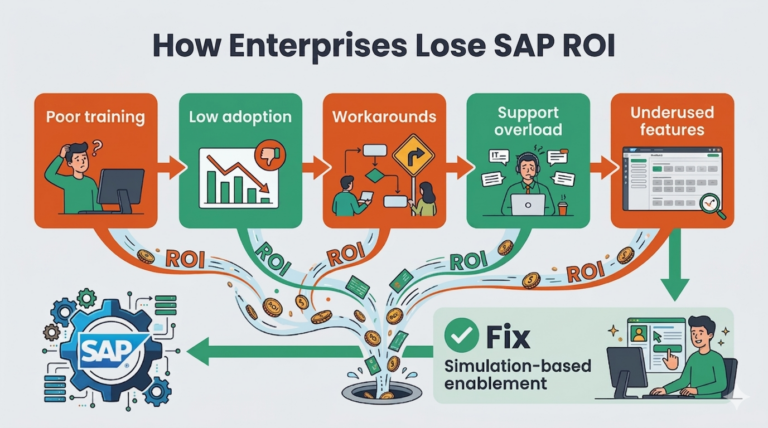
A common problem is that workers don’t use all of the system’s features. Workers may only use the basic features and not the more advanced ones that could help them get more done. And it’s not just their fault; it’s a failure of training.
People also don’t want to change, which is another problem. Some teams that are used to old systems may not want to switch to the new workflows that SAP has put in place.
People are less likely to adopt if they don’t get the right training. If workers don’t fully understand how the system works, they might not do their jobs well or rely too much on IT support teams.
Common SAP Adoption Challenges
- Underutilized SAP features and capabilities
- Resistance to new workflows and system processes
- Inefficient task completion due to limited training
- Increased support requests from employees
Organizations can deal with these problems by measuring adoption ROI. Companies can find out where they need to make changes and make sure their SAP investments bring in measurable business value by keeping track of adoption metrics.
Key Metrics for Measuring SAP Adoption ROI
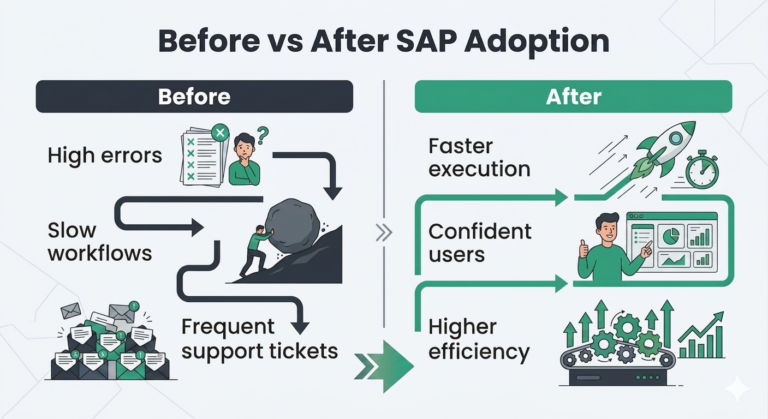
Companies need to keep an eye on certain performance indicators to see if SAP systems are worth the money. These numbers show how well workers use the system and if training programs help them get more done.
Key SAP Adoption Metrics
Metric | What It Measures | Why It Matters |
User Adoption Rate | Percentage of employees actively using SAP workflows | Indicates whether the system is integrated into daily operations |
Task Completion Time | Time required to perform workflows before and after implementation | Reveals productivity improvements |
Support Ticket Reduction | Decrease in helpdesk requests related to SAP usage | Shows increased user confidence and system understanding |
Training Completion & Retention | Effectiveness of SAP training programs | Helps evaluate whether employees retain system knowledge |
Feature Usage | Frequency of advanced SAP features being used | Shows whether workers are using the full potential of the system |
Keeping an eye on these metrics can help companies find both the good and bad parts of their SAP adoption strategy.
Businesses can improve their SAP adoption strategies and boost employee productivity by regularly looking at these metrics.
Calculate the business impact of improving SAP adoption, reducing errors, and accelerating employee productivity.
Business Impact Metrics
It’s important to look at user behavior metrics, but businesses also need to think about how using SAP will affect the whole business.
When employees use SAP correctly, departments can see that they are working better. An increase in productivity is often the first sign that something has been adopted successfully. People who know how the system works can get things done faster and with fewer problems.
The number of mistakes that go down is another important sign. Proper training helps workers avoid making mistakes when they enter data, do transactions, or finish tasks. Standardizing workflows makes them work better. SAP systems automate a lot of everyday tasks, but these benefits only happen when users do things the right way.
Business Impact Indicators
- Faster workflow completion across departments
- Reduced operational errors and data inconsistencies
- Improved process efficiency and reporting accuracy
- Increased employee productivity
These outcomes translate directly into measurable business value. Organizations that track both user behavior metrics and operational performance gain a clearer understanding of SAP adoption ROI.
Challenges in Measuring SAP Adoption ROI
Despite the importance of adoption metrics, many organizations struggle to measure SAP ROI effectively.
One common issue is fragmented training systems. Training materials may exist across different platforms, making it difficult to evaluate learning outcomes.
Limited analytics capabilities also restrict visibility into user behavior. Without detailed insights into system usage, organizations cannot accurately measure adoption levels.
Outdated training methods present another challenge. Traditional training programs often focus on course completion rather than real system usage.
Common Measurement Challenges
- Fragmented training and learning platforms
- Limited visibility into user behavior analytics
- Difficulty connecting training outcomes with productivity improvements
- Lack of standardized adoption KPIs
These challenges make it difficult for organizations to understand whether SAP investments deliver real operational value.
As a result, many enterprises seek solutions that provide deeper insights into user performance and training effectiveness.
How Assima Train Improves SAP Adoption ROI
Assima Train helps organizations improve SAP adoption outcomes by providing simulation-based training environments and scalable learning programs.
The platform lets workers practice SAP workflows in realistic simulations before they use them in real life. This method helps users gain confidence and real-world knowledge.
Assima Train lets employees learn by doing tasks in simulated environments instead of just reading documents or going to class.
Simulation-Based SAP Training
Employees use realistic SAP simulations that mimic how the real system works. Users can practice tasks in these environments without affecting the systems that are running.
Real-Time Guidance
Assima Train can also support contextual learning experiences. Users receive guidance while performing workflows, helping them avoid mistakes and complete tasks efficiently.
Global Training Consistency
Large enterprises often operate across multiple regions and languages. Assima Train supports scalable training programs that deliver consistent learning experiences across global teams.
Reduced Training Costs
Traditional SAP training often requires sandbox environments that are expensive to maintain. Simulation-based training reduces these infrastructure requirements while improving learning outcomes.
Outcomes Enabled by Assima Train
- Faster user onboarding for SAP systems
- Improved knowledge retention through hands-on learning
- Reduced support tickets from employees
- Higher adoption rates across enterprise teams
These improvements directly contribute to measurable SAP adoption ROI.
Best Practices for Tracking SAP Adoption ROI
Organizations that successfully measure SAP adoption ROI typically follow structured monitoring practices.
Companies should first ensure that their adoption KPIs align with their objectives. Metrics like how quickly users adopt the system, how long it takes to complete a task, and how frequently the system is used can teach us a lot.
Additionally, you should monitor user behavior. By monitoring how employees use SAP systems, you can identify areas where they may require additional training.
Training courses ought to closely resemble real-world procedures. Employees can immediately apply what they have learned when the learning environment is similar to the real world.
Recommended Practices
- Define measurable SAP adoption KPIs
- Monitor system usage and behavior analytics
- Align training with real operational workflows
- Provide continuous learning and refresher training
- Evaluate adoption metrics regularly
These practices help organizations improve adoption strategies over time.
Conclusion
Putting SAP into place is a big investment in business technology. But how well these programs work depends on how well employees use them every day.
Companies can measure the ROI of adopting SAP in more ways than just counting how many people finish training. By keeping track of adoption metrics, productivity gains, and operational efficiency, businesses can get a better idea of how much their SAP systems are worth.
Assima Train and other solutions help with this by making it possible to train people through simulations, offer learning programs that can grow, and get the workforce ready for work. Companies that put user enablement and measurable adoption outcomes first are much more likely to get a good return on their SAP investments.