

Key Highlights
- KPIs confirm whether client training is working and driving real adoption.
- Completion, engagement, retention, time-to-competency, and adoption are the five core measures.
- Simulations provide accurate, real-world performance insights.
- Dashboards reveal gaps and guides for quick improvements.
- Strong KPIs boost satisfaction and improve training ROI.
Introduction
For software providers, the work does not stop once the product is delivered. The real test begins when clients start using it in their daily operations. In the process of successfully delivering software, training plays the most important role. It acts as the bridge between product delivery and real value. Without effective training, even the most advanced solution can struggle to reach adoption goals, which often results in higher churn and missed renewals.
For software providers, the only way to know whether training is working effectively is through metrics. One may believe that training is successful because it is delivered, but without understanding and analyzing metrics or key performance indicators, there is no way to confirm if the client has understood or retained what was taught. KPIs for client training projects show whether clients are engaged, if they are learning effectively, and whether they are applying the software in practice. With the right KPIs for software training, providers can strengthen client relationships and prove the return on investment of training programs.
Assima Train supports this process with simulation-based learning and built-in analytics. It combines realistic practice environments with measurable results, making training both impactful and accountable.
Why KPIs Matter in Client Training
Training is not just a step in the onboarding checklist. It directly affects adoption, client satisfaction, and renewals. When clients become confident with a product quickly, they see value faster. This builds stronger engagement, reduces pressure on support teams, and increases renewal rates. Poor training does the opposite. It slows adoption, creates frustration, and damages trust in the provider.
Many providers assume training is successful because sessions were delivered. Without data, there is no proof of whether clients understand the material. There is also no way to find weak points or improve future programs.
This is why client training success metrics are critical. With the right set of KPIs, providers can connect training activities to business outcomes. By tracking measurable training project performance indicators, they can show the impact of their programs, adjust when needed, and continuously keep improving the client experience. For software providers that want to grow at scale, KPIs form the foundation of a training strategy that is both effective and measurable.
Top 5 KPIs for Client Training Projects
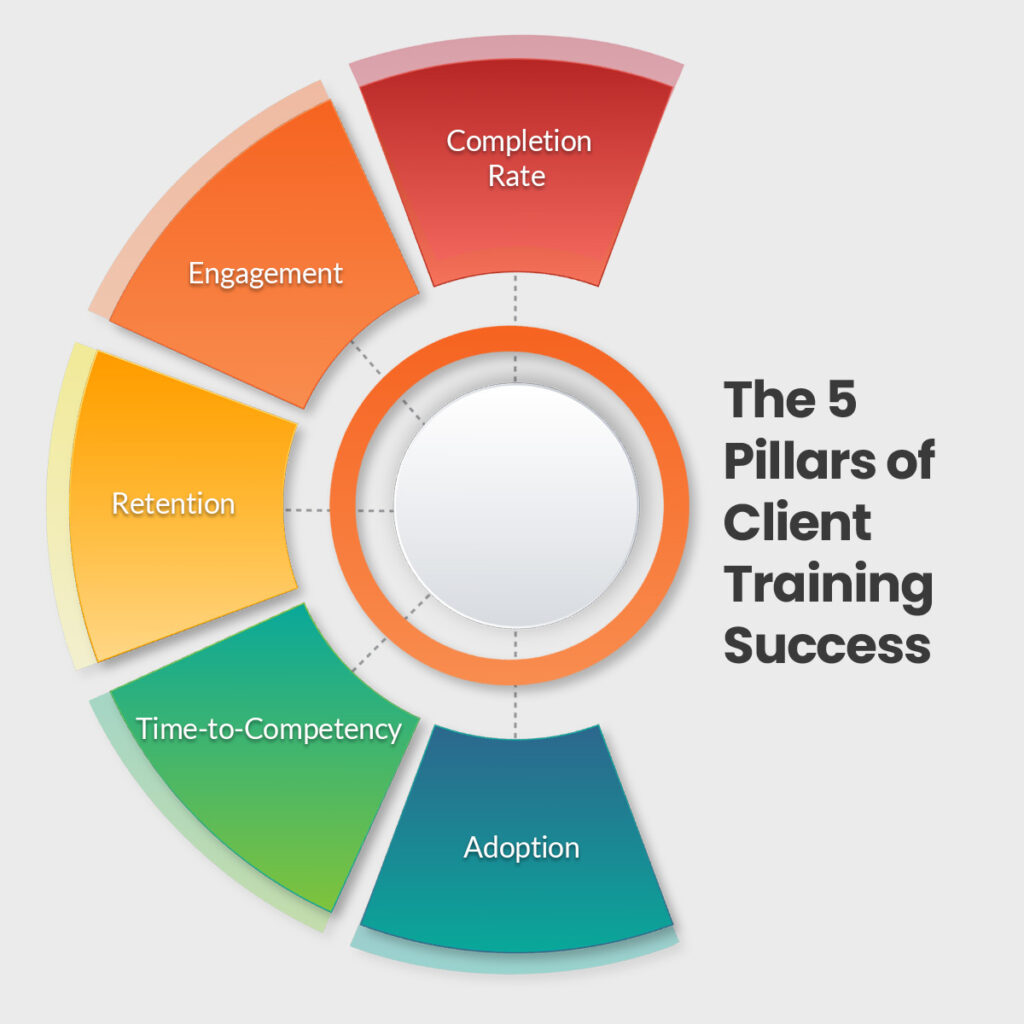
Training Completion Rate
Think of completion rate as the attendance sheet for training success. If learners are not finishing the program, they never get the chance to build the skills needed for adoption. A high completion rate suggests clients are motivated and see value in the training. A low rate, however, often signals a problem. The training may be too long, too generic, or difficult to access.
For example, software providers have noticed that once they break lengthy onboarding courses into shorter, role-based modules, the completion rate jumps to a significant number. The difference was not in the content itself but in how it was delivered. Tracking completion gives providers that first clue about whether clients are even staying engaged long enough to learn.
Learner Engagement Levels
Completion alone is not the full story. A client may finish the modules while barely paying attention. Engagement digs deeper by looking at how active learners participate. Metrics like time spent in sessions, interaction with exercises, and involvement in simulations tell providers if clients are truly engaged.
Imagine a classroom where everyone shows up, but only half the students raise their hands or take notes. The same applies to software training. Active participation signals deeper understanding and confidence. Platforms such as Assima Train make this easier by giving clients realistic environments where they can “learn by doing.” The hands-on nature of simulations keeps learners interested and makes it more likely they will adopt the software in real life. This makes engagement one of the most important training engagements of KPIs.
Knowledge Retention and Assessment Scores
Attendance does not guarantee learning. What matters is what clients remember a week or a month after the training. Retention is tested through assessments, quizzes, and practical exercises. Without these checks, providers risk believing that training was effective simply because people showed up.
Simulation-based assessments offer a stronger way to measure retention. Instead of asking, “Do you know how to generate a report?” They place the learner in the system and ask them to do it. One company found that while 90 percent of clients passed a multiple-choice test, less than half of them could complete the task inside the software. By switching to simulation-based testing, they gained a clearer picture of real competency and improved follow-up support.
Time to Competency
Time to competency measures how quickly clients can stand on their own two feet with the product. Every extra day spent struggling adds pressure on support teams and risks client frustration. Faster competency means clients see value sooner, and providers spend less time on firefighting issues.
For instance, a SaaS company introduced in-app guidance alongside formal training. Instead of waiting for helpdesk ticket responses, clients could access quick tips right in the system. As a result, the average time for competency dropped from six weeks to three. This simple shift not only reduced support tickets but also improved client confidence. It shows how small changes in training design can have a big impact on this KPI, making it one of the most valuable client onboarding metrics.
User Adoption Rate and System Utilization
If training completion is the starting line, adoption rate is the finish line. It measures whether clients are actively using the software and to what extent. High adoption shows that training worked, while low adoption reveals gaps in onboarding or resistance to change.
Consider a financial services firm that invested heavily in a new CRM. Training completion was high, but six months later only 30 percent of staff were using the system regularly. By tracking the adoption of metrics such as logins and feature usage, the provider realized that advanced modules were too complex. Simplifying training and offering post-training support raised adoption above 70 percent.
Adoption is like planting trees. Training prepares the soil, but the real proof of success is whether the tree grows. Without adoption, even the best-designed training program cannot demonstrate long-term value. Providers should treat adoption and usage as core software adoption of KPIs.
Bringing It All Together
These five KPIs work best when they are viewed together. The completion rate shows whether clients started the journey. Engagement tells you how invested they were. Retention proves that knowledge is stuck. Time to competency reveals how quickly they became confident. Adoption rate is the ultimate proof that training created a lasting impact. Together, these software training effectiveness KPIs give providers a clear, end-to-end picture of client training success.
Curious how to pick the right digital adoption platform? Learn the features and metrics that matter most.
How Assima Train Supports KPI Tracking
Tracking KPIs can be a challenge when data sits in different systems or when training results are difficult to measure. Assima Train makes this process simpler by combining immersive training with powerful analytics. Instead of guessing how effective training was, providers can see the results clearly.
- Simulation-based training with analytics
Learners practice workflows inside a replica of the live software. Every click, mistake, and correction is recorded. For example, if a client struggles repeatedly with creating an invoice, providers can spot the issue early and reinforce that area. This creates accurate, actionable data instead of vague feedback. - Real-time dashboards
Dashboards show completion rates, adoption trends, and competency levels in real time. A provider can instantly see whether a group of finance users in one client organization is keeping pace with training compared to another group. This visibility makes it easier to step in before problems escalate. - Contextual, in-app training
Learners do not always need another manual. With Assima, they get prompts inside the application exactly when they need them. A new HR manager, for example, can follow step-by-step guidance while running payroll, cutting down support calls, and building confidence faster. - Centralized reporting and proven results
Instead of piecing together LMS reports, surveys, and support logs, providers get everything in one place. Clients using Assima Train client training have seen adoption rates climb and training costs fall because insights are easier to act on.
By blending training delivery with measurement, Assima ensures that providers not only teach effectively but also prove the value of their programs.
Best Practices for Improving Training KPIs
Tracking KPIs is the first step. The real value lies in improving them over time, so training consistently delivers stronger outcomes. Providers who take a structured approach to refining KPIs often see improvements in both adoption and client satisfaction.
- Align with client objectives
KPIs should mirror what clients care about most. If a client wants to reduce onboarding time for new hires, time-to-competency should be the KPI you prioritize. One SaaS provider cut their onboarding time in half by designing training modules specifically around this metric. - Use micro-learning and reinforcement
Breaking content into short, focused lessons keeps learners from feeling overwhelmed. Reinforcement through quick follow-ups or refresher quizzes helps the knowledge stick. For example, a healthcare client introduced 10-minute refresher sessions for nurses, which boosted retention scores across the board. - Personalize training
Not all learners need the same depth of training. Customizing modules based on roles ensure relevance. A sales executive does not need the same level of technical detail as a system administrator, and tailoring content keeps both engaged. - Provide ongoing support
Clients often need help after training ends. Simple aids like job aids, reference cards, or in-app prompts provide reassurance when questions come up. This support builds confidence and reduces frustration.
Improving KPIs is not about chasing numbers alone. It is about creating a training experience that feels practical, relevant, and supportive, ultimately building stronger relationships with clients and driving training ROI for software providers.
Challenges in Tracking Training KPIs
Tracking KPIs sounds simple in theory, but in practice, it’s often a complex task. Many software providers deal with fragmented data scattered across multiple systems such as LMS reports, surveys, and support logs that don’t talk to each other. When data is siloed like this, it’s almost impossible to get a full picture of training effectiveness. Even when the data exists, it’s often reported inconsistently. Different teams may track performance differently, making it difficult to compare results or make informed decisions quickly.
Another common challenge is the manual effort required to pull everything together. Without a single, unified view of performance, providers can easily miss early signs of trouble like declining engagement or longer time-to-competency. These blind spots mean lost opportunities to optimize training and strengthen client outcomes.
That’s where having the right platform makes all the difference. Assima brings every performance metric into one centralized system, complete with real-time dashboards and standardized reporting. By removing data silos and simplifying measurement, Assima gives providers a clear, actionable view of their training project performance indicators. The result? Providers can track KPIs more confidently, respond faster to issues, and continuously improve their client training success metrics.
Conclusion
Training is the foundation of client adoption and long-term success. Without measurement, its value often goes unnoticed. By tracking KPIs for client training projects, providers can prove ROI, improve programs, and strengthen client trust.
Assima Train makes this process simple and reliable. With realistic simulations and built in analytics, it helps providers deliver training that is both effective and measurable. These software training success measures give providers the evidence they need to demonstrate impact and scale client success.
Cut training risks and boost adoption with Assima Train
Frequently Asked Questions
Let’s Answer Some of Your Questions.
The five most important KPIs are completion rate, engagement, knowledge retention, time to competency, and adoption rate. Together, they form the key client training success metrics.
They link training activities to adoption, renewals, and ROI, giving providers proof of success and areas for improvement. Tracking software training effectiveness of KPIs ensures no effort is wasted.
It provides simulation-based training with built-in analytics and real-time dashboards for complete visibility. Assima Train client training combines delivery and measurement in one solution.
Providers cannot prove ROI, identify gaps, or improve strategies, which reduces client satisfaction and slows adoption. Missing out on these software adoption KPIs can hurt long-term success.
By aligning them with business objectives, using micro learning, reinforcing knowledge, personalizing content, and offering post training support. These practices help strengthen training project performance indicators and long-term outcomes.