

Key Highlights
- Technology rollouts fail most often because of people problems, not software problems.
- Employees get overwhelmed when change is poorly sequenced or inadequately supported.
- Training that arrives too late and covers too little creates a dangerous confidence gap at go-live.
- Role-based, simulation-driven learning builds competency before employees ever touch the live system.
- Performance support after go-live is what separates programs that sustain adoption from those that stall.
- Measuring completion rates instead of actual adoption behavior is one of the most common and costly mistakes.
Introduction
Here’s something that doesn’t get said enough in boardroom conversations about digital transformation: technology is rarely the hardest part.
What’s hard is asking people to fundamentally change how they work, learn entirely new systems, and keep their output steady, all while the ground is shifting beneath them. Most transformation programs are designed around the technology rollout. The human side gets less attention, less budget, and less time than it deserves.
Organizations pour billions into ERP systems, CRM platforms, cloud migrations, and AI tools every year. A significant number of those initiatives don’t deliver what they promised. Not because the software failed. Because the people who were supposed to use it never got there.
There’s a way to think about this that reframes the whole challenge. Digital adoption during digital transformation is fundamentally a people initiative. It just tends to arrive dressed up as a technology project.
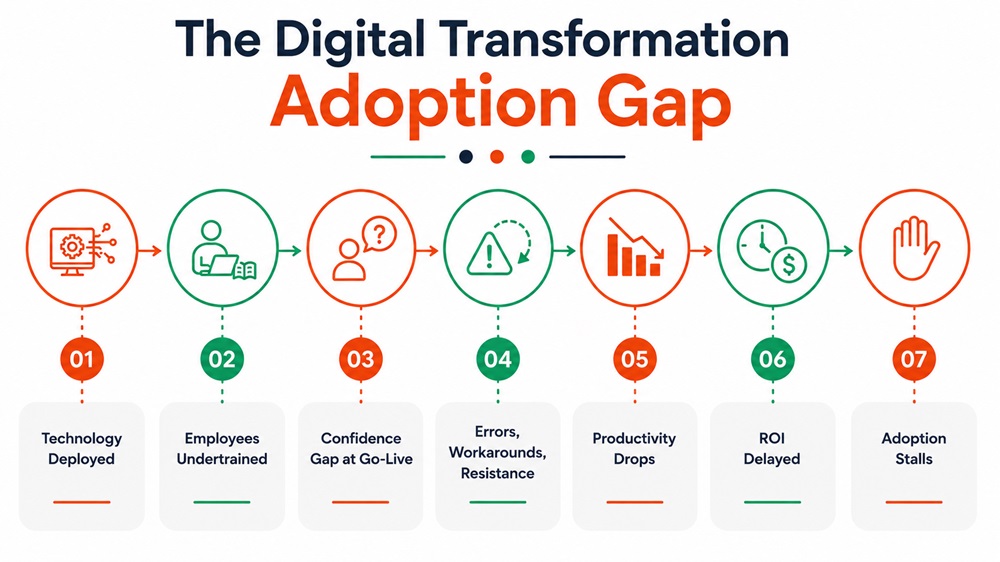
Why Employees Reach Overwhelm in the First Place
It’s Rarely One Change. It’s Several at Once.
Picture a mid-level operations manager six months into a major transformation program. Their company is rolling out a new ERP. The CRM is being upgraded simultaneously. There’s a process redesign underway in their department. The org structure shifted two months ago. And hybrid work policies are still being figured out.
Any one of those changes, handled on its own with proper time and support, would be manageable. Together, they stack.
That stacking effect is something transformation programs consistently underestimate. Employees aren’t experiencing change as a neat sequence of events. They’re absorbing multiple disruptions at once, often without enough time to stabilize between them. The technology rolls out faster than people can keep up. That gap is where overwhelm lives.
Training Usually Arrives Too Late and Covers Too Little
Spend time looking at where training sits in most transformation budgets and timelines. It’s typically treated as a downstream activity, something to schedule once the system is nearly ready, with whatever resources remain after implementation consulting and licensing costs have been covered.
The consequences of that approach are predictable.
Employees receive training that lands too close to go-live to be absorbed properly. The content is generic enough to apply to everyone and specific enough for no one. Sessions run short because there’s pressure to minimize disruption to the business.
You cannot prepare someone for a complex enterprise system in a day. Maybe not even in a week. What employees walk away with after that kind of training is awareness. What they don’t have is confidence. Then go-live arrives, and immediate performance is expected. That’s the moment overwhelm becomes visible.
Resistance Usually Isn’t What It Looks Like
When employees push back on a new system, the instinct in some organizations is to read that as a people problem. Negativity. Lack of engagement. Resistance to change.
It’s worth looking more carefully before drawing that conclusion.
In most cases, resistance is an expression of uncertainty. People resist systems they don’t understand well enough to use confidently. They resist processes where they’re afraid of making a mistake that has real consequences. That’s not stubbornness. That’s a reasonable response to being asked to perform in an environment where they don’t yet feel competent.
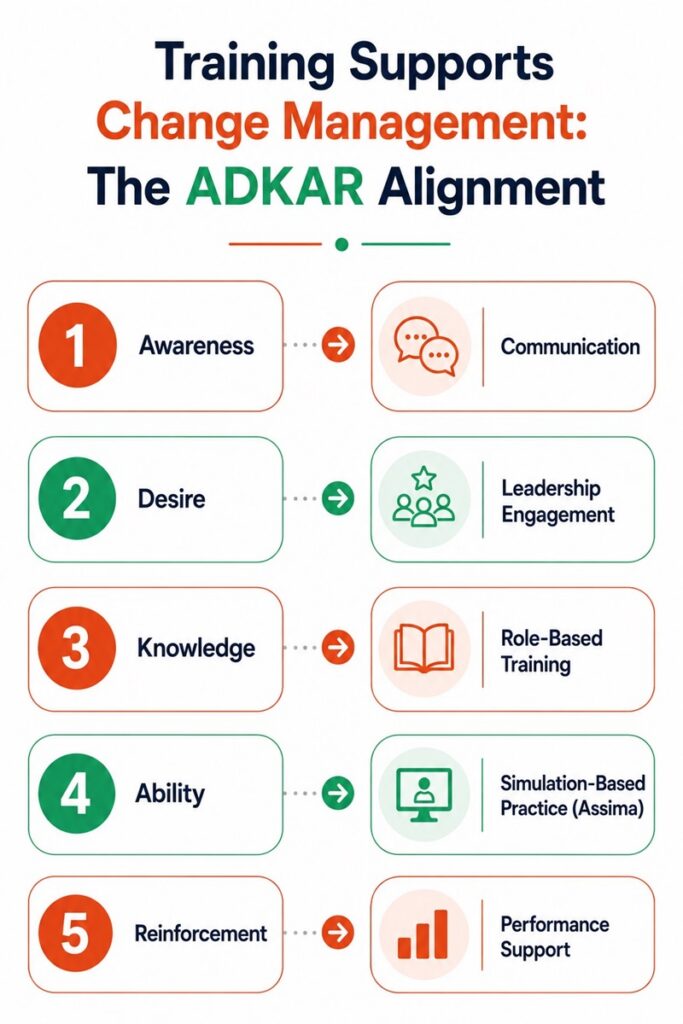
The ADKAR model is useful here. Most organizations invest reasonably well in building Awareness and Desire. People understand why the change is happening. They might even believe in it. But Knowledge, Ability, and Reinforcement are where the investment tends to thin out. Understanding the “why” doesn’t help someone complete a workflow under pressure on day three of go-live.
Competence is what reduces resistance. Not more communication about the vision.
Learn why software investments fail to deliver value and how digital adoption closes the gap.
A Five-Stage Framework for Driving Digital Adoption During Digital Transformation
Strong adoption outcomes don’t happen by accident. Organizations that consistently achieve them tend to follow a structured approach, one that treats adoption as a progression rather than a single moment.
Stage 1: Communication Has to Come Before Training
This seems obvious. It’s violated constantly.
Announcing a new system and immediately booking training sessions puts employees in a position of learning something before they understand why it matters. That sequencing doesn’t work well for human beings.
People need context before they can absorb instruction. Why is this change happening? What problem is it solving? What does it mean for how I do my job specifically? What support is available?
These aren’t unreasonable questions. They’re the questions every employee is quietly carrying. If training arrives before those questions are answered, a significant portion of the learning won’t land.
Dedicated communication should ideally begin four to six weeks before formal training starts. And it should be tailored. A message about transformation that speaks to a warehouse team lands very differently than one written for finance or customer service. People engage with change when they can see themselves in the story being told.
Stage 2: Organize Learning Around Roles, Not Systems
Technology vendors train people on modules. That makes sense for the vendor. It rarely makes sense for the learner.
An accounts payable clerk doesn’t need a comprehensive tour of the finance system. They need to know how to process an invoice. A customer service rep doesn’t need to understand the full CRM architecture. They need to handle the three or four workflows that will consume most of their day.
When training is organized around how the system is built rather than how people actually work, employees absorb information that has no immediate application. It fades. Meanwhile, the knowledge they need most is buried in a generic module.
Role-based learning fixes this. It’s not a complicated idea, but it requires resisting the path of least resistance, which is usually deploying one training program for everyone and calling it done.
| Traditional Approach | Role-Based Approach |
|---|---|
| System modules first | Workflows first |
| One size fits all | Tailored by role |
| Technical framing | Operational framing |
| Information transfer | Competency building |
Stage 3: People Need to Practice Before They Go Live
This is probably the most impactful change an organization can make, and it’s also the one most often skipped due to timeline pressure.
The standard model is to train people and then send them into the live system. The problem is that the live system is where mistakes have real consequences. Data gets corrupted. Transactions are posted incorrectly. Customers are affected. That pressure doesn’t create a good learning environment. It creates anxiety, which actively interferes with performance.
Npower’s SAP implementation is a useful reference point. They needed to bring roughly 4,500 employees into a new way of working without halting operations. Rather than concentrating training at the end of the implementation cycle, they built learning experiences that allowed employees to practice in realistic simulations before launch. The system they were practicing in looked and felt like the real thing. The mistakes they made didn’t matter.
The outcomes were measurable:
- Onboarding time dropped by 50 percent
- Training staffing requirements fell by 80 percent
- The program generated approximately £3 million in savings
What made that possible wasn’t a bigger training budget. It was better sequencing and a more realistic practice environment.
Simulation-based learning, where employees interact with a replica of the actual system, is increasingly how serious transformation programs are solving this problem. Assima’s cloning technology makes this possible by creating hyper-realistic software simulations that mirror live environments, allowing employees to build genuine competency before go-live without any risk to production systems.
Stage 4: Support Has to Continue After Go-Live
Training completion is not the finish line. It’s closer to the starting gun.
Employees might leave training in reasonable shape. Three weeks later, they encounter a workflow they’ve only seen once. The steps aren’t fully clear. The system isn’t forgiving. So they stop, search for documentation, ask a colleague, or raise a ticket. That interruption breaks focus, takes time, and happens dozens of times a day across a large user population.
The cumulative effect of all those small friction points is significant. It slows productivity, drives up support costs, and erodes confidence in the system at exactly the moment when confidence is most needed.
Performance support is the practical solution. Not another training session, but guidance embedded in the flow of work. In-app prompts, contextual help, searchable knowledge resources, process walkthroughs that appear when an employee needs them rather than when a trainer schedules them.
The goal shifts when you think about it this way. It’s not to create employees who have memorized every process. It’s to create employees who know how to find what they need when they need it, and who can complete their work without having to hold everything in their head.
Organizations that build this layer into their transformation programs see the difference in support ticket volumes, in productivity curves, and in how employees talk about the system six months after go-live.
Stage 5: Stop Measuring Completion and Start Measuring Adoption
Training completion rates are easy to report. They’re also a fairly weak indicator of whether anything useful has happened.
An employee can sit through every required module and still be completely lost in the live system. Completion tells you that training occurred. It doesn’t tell you whether people can actually do their jobs in the new environment.
| What Most Programs Measure | What Actually Indicates Adoption |
|---|---|
| Course completions | Workflow completion rates |
| Attendance figures | Time-to-productivity |
| Hours of training delivered | Support ticket volume |
| Assessment scores | User confidence levels |
| Learning engagement | Business performance impact |
The Five Things That Quietly Kill Digital Adoption
These show up in some form in nearly every transformation program that struggles.
- Stacking too many changes at once. People can handle significant disruption. They struggle with multiple simultaneous disruptions. Where possible, sequence major changes with enough spacing for people to stabilize before the next one arrives.
- Training everyone the same way. Generic training creates generic outcomes. Role-specific learning produces people who can actually perform their specific jobs.
- Skipping practice. Knowing about a process and being able to execute it under pressure are different things. Employees need repetition before go-live, not just exposure.
- Withdrawing support after launch. The period immediately after go-live is when employees need the most help. It’s often when the least is available.
- Treating completion as success. Completion is an input. Adoption is the outcome. Measuring the former while ignoring the latter means most adoption problems get discovered too late.
Closing Thoughts
Transformation programs tend to get evaluated on whether the technology went live on time and on budget. Those are legitimate measures. They’re just not sufficient ones.
The harder question, and the one that determines whether the investment actually pays off, is whether employees can use the new systems well enough to change how work gets done. That question has a people answer, not a technology answer.
What Npower demonstrated is that when organizations take employee readiness seriously, the results follow. Faster onboarding, lower support burden, meaningful cost savings. Those outcomes didn’t come from better software. They came from better adoption.
The organizations that figure this out tend to stop treating training as a line item to be minimized and start treating it as a core part of how the transformation gets delivered. They invest in realistic practice environments. They build support into the flow of work. They measure what actually tells them something useful.
Assima helps enterprises do exactly that. Through simulation-based learning, realistic cloning technology, and scalable training infrastructure, Assima gives employees the practice environment they need to arrive at go-live confident rather than anxious. For organizations serious about making digital adoption during digital transformation actually work, that difference matters more than most budget conversations acknowledge.
And they end up with a workforce that isn’t just using the new systems. They’re using them well.
Ready to Reduce Adoption Risk?
Explore how Assima's simulation-based learning helps teams build real competency before go-live.
Frequently Asked Questions
Let’s Answer Some of Your Questions.
Workflow completion rates, time-to-productivity, support ticket volumes, and user confidence levels tell a more accurate story than training completions alone. Adoption shows up in how people work, not in whether they attended a session.