


Introduction
Key Highlights
- Hands-on SAP S/4HANA training helps users build confidence and reduce errors before go-live.
- Effective SAP training should include realistic workflows, role-based exercises, and safe practice environments.
- Traditional sandbox-based SAP training creates scalability, maintenance, and cost challenges for enterprises.
- Assima Train enables realistic SAP simulations without relying on live sandbox environments.
- Continuous, role-based SAP practice improves adoption, productivity, and long-term system success.
For this reason, practical hands-on SAP S/4HANA training has become crucial. Users can learn by doing rather than merely observing through practical exercises. This type of training cut the time it takes for teams to become productive, decrease errors, and boost confidence prior to go-live.
1. Why Hands-on Training Is Critical for SAP S/4HANA
Upgrading to SAP S/4HANA is not easy. It alters how the company’s manufacturing, procurement, supply chain, and finance operations function. Workflows are closely linked across modules, transactions proceed more quickly, and data is updated in real time. Even minor user mistakes can have an instantaneous downstream effect due to this interdependent design.
Without practical SAP S/4HANA training, customers frequently find it difficult to apply their academic understanding. When browsing displays, entering data, or doing time-sensitive tasks, they may feel uncertain even though they know what a process is meant to accomplish.
Common challenges appear quickly after go-live:
- Users hesitate when performing daily transactions
- Errors increase in financial and operational workflows
- Support teams see a spike in repetitive questions
- Productivity slows as employees second-guess their actions
For example, a finance user may understand journal entry concepts but feel uncertain navigating the Universal Journal. A supply chain planner may know the process flow but struggle when executing MRP runs in the new interface.
Hands-on practice addresses these issues directly. It allows users to rehearse real tasks before mistakes carry business consequences. Much like flight simulators prepare pilots for real conditions, SAP S/4HANA hands-on practice prepares users for live execution.
Muscle memory is developed through repeated exposure. Users begin working confidently and cease speculating. As a result, there are fewer disruptions, quicker adoption, and higher returns on SAP expenditures. Practical training is required for SAP S/4HANA. It is critical to accuracy, confidence, and long-term system success.
2. What Are Hands-on Exercises in SAP S/4HANA Training?
In SAP S/4HANA training, hands-on exercises are organized activities that let users carry out actual tasks in a controlled or simulated setting. Learners actively execute transactions, adhere to protocols, and react to realistic events rather than just watching demonstrations.
These exercises typically focus on specific job-related tasks. For example:
- Creating and approving purchase orders
- Posting financial documents
- Managing inventory movements
- Running reports and analyzing outputs
Effective SAP S/4HANA hands-on practice mirrors how users actually work. Screens look familiar. Data behaves realistically. Steps follow the same sequence users will encounter in production.
This experiential approach improves learning because users engage directly with the system. They learn where to click, what fields matter, and how actions affect downstream processes. If they make a mistake, they learn why it happened and how to correct it.
Hands-on exercises also reduce anxiety. Users gain confidence before go-live instead of learning under pressure. Much like practicing a presentation before a live audience, rehearsal in SAP S/4HANA helps users perform better when it counts.
3. Key Elements of Effective Hands-on SAP Training
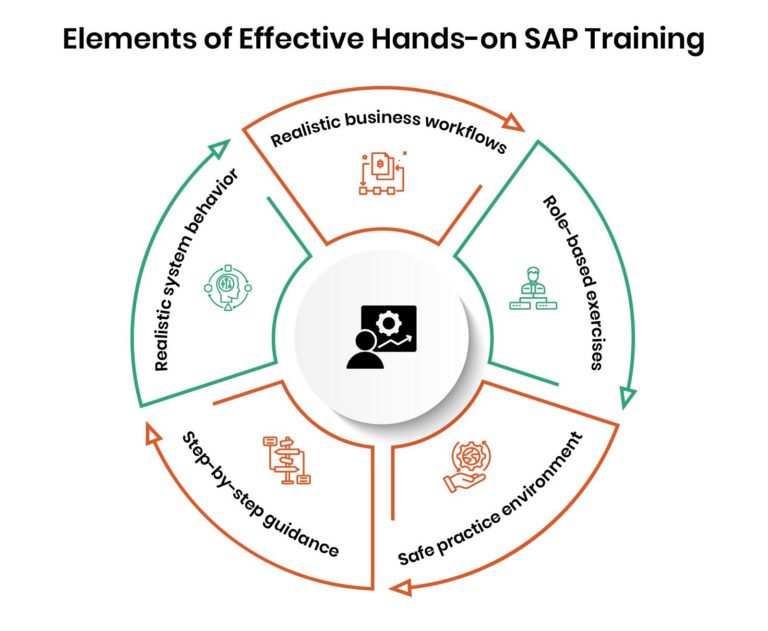
Not all hands-on SAP training delivers the same value. Effective SAP S/4HANA training exercises share several essential elements.
Realistic business workflows
Exercises must represent complete business processes rather than discrete clicks. For instance, the formulation, approval, processing of purchase orders, receipt of items, and posting of invoices should all be part of a procure-to-pay procedure. This aids in consumers’ comprehension of dependencies and context.
Role-based exercises
SAP is used differently by various roles. The training paths of a procurement manager, warehouse supervisor, and finance analyst shouldn’t be the same. Information overload can be avoided, and relevance is ensured through role-based SAP S/4HANA user training.
Error-free practice environment
Users need a safe setting so they may experiment without endangering actual data. With Assima Train learners can experiment, make mistakes, and try again in an safe environment. This is especially important in financial processes and compliance-related tasks.
Step-by-step guidance and repetition
Clear instructions facilitate learning, especially for inexperienced users. Giving users step-by-step instructions helps them understand not just what to do but also why each step is crucial. Repetition improves accuracy and confidence over time.
Realistic system behavior
Effective SAP training simulations must behave like the real system. Fields should validate data correctly. Workflows should follow real rules. This realism prevents surprises during go-live.
Together, these elements transform hands-on SAP S/4HANA training from basic practice into meaningful preparation that supports adoption and performance.
Discover proven approaches to hands-on SAP training that actually work.
4. Common Gaps in Traditional SAP Hands-on Training
Many organizations attempt hands-on SAP training using sandboxes or shared training systems. While these environments provide access to SAP functionality, they introduce several limitations that affect effectiveness and scalability.
The table below highlights common gaps and their impact on training outcomes:
| Challenge Area | Traditional SAP Training Limitation | Impact on Users |
|---|---|---|
| Sandbox availability | Limited access and shared usage | Inconsistent practice time |
| Environment maintenance | Frequent refreshes and resets required | High IT effort and delays |
| Scalability | Difficult to support large or global teams | Uneven training experience |
| Cost | High infrastructure and support expenses | Training scope often reduced |
| Timing | Environments ready close to go-live | Limited retention before production use |
Sandbox environments also introduce risk. Users may accidentally affect shared data or block others from practicing. As a result, organizations often restrict access, reducing hands-on exposure for many employees.
Additionally, multilingual and role-based learning are difficult to offer at scale in traditional SAP training settings. Training quality varies by location as teams grow internationally.
These difficulties show why a lot of companies go beyond sandboxes. They require safer, more scalable, and easier-to-maintain SAP training methods. This is where simulation-based SAP S/4HANA training provides a more reliable alternative.
5. How Assima Train Enables Better Hands-on SAP S/4HANA Training
Assima Train enhances hands-on SAP S/4HANA training by removing the limitless of traditional training environments and replacing them with realistic, scalable simulations.
Assima Train builds high-fidelity simulations straight from actual SAP systems rather than using sandboxes. With the help of these simulations, which replicate real screens, fields, and processes, users may rehearse precisely how they would operate in production without having to deal with real data.
This approach delivers several advantages.
Realistic practice without system risk
Users complete end-to-end SAP workflows in a safe environment. They can repeat tasks, correct mistakes, and build confidence without affecting business operations.
Faster readiness before go-live
Teams rehearse critical processes before deployment. For example, finance teams can practice period-end activities, while supply chain users prepare for inventory and planning workflows. This reduces post-go-live errors and hesitation.
Consistent training at scale
Assima Train delivers the same hands-on experience to users across regions, roles, and locations. Training teams maintain one source of truth, ensuring accuracy and alignment.
Role-based and multilingual delivery
Organizations tailor simulations to specific job roles while supporting multiple languages. Content is created once and deployed globally without rebuilding workflows.
Simplified updates as systems evolve
When SAP S/4HANA changes, training teams update simulations quickly without re-recording content. This keeps training aligned with system updates and reduces IT workload.
By combining realism, scalability, and safety, Assima Train turns hands-on SAP S/4HANA training into a continuous enablement strategy rather than a one-time event.
6. Best Practices for SAP S/4HANA Hands-on Training Programs
In order to optimize the effectiveness of practical SAP S/4HANA training, companies should adhere to tried-and-true best practices that mirror user behavior:
- Align exercises with real job roles and responsibilities
Training ought to be similar to what SAP employees perform on a daily basis. Planners should concentrate on forecasting and MRP tasks, procurement teams should work through purchasing cycles, and finance users should practice posts and reconciliations. Role-based relevance avoids overburden and maintains training concentration.
- Focus on high-impact workflows that affect daily operations
Give priority to procedures including period-end closing, order processing, inventory transfers, and approvals when mistakes are expensive or common. Users can gain confidence in the tasks that are most important to business continuity by practicing these workflows.
- Introduce training early, well before go-live
Instead of learning under pressure, early exposure enables users to gradually get accustomed to the system. Go-live becomes a transition rather than a disruption when staff members practice before deployment.
- Reinforce learning through repetition and refreshers
To reinforce what you’ve learnt, use repetition and refreshers. One-time training is seldom enough. When exercises are repeated and refreshers are given, users are better able to retain information and maintain accuracy, especially when they encounter novel scenarios or system modifications.
- Measure effectiveness using completion rates, error reduction, and adoption metrics
Monitor if users finish training, make fewer mistakes, and depend less on support staff. These metrics demonstrate whether practical instruction is turning into practical expertise.
Hands-on SAP S/4HANA training delivers the strongest results when it supports users over time, not just during implementation. Continuous reinforcement helps teams stay confident and adapt as systems and processes evolve.
Conclusion
A key component of effective adoption is practical SAP S/4HANA training. Users can go beyond theory and develop confidence in carrying out actual tasks with the aid of practical exercises. Even well-designed SAP systems find it difficult to provide value without practical experience.
Training strategies that scale, remain up to date, and lower risk are essential for organizations. Assima Train offers a simulation-based solution that eliminates the overhead of sandboxes and allows for genuine SAP S/4HANA practice.
Businesses may increase preparedness, decrease errors, and optimize the return on their SAP S/4HANA initiatives by investing in practical training.