


Key Highlights
- Enterprise transformation fails more from poor adoption than poor technology.
- The “training layer” directly impacts adoption, productivity, and ROI.
- Traditional training fails because it is static, disconnected from workflows, and lacks real-time support.
- Modern training works best when it combines hands-on learning with in-app guidance and continuous reinforcement.
- Assima Train helps enterprises improve adoption through simulation-based learning and contextual guidance.
Introduction
Enterprise transformation has become a priority for organizations across industries. Companies are investing heavily in ERP systems, CRM platforms, automation tools, and data-driven technologies to improve efficiency and stay competitive.
But despite these investments, many transformation initiatives fail to deliver expected results.
The reason is rarely technology.
In most cases, failure happens at the execution level. Employees struggle to adapt to new systems; workflows remain underutilized, and organizations fall back on old processes.
This is where the “training layer” becomes critical.
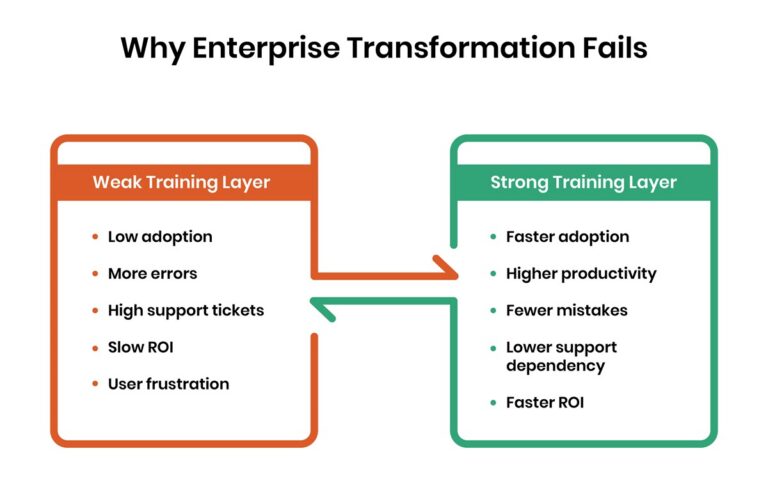
The training layer sits between system deployment and real business outcomes. When it is strong, adoption accelerates. When it is weak, transformation slows down.
Platforms like Assima Train help strengthen this layer through hands-on learning and real-time guidance.
What is Driving the Next Wave of Enterprise Transformation
Enterprise transformation is no longer just about implementing tools. It is about managing complexity on a scale while keeping the workforce aligned.
Several forces are shaping this next phase:
- Expansion of enterprise systems
Organizations are deploying ERP, CRM, and HCM platforms across multiple functions, increasing dependency on digital systems for daily operations.
- Rising operational complexity
Workflows are becoming more interconnected, which means even small errors can impact multiple departments and processes.
- Demand for agility and speed
Businesses must respond quickly to changes in markets, regulations, and customer expectations, putting pressure on systems and users alike.
- Workforce alignment challenges
Technology only works when employees understand how to use it. Misalignment between tools and users slows down transformation.
These factors make one thing clear: transformation of success depends as much on people as it does on technology.
Why Training is the Weakest Link
Most organizations invest heavily in systems but treat training as a secondary step. This creates a gap between what the system can do and what users actually achieve.
The biggest issues with traditional training include:
- Static and outdated content
Training materials often fail to keep up with system updates, leaving employees with irrelevant or incomplete knowledge.
- Learning disconnected from execution
Employees learn outside the system but are expected to perform tasks inside it, creating a gap between theory and action.
- Low retention over time
Without reinforcement, employees forget what they learned, especially when training happens long before real usage.
- Lack of real-time support
Users often struggle during workflows because guidance is not available when they actually need it.
Because of these gaps, employees may understand the system conceptually but fail to execute tasks efficiently.
Training is not failing because of effort. It is failing because it is not aligned with how people actually work.
Calculate potential savings from reducing support tickets, errors, and onboarding time across enterprise teams.
The Real Cost of Poor Training
Poor training does not just affect learning outcomes. It creates measurable business impact across the organization.
When training is ineffective, organizations typically experience:
- Low system adoption
Employees use only basic features, leaving advanced capabilities underutilized and reducing the value of enterprise systems.
- Operational inefficiencies
Tasks take longer to complete, workflows become inconsistent, and manual workarounds increase across teams.
- Higher dependency on IT support
Users rely heavily on helpdesk teams for guidance, increasing support costs and slowing down operations.
- Increased error rates
Lack of practical understanding leads to mistakes in data entry, transactions, and workflow execution.
- Poor employee experience
Employees feel frustrated and uncertain when using systems, which reduces confidence and engagement.
These issues compound over time, ultimately delaying ROI from transformation initiatives.
In simple terms, weak training turns strong technology into underperforming systems.
How Modern Training Drives Enterprise Success
Organizations that succeed in transformation rethink training as a continuous, embedded process rather than a one-time activity.
Modern training works because it aligns learning with real work.
What Makes Modern Training Effective
- Hands-on learning
Employees practice real workflows instead of just reading instructions, which improves retention and builds confidence.
- In-app guidance
Users receive step-by-step support while performing tasks, reducing errors and improving accuracy.
- Scalable delivery
Training programs can be deployed across global teams while maintaining consistency.
- Continuous reinforcement
Learning does not stop after onboarding. Employees receive ongoing support as systems evolve.
These elements directly impact business outcomes by improving adoption, reducing errors, and increasing productivity.
When training evolves, transformation outcomes improve.
How Assima Train Powers the Training Layer
Assima Train strengthens the training layer by enabling organizations to move from passive learning to active user enablement.
Key Capabilities of Assima Train
- Simulation-based learning
Employees practice workflows in realistic environments without affecting live systems, building confidence before real execution.
- Real-time contextual guidance
Users receive support during tasks, helping them complete workflows correctly and independently.
- Global scalability
Training programs can be deployed across regions, roles, and languages without compromising consistency.
- Reduced training costs
Organizations eliminate the need for complex training infrastructure while improving learning effectiveness.
These capabilities help organizations shift from reactive support models to proactive enablement.
The result is faster adoption, fewer errors, and stronger transformation outcomes.
Best Practices for Strengthening the Training Layer
Organizations can improve transformation success by building a structured and measurable training strategy.
Recommended Practices
- Align training with transformation goals
Ensure that learning programs directly support business objectives and system usage.
- Define clear KPIs
Track metrics such as adoption rates, task efficiency, and error reduction to measure impact.
- Adopt continuous learning models
Provide ongoing support instead of relying on one-time training sessions.
- Integrate learning into workflows
Deliver guidance where employees actually perform tasks.
When training becomes part of daily work, adoption improves naturally.
Conclusion
Enterprise transformation is no longer just about deploying new systems. It is about ensuring that employees can use those systems effectively.
The training layer determines whether transformation succeeds or fails.
Organizations that invest in strong training strategies see higher adoption, better productivity, and faster ROI. Those that overlook it struggle to realize the full value of their investments.
By focusing on hands-on learning, real-time support, and scalable training programs, enterprises can close the gap between technology and execution.
If you want your transformation to work, fix the training layer first.