

Introduction
Key Highlights
- SAP rollouts fail more from poor user readiness than poor technology implementation.
- Enterprise training infrastructure is an ongoing enablement system, not just one-time training content.
- Weak training infrastructure leads to productivity loss, retraining costs, support tickets, and delayed ROI.
- Simulation environments, in-app guidance, analytics, and scalable delivery are essential components of effective training infrastructure.
- Assima Train helps enterprises reduce SAP rollout risk, lower support costs, and improve adoption outcomes through scalable simulation-based learning.
And then adoption stalls, support tickets pile up, and the ROI that was promised in the original business case quietly disappears.
Not a one-time course. Not a pre-go-live workshop. An actual system that supports people before, during, and long after a rollout. One that scales, adapts, and keeps working as the technology evolves.
Why Training Programs Fail Without Infrastructure
There is a fundamental difference between training and training infrastructure. Most organizations invest in the former while ignoring the latter entirely.
Workers participate in meetings, finish modules, and perhaps pass an exam. After the system goes live, a lot of what they learnt has vanished in a matter of weeks. People forget most new information within days unless it is reinforced in context, according to numerous studies on learning retention.
That is not a human issue. That is an issue with infrastructure.
Even well-designed training fails if there is no mechanism in place to reinforce learning in the course of work, offer real-time help when employees run into problems, and adapt to how people really use the software.
The common failure points look like this:
- Employees complete training but cannot replicate tasks in the live environment
- No support mechanism exists once training ends
- Workflows change post-launch and there is no way to update guidance at scale
- New hires joining after go-live have no structured way to get up to speed
Training prepares people for a test. Infrastructure prepares them for reality. These are not the same thing, and treating them as interchangeable is one of the most expensive mistakes enterprises make.
The Real Cost of a Failed Enterprise Rollout
Before building a business case for training infrastructure, it helps to understand what the absence of it actually costs. The numbers are larger than most stakeholders expect.
Hidden Costs Most Organizations Ignore
The direct costs of a failed SAP rollout are easy to spot:
- Delayed timelines
- Consultant overruns
- Extended hypercare periods
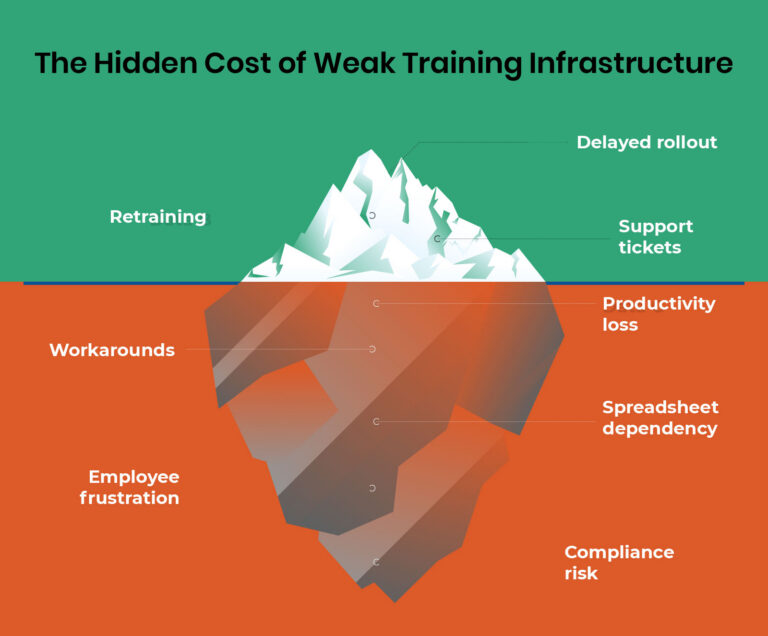
But the hidden costs are often what do the most damage.
When users are not confident in a new system, they adapt in ways that hurt the business:
| What Employees Do | What It Actually Costs |
|---|---|
| Revert to spreadsheets | Duplicate work, data inconsistencies |
| Complete tasks manually | Hours lost every single day |
| Ask colleagues for help | Two people lose productivity, not one |
| Skip steps or use workarounds | Errors that surface weeks later |
None of this shows up on a project tracker. All of it shows up on the bottom line.
Depending on the size of the workforce, productivity losses in the first six to twelve months after go-live can cost businesses hundreds of thousands to several million dollars, according to research from ERP implementation studies. That figure quickly increases for a worldwide SAP S/4HANA installation.
Impact on SAP Adoption and Productivity
Low adoption creates a compounding problem. The longer it takes for employees to become proficient, the longer the business operates below optimal efficiency. That gap has a real cost per day.
Here is a simplified way to think about it:
If a 500-person team experiences a 20 percent productivity drop for 90 days because they are struggling with a new SAP system, and the average fully loaded cost per employee is around $300 per day, the productivity loss alone approaches $2.7 million.
That does not include the cost of support tickets, retraining, or error correction. It does not include the cost of delayed reporting, billing errors, or inventory miscalculations that show up downstream.
The cost of not investing in training infrastructure is not theoretical. It is measurable, and in most cases, it dwarfs the cost of getting infrastructure right from the start.
What Is Enterprise Training Infrastructure?
The network of systems, settings, and tools that support ongoing, scalable, and efficient learning throughout a company is known as enterprise training infrastructure.
There isn’t just one product. It is an ability. Additionally, it usually consists of:
Simulation environments that mimic real software without endangering production data. Before they ever touch the live system, workers can rehearse actual operations, make mistakes, and develop muscle memory.
Real-time performance support that helps users navigate the application while they work. The system guides users through a procedure step-by-step when needed, rather than letting them figure it out on their own.
Scalable delivery mechanisms that allow training to reach global teams without requiring synchronized sessions, travel, or heavy IT involvement.
Analytics and tracking that show how employees are actually interacting with the system, where they are struggling, and where additional support is needed.
Updateable content that can be revised quickly when processes or system configurations change, without rebuilding entire training programs from scratch.
When combined, these elements form an ongoing learning system as opposed to a sequence of isolated training sessions. That distinction is what separates organizations that achieve real adoption from those that are still fighting the same problems eighteen months after go-live.
A strong SAP S/4HANA adoption strategy is built on four pillars. Each one matters. When organizations skip one, the others cannot fully compensate.
Change management is not a communication plan. That is a common misconception. Communication is part of it, but it is the foundation, not the entire structure.
Effective change management frequently begins months in advance of the launch. It determines which segments of the workforce will be most impacted, increases awareness of the reasons behind the change, and establishes channels for workers to voice concerns and get genuine responses.
It also entails finding champions within the company—individuals who are well-liked by their colleagues, truly interested in the new system, and prepared to promote the change in their daily interactions. Compared to top-down announcements, those champions do more to promote adoption.
Compliance is not the aim. There is a sincere hope that the new method would improve productivity. It is not an automatic belief. It must be earned via openness, participation, and persistent leadership.
Not every employee in a company utilizes SAP in the same manner. The training requirements of a procurement specialist processing purchase orders or a warehouse operator overseeing inventory movements are entirely different from those of a finance analyst conducting month-end closure procedures.
In an attempt to cover everything, generic training ultimately fails to adequately prepare anyone. Each user is focused on the particular workflows and transactions pertinent to their profession through role-based learning pathways. Training becomes far more effective, efficient, and relevant.
This type of focused, role-specific learning is precisely what Assima Train is designed to facilitate. To ensure that the training experience accurately mirrors the real work that employees will perform once the system goes live, organizations might design customized simulations for each user group.
This is the piece that most traditional training approaches miss entirely.
Employees can practice actual SAP procedures in a secure setting that replicates the live system thanks to simulation-based learning. Without endangering production data, they use the genuine interface, carry out real transactions, make mistakes, and learn from them. By the time they take a seat at the live system, it feels more like home than unfamiliar.
Consider it similar to a flight simulator. Without hundreds of hours of simulator training, no airline would place a pilot in the cockpit of a commercial aircraft. Complex enterprise software follows the same reasoning. One is not prepared to perform under pressure by reading a guidebook. Practice makes perfect.
Continuous Support
Training that ends at go-live is not enough.
As soon as they begin utilizing the system in their day-to-day job, employees come across new situations and edge cases. People who have access to responsive support channels, contextual assistance, and refresher content adjust more quickly and maintain improved performance over time.
Those who don’t frequently build backlogs of support tickets, devise workarounds, and subtly underuse the same features that the system was intended to provide.
Planning for the post-go-live phase with the same intentionality as the pre-go-live phase is known as continuous support. Productivity indicators and user confidence scores explicitly demonstrate the benefits of that planning.
Why Infrastructure Matters More Than Training Content
This is a point that tends to surprise L&D and transformation leaders when they first encounter it.
Most training investment goes into content. Writing scripts, building modules, designing job aids. Content is tangible. It feels productive. It is easy to report on.
But content without infrastructure is like building a road without maintaining it. It works at first, then slowly becomes unusable.
Content becomes outdated almost immediately after it is created. SAP configurations change. Processes get refined. New modules get added. Every time that happens, static training content becomes a liability rather than an asset.
Infrastructure, on the other hand, scales and adapts. A simulation environment that mirrors the live system will always reflect current workflows. Real-time in-app guidance can be updated without rebuilding an entire course. Analytics surface new gaps as they emerge rather than waiting for the next formal training review.
The organizations that consistently see strong SAP training ROI are the ones that invest in the infrastructure layer first and treat content as something that lives within that infrastructure, not as the infrastructure itself.
That is a long-term ROI perspective, and it is the right one. Training content is a depreciating asset. Training infrastructure is an appreciating one.
How to Calculate the ROI of Training Infrastructure
One of the biggest obstacles to getting budget approved for training infrastructure is the perception that ROI is hard to measure. It is not. It just requires framing the calculation correctly.
Cost of Inefficiency
Start with what poor training actually costs in terms of lost productivity. Take your average employee cost per day, multiply it by estimated productivity loss percentage during the adoption period, then multiply by headcount and duration.
Even conservative estimates tend to produce numbers that justify infrastructure investment quickly.
Formula: Average daily cost per employee x % productivity loss x number of employees x number of days = Cost of inefficiency
Cost of Retraining
Failed rollouts do not end at go-live. They generate retraining cycles. Employees who never properly adopted the system need refreshers. New hires need onboarding. Process changes require updated training.
Each of these cycles has a cost: facilitator time, employee time away from work, content development, and logistics. In large enterprises, annual retraining costs for a single SAP deployment can run into six figures.
Infrastructure reduces this by making updates faster and delivering them in the flow of work rather than through formal sessions.
Cost of Support Tickets
High volumes of IT and helpdesk tickets are one of the clearest signals that training infrastructure is missing.
When employees do not know how to complete a task, they call for help. Each ticket has an average resolution cost. Multiply that by ticket volume and you have a concrete, defensible number to bring to stakeholders.
Infrastructure that provides real-time in-app guidance can cut support ticket volume significantly.
Calculate how much your organization could save by reducing training inefficiencies, support tickets, and onboarding delays.
Building a Business Case That Gets Approved
A business case for enterprise training infrastructure fails when it sounds like a training proposal. It succeeds when it sounds like a risk mitigation and ROI story. That reframe matters more than anything else.
Aligning with Business Outcomes
Start by connecting training infrastructure directly to outcomes that executives care about. Not learning outcomes. Business outcomes.
What is the projected productivity gain from faster SAP adoption? What is the cost of delayed go-live? What is the revenue impact of billing errors or inventory inaccuracies caused by user mistakes in the system? What is the cost per support ticket, and how many are expected in the first year?
When training infrastructure is positioned as the answer to those questions rather than as a training initiative, the conversation changes entirely.
Quantifying ROI
Use the cost model from the previous section to build a simple before-and-after comparison.
Column one: what the rollout costs without infrastructure, including productivity loss, retraining, support tickets, and error correction. Column two: the same rollout with infrastructure, showing reduced costs across each category. The difference is your ROI.
Add a payback period calculation. In most enterprise SAP rollouts, training infrastructure pays for itself within the first six to twelve months when the full cost of inefficiency is properly accounted for.
Reducing Risk
Frame infrastructure as risk reduction as well as cost savings. Every SAP rollout carries risk. Go-live delays. Adoption failures. Data entry errors. Compliance issues from process deviations.
Training infrastructure directly reduces each of these risks. That is a compelling argument for risk-averse stakeholders who may not be moved by ROI calculations alone but respond strongly to the idea of protecting a major capital investment.
How Assima Train Reduces Training Costs and Risk
Assima Train was built specifically for the challenges that enterprise SAP and ERP rollouts create. It is not a generic learning platform adapted for enterprise use. It is purpose-built for the environments where traditional training consistently falls short.
Simulation-based learning without production risk. Assima creates high-fidelity replicas of live SAP environments. Employees practice real workflows, complete real tasks, and build genuine confidence without touching production systems. This eliminates one of the biggest barriers to meaningful pre-go-live preparation.
Real-time in-app guidance. When employees are working in SAP and hit a point of uncertainty, Assima guides them through the task in the moment. No need to search documentation, ask a colleague, or log a ticket. The support is there when it is needed.
No dependency on sandbox environments. Traditional simulation approaches require maintaining separate sandbox systems, which creates IT overhead and limits scalability. Assima removes that dependency, making it significantly easier to deploy training across large, geographically distributed workforces.
Faster onboarding for new users. Whether it is new hires joining after go-live or teams in new regions being brought onto the system, Assima enables faster, more consistent onboarding without requiring repeated facilitator-led sessions.
Measurable reduction in support ticket volume. Enterprises using Assima typically see meaningful reductions in helpdesk tickets related to system usage, with many reporting cost reductions in their SAP training programs of up to 50 percent.
The result is a change management strategy that does not just survive go-live. It keeps delivering value as the organization grows and the system evolves.
Use Cases: Where Training Infrastructure Delivers ROI
SAP S/4HANA Rollouts
One of the most difficult and expensive transformation projects an organization can undertake is a S/4HANA migration. Users in supply chain, operations, finance, and procurement must all adjust at the same time, which has a huge influence on the workforce.
The basis for handling that complexity at scale is provided by training infrastructure. Before going live, users can rehearse in simulation environments. Real-time guidance on platforms like Assima in-app search reduces errors during the transition. In order to provide support where it is most required, analytics show where adoption is falling short.
ERP Upgrades and Module Expansions
Even businesses that now use SAP encounter continuous training difficulties as they add modules, update versions, or modify procedures. Static training materials are unable to keep up with the new gaps created by each update.
Upgrades do not result in costly retraining cycles when the infrastructure facilitates quick content updates and provides assistance in the work flow.
Global Workforce Training
Traditional training methods are unfeasible when deploying SAP across many areas due to logistical, linguistic, and time zone issues.
Global rollouts are much easier to handle with scalable infrastructure that doesn’t require synchronized sessions or centralized facilitation. Within the systems they actually use, employees in various locations receive consistent, current guidance in their own language at their own pace.