

Introduction
Key Highlights
- Traditional onboarding methods fail because employees need practical system experience, not just static content.
- Effective onboarding software should deliver role-based learning, hands-on practice, and in-context guidance.
- Scalable onboarding platforms help enterprises standardize onboarding across regions, teams, and languages.
- Analytics and continuous improvement are critical for reducing onboarding friction and improving employee readiness.
- Assima Train enables simulation-based onboarding with realistic workflows, multilingual delivery, and scalable enterprise deployment.
These days, employee onboarding software features directly affects how quickly employees ramp up and how supported they feel during the process. Selecting the appropriate platform involves more than just HR considerations. Engagement, performance, and long-term retention are all directly impacted.
Why Choosing the Right Employee Onboarding Software Matters
When employees feel that their onboarding experience is stressful or unorganized, it starts affecting their perceptions of their roles. New hires will hesitate in their day-to-day work, make costly mistakes, and rely disproportionately on others for assistance. That annoyance may eventually result in disengagement.
In today’s business, traditional onboarding techniques are ineffective. Classroom sessions delay productivity. PDFs are frequently ignored. Real tasks are rarely reflected in recorded demos. The experience of shadowing differs greatly from person to person since it depends on availability and regularity.
Think of onboarding like learning a new route to work. Reading directions helps, but confidence comes from driving the route yourself with clear guidance. Employees need that same kind of support when learning systems they use every day.
Modern onboarding software delivers repeatable, role-aware experiences at scale. Every hire gets the same foundation, regardless of location or start date. Managers and support teams also benefit, since they no longer act as the default trainers for every new employee.
For enterprises, the right onboarding software protects productivity, improves retention, and helps employees contribute sooner and with confidence.
Top 5 Employee Onboarding Software Features to Look For
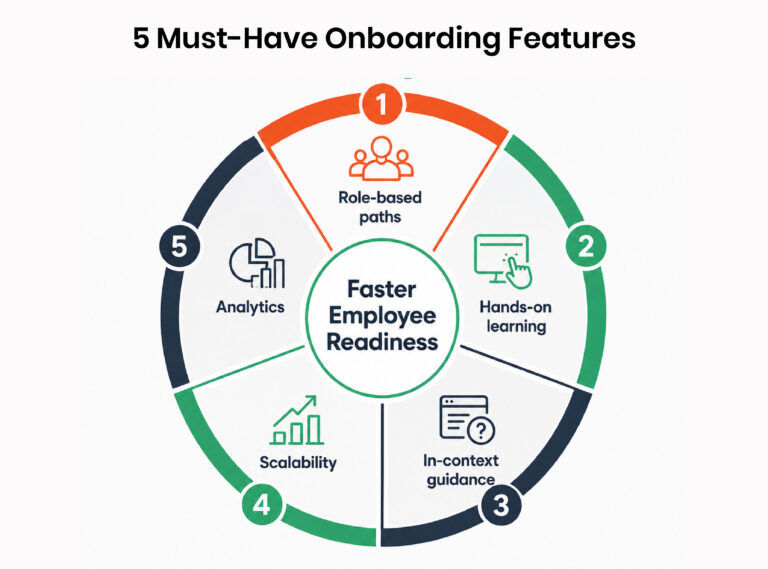
- Role-Based Onboarding Paths
Not all employees must acquire the same knowledge. Systems are used differently by an operations manager, a finance analyst, and a sales representative. This is taken into account by good onboarding software.
Role-based onboarding programs concentrate on teaching each role’s key competencies. The platform walks staff members through the workflows they will utilize on a daily basis rather than overloading them with general system overviews.
It’s comparable to training for sports. A goalie does not train in the same way as a striker. Learning feels targeted, useful, and simpler to assimilate when onboarding is in line with the position.
- Interactive, Hands-On Learning
People learn best by doing. Reading instructions or watching a video only goes so far, particularly when dealing with complex systems. Interactive onboarding software helps employees practice things instead of merely seeing them.
Hands-on learning builds confidence quickly. When users click through workflows and see real outcomes, they develop muscle memory. Practicing a task a few times during onboarding often removes hesitation later.
It’s like learning to cook. Reading the recipe helps, but cooking the dish yourself is what makes it stick.
- In-Context Guidance Inside Systems
Strong onboarding software supports employees while they work, not outside the system. Instead of searching for help in separate tools, users receive guidance exactly where they need it.
In-context guidance reduces errors and frustration. It keeps employees focused and helps them complete tasks correctly the first time. Even small prompts, like highlighting the right field or explaining the next step, can prevent common mistakes early on.
This feels like having a mentor nearby, offering guidance when needed without interrupting the flow of work.
- Scalability for Global and Growing Teams
Onboarding must work at scale. Enterprises hire across regions, languages, and departments. Software that cannot scale quickly becomes a bottleneck.
Scalable onboarding software allows teams to build onboarding once and deploy it globally. It supports localization and role variations without recreating content.
Think of modular furniture. You reuse the same core pieces and arrange them differently depending on the space. The structure stays consistent while adapting to local needs.
- Measurement and Continuous Improvement
Onboarding becomes a guessing game in the absence of data. Effective onboarding software keeps track of completion, progress, and common problems so teams may get better over time.
Metrics like time to proficiency or recurring errors highlight where employees struggle. Before minor problems grow into more serious ones, training staff can modify the content.
This feedback loop functions similarly to a dashboard. To make wise choices and change your direction when necessary, you need visibility.
How Assima Train Supports Modern Employee Onboarding
Assima Train treats onboarding as a practical experience, not a content dump. Instead of static materials, it offers simulation-based onboarding that mirrors real systems and workflows.
New hires practice tasks in realistic simulations that behave like live applications. They click, type, and complete workflows safely, without touching production data. This builds confidence before real work begins.
Assima Train also supports learning during work. Employees receive guidance while completing tasks, reinforcing correct actions and reducing reliance on manuals or support teams.
For enterprises, scalability matters. Assima Train supports onboarding across roles, departments, and regions from a single platform. Training teams create content once and deploy it globally, with multilingual support built in.
As systems evolve, teams update simulations quickly so onboarding stays aligned with reality. It works much like a flight simulator. Pilots practice before flying. Employees practice before working in live systems.
Best Practices for Successful Employee Onboarding
Successful onboarding starts early and continues beyond day one.
| Best Practice | What It Means in Practice | Why It Matters |
|---|---|---|
| Start onboarding before day one | Share access, expectations, and foundational training early | New hires arrive prepared, not overwhelmed |
| Support learning inside workflows | Guide employees while they complete real tasks | Learning feels practical and immediately useful |
| Measure onboarding outcomes | Track adoption speed and error reduction | Teams know what to improve |
| Reinforce learning over time | Provide refreshers as systems and roles evolve | Knowledge stays accurate |
| Treat onboarding as ongoing support | Extend guidance into daily work | Builds long-term confidence |
Conclusion
The employee onboarding software that is right fit for your company help employees feel capable rather than overwhelmed. Role-based routes, hands-on practice, contextual help, scalability, and assessment convert onboarding into something that really prepares people for real-world work.
For businesses managing complex systems and distributed teams, onboarding must scale without losing relevance. Assima Train contributes to this by combining realistic simulations, practical instruction, and worldwide distribution.
Choosing platforms with the right employee onboarding software features ensures faster readiness, stronger engagement, and scalable onboarding success.
Explore Assima Train and start building a resilient digital workforce today.
Frequently Asked Questions
Let’s Answer Some of Your Questions.
Onboarding software for enterprises must support global hiring, localization, and role-based paths while maintaining consistency across teams.
Assima Train is a digital onboarding solution that combines simulations, workflow guidance, and global deployment to create practical learning experiences.