

Key Highlights
- The forecast you cannot trust is rarely a software fault. It is the visible edge of an adoption gap, because a CRM only ever reflects what reps put into it, whether you run Salesforce, HubSpot, Zoho CRM, or another platform.
- Bad CRM data is widespread: 76 per cent of organisations say less than half of theirs is accurate and complete, and 37 per cent report losing revenue as a direct result (Validity). Poor data is not a technology fault; it is what low adoption looks like.
- Bad data is a behaviour problem, not a cleanup project. Reps skip or rush entry because it interrupts selling, and a one-off scrub decays again by the next quarter if the entry habit does not change.
- AI raises the stakes. CRM vendors are building agents into the platform, and an agent acting on unreliable data automates bad decisions faster. Getting data entry right stopped being hygiene and became the foundation.
The pipeline nobody believes
A sales leader opens the forecast before a board meeting and cannot take it at face value. Deal stages that have not moved in weeks, close dates already in the past, opportunities with no contact attached, amounts that look like placeholders. The instinct is to blame the CRM or to order a data cleanup. Both miss the cause, which is that the system is doing exactly what it was told. It reflects what reps entered, and reps enter what the workflow makes easy and what they have been trained and prompted to record.
This is the uncomfortable truth behind most CRM disappointment, and it holds across platforms. When a CRM underperforms, the cause is rarely the software; it is that people do not use it as intended, and the symptom shows up as data. In Validity’s 2025 survey of CRM users and administrators, 76 per cent said less than half of their organisation’s data is accurate and complete, and 37 per cent had lost revenue as a direct result. A CRM that no one populates properly is not a reporting tool. It is an expensive guess.
A licence buys capability, not value
You buy a CRM for pipeline visibility, cleaner forecasting, tighter handoffs, and now automation and AI on top. Every one of those outputs is a function of the same input: the data reps type in as they sell. When that input is thin, none of the outputs can be trusted, however well the platform is configured, and that is true whether the badge on the login screen says Salesforce, HubSpot, or Zoho.
The gap is easy to underestimate, because leaders and users see different pictures: most executives believe their teams have adequate data, while the people entering it know otherwise (Validity). Organisations respond by customising: more fields, more automation, more dashboards. None of that changes what a rep does at four o’clock with three more calls to make. Configuration shapes the container. It does not decide whether anyone fills it.
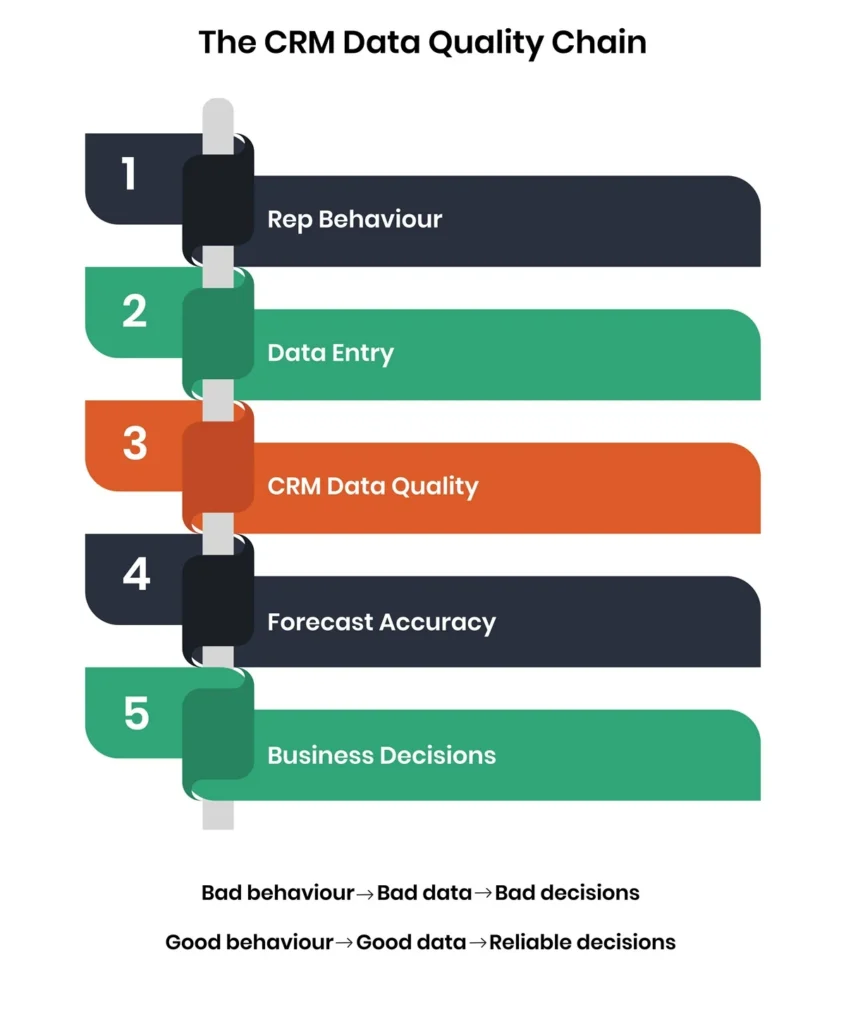
Bad data is a behaviour problem
The data goes wrong for a reason, and it has little to do with carelessness. Entering a deal properly interrupts the thing a rep is measured on, which is selling. Reps already spend most of their week not selling: only around 28 to 30 per cent of their time goes to active selling, with the rest lost to admin, internal meetings, and manual data entry (Salesforce, State of Sales). So when a screen asks for more, the rational move under quota pressure is to do the minimum: leave the stage untouched, guess the close date, keep the real pipeline in a private spreadsheet or in their head. Every one of those shortcuts is a small, reasonable decision that adds up to a forecast leadership cannot use.
That is also why the standard fix fails. A data cleanup resets the symptom for a quarter, then the same entry habits refill the CRM with the same gaps. Unless the behaviour at the point of entry changes, you are paying to clean the same data twice a year. The problem was never the state of the data. It was the moment the data is created.
The stakes just rose, because AI reads the same data
For years, poor CRM data was a reporting nuisance you could work around with a few careful calls before the forecast went up. That grace period is closing. CRM vendors are pushing agents into the platform itself, from Salesforce Agentforce to the assistants now shipping in HubSpot, Zoho, and the rest, and Gartner expects around a third of enterprise applications to include agentic AI by 2028, up from less than one per cent in 2024. An agent does not just report on your data. It reads it, acts on it, and writes more of it back.
An agent is only as reliable as the records it works from. Point one at a pipeline full of blank stages and stale close dates and it will prioritise the wrong deals, message the wrong contacts, and do it at a speed no human reviewer can catch. The data is not ready for this: 45 per cent of organisations say their CRM data is not prepared for AI (Validity). It is worth remembering that Gartner also expects more than 40 per cent of agentic AI projects to be cancelled by the end of 2027, citing escalating costs, unclear business value, and weak controls. A model acting on data your own team does not trust is a fast route into that statistic. The sloppy data entry you tolerated as a reporting problem is now the foundation the AI stands on.
Weighing what better CRM adoption is worth before you add AI? Our ROI calculator estimates the training time and cost you could recover.
Fix it where the selling happens
If bad data is made at the point of entry, that is where it has to be fixed, not in a downstream scrub or another mandate from management. That means changing two things: how reps are trained, and what the screen does while they work. Neither is tied to one CRM brand.
Start by training reps on the real selling process rather than a tour of the interface. A walk through the menus teaches navigation. A run through the actual sequence, creating the opportunity, moving it through the right stages, logging the activity that the forecast depends on, teaches the job. Assima Train builds that practice on an editable, true-to-life clone of your own CRM. Because Assima captures the live application at the object level, the same approach works on Salesforce, HubSpot, Zoho CRM, or another web-based system, rather than being tied to one vendor. A rep rehearses the full flow, exceptions included, before touching live pipeline, so correct entry becomes habit in a place where a mistake costs nothing. The results are on record. When a major retail bank rolled out a new CRM for its mortgage process, it trained more than 3,000 branch, contact-centre and sales staff on clones of the live system before go-live, so they could work in it correctly from day one, and it saved roughly three million dollars against building a traditional training environment. The pattern scales: when the energy group ENGIE upgraded the SAP CRM that thousands of its people depend on, it moved 4,000 internal and partner staff onto the new release over a single weekend, having rehearsed them on clones first, so they worked in it from Monday morning with no lost productivity, and at a fraction of the up to one million euros a traditional training build would have cost.
The other half is guiding and checking entry inside the live system. Assima Assist prompts a rep through the step at the moment they are on it, and Assima In-App Search brings your own process guide onto the screen they are already working in, so the answer arrives without a call to an admin. Business rules and input validation catch a bad entry as it is made rather than at quarter-end, which is the difference between preventing bad data and cleaning it up later. Assima is explicit that this is the point: increase adoption, enforce business rules, and validate critical inputs so the data is right the first time.
None of this is a one-off. Cloud CRMs ship several releases a year, so the training and in-app guidance have to move with them, which is far easier when the content sits on an editable clone rather than a pile of screenshots that go stale at the next update.
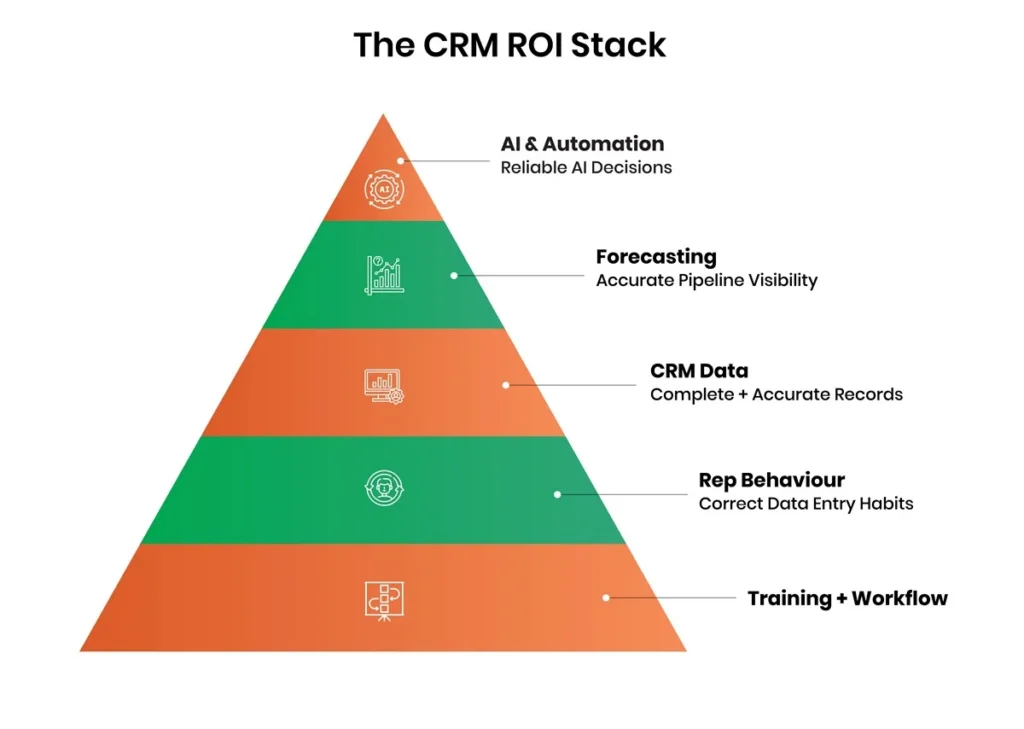
Measure the thing that matters
Login counts and course completions tell you almost nothing about whether the data can be trusted. Two measures do. First, completeness and accuracy on the fields that drive the forecast: stage, close date, amount, next step. Second, capability: can a rep take a real opportunity from creation to close with the record correct at every stage, on their own? Answer those two and you will know whether your pipeline is a picture of reality or a hopeful sketch, long before the board meeting where it matters.
Conclusion
Low CRM adoption is not a technology problem you can configure your way out of, and it is not a data problem a cleanup can solve for more than a quarter. It is a behaviour problem, decided in the seconds when a rep chooses how much to record about a live deal. Change what happens in that moment, through practice on a realistic copy and guidance inside the live system, and the data follows. That was always worth doing for a forecast you could believe. With AI now reading and acting on the same records, it has become the thing your entire CRM investment rests on, whatever platform that investment is built on.
See Assima on your own systems. Book a demo for hands-on practice your team actually retains.
Frequently Asked Questions
Let’s Answer Some of Your Questions.
Because a CRM reflects what reps enter, and under quota pressure many enter the minimum: untouched stages, guessed close dates, blank contacts. The platform is working correctly; the data going in is the weak point. In Validity’s 2025 survey, 76 per cent said less than half of their CRM data is accurate and complete, and this holds across Salesforce, HubSpot, Zoho, and the rest.
Mostly a training and workflow problem. Poor user adoption is the leading cause of CRM failure, ahead of integration and complexity, and adding more configuration rarely changes what a rep does day to day. Training on the real selling process, plus guidance at the point of entry, moves the number that matters.
No, and it raises the stakes. An agent acts on the records it reads, so poor data means faster, automated bad decisions. Gartner expects a third of enterprise applications to include agentic AI by 2028, and over 40 per cent of agentic AI projects to be cancelled by 2027. Reliable data has to come first.
Fix it at the point of entry rather than downstream. Rehearse reps on the full selling workflow on a realistic copy of your CRM so correct entry becomes habit, then use in-app guidance, business rules, and input validation in the live system to catch errors as they happen. A one-off cleanup alone decays within a quarter.
Yes. The adoption and data-quality pattern is the same on HubSpot, Zoho CRM, Oracle, and other cloud platforms, because it comes from how reps enter data under pressure, not from any one vendor’s design. Assima captures the live application at the object level, so the training and guidance work on whichever web-based CRM you run.
By data quality and capability, not logins. Track completeness and accuracy on the fields that drive the forecast, and test whether a rep can carry a real opportunity from creation to close with the record correct throughout. Those tell you far more than course-completion reports.