

Key Highlights
- Most change management failures happen because employees struggle with adoption after go-live, not because of poor planning.
- One-time training is no longer enough for modern enterprise transformation environments.
- Traditional training methods fail because they do not prepare users for real-world execution under pressure.
- Continuous learning, workflow-integrated support, and real-time guidance improve adoption and reduce errors.
- Assima Train helps enterprises strengthen change management through simulation-based learning and in-app guidance.
Introduction
After working with dozens of enterprise technology rollouts, one pattern keeps showing up: organizations put serious effort into digital transformation, and still end up with low adoption.
The frustrating part? It is rarely about effort. Most teams are working hard. The problem is where that effort is going.
CIOs today are managing environments that are genuinely complex. ERP systems, cloud migrations, new workflows layered on top of old ones. Employees are being asked to learn faster while still hitting their numbers. That tension is real, and traditional change management approaches were not built to handle it.
1. Why Change Management Still Fails
Most change management programs do not fail because of bad planning. They fail because what looks good on a roadmap does not survive contact with the real world.
At the leadership level, everything feels aligned. There is a vision, a timeline, a communication plan. But down on the floor, employees are dealing with something very different. The new system feels foreign. The process is not obvious. And there is still pressure to get work done while figuring it all out.
That is where frustration takes hold.
An employee can sit through training, pass an assessment, and still freeze up when they actually try to complete a task in the live system. Without ongoing support, even the best training starts to fade within days.
The other issue is how change tends to get framed as an event with a finish line. Go-live happens, the project team celebrates, and then everyone moves on. But for the people actually using the system, that is when the hard part starts.
Environments move too fast now for that kind of approach to work.

2. Top Change Management Mistakes CIOs Make
Mistake 1: Treating Change as One-Time
A lot of CIOs still run change management like a project phase that ends at go-live. Training wraps up before launch, success gets measured on how smooth the rollout was, and that is that.
But what happens three months later when usage drops off? Or when a process changes and no one has been prepared for it?
Change does not stop at go-live. That moment is actually where the real work begins. Without reinforcement, people forget. Without follow-up, adoption becomes inconsistent. The metrics that looked fine at launch start looking very different over time.
Mistake 2: Ignoring User Experience
Enterprise systems are complex by nature. That part is expected. What often gets missed is how that complexity lands for the people using it.
Training doesn’t stick if it seems unrelated to what employees really accomplish at work. Adoption slows down in ways that are difficult to undo, people become bewildered, and they become frustrated.
A good change management plan must take into consideration not only the system’s configuration but also how users interact with it.
Mistake 3: Relying on Traditional Training
manuals, lectures, and general e-learning courses. The majority of company training programs still revolve around them. It’s not that these approaches are flawed. The reason for this is that they describe the system’s operation without preparing users for what it’s really like to utilize it under pressure.
Thus, there is anxiety when an employee must finish an actual task. Additionally, that behavior eventually becomes commonplace. In large-scale enterprise rollouts, this is one of the most prevalent patterns.
See how enterprises identify adoption gaps before transformation projects lose momentum.
Mistake 4: No Real-Time Support
Questions don’t end when training does. When staff run into problems when working on actual tasks, they often have three options: look through documentation, ask a coworker, or open an IT ticket.
Everything slows things down. It produces dependencies that aren’t necessary. Additionally, it strains already overworked staff. Support must be accessible when needed, not just in the weeks leading up to launch.
Mistake 5: Weak Communication
When people don’t grasp why something is changing, change initiatives lose momentum.
Uncertainty is nearly always the source of resistance. Employees will fill in the spaces on their own if they don’t understand what is changing, why it matters, and how it affects them. Usually not in manners that facilitate adoption.
Announcements are only one aspect of communication. It is about ensuring that people truly comprehend and maintaining that comprehension when circumstances change.
3. Impact of These Mistakes
The consequences show up fast.
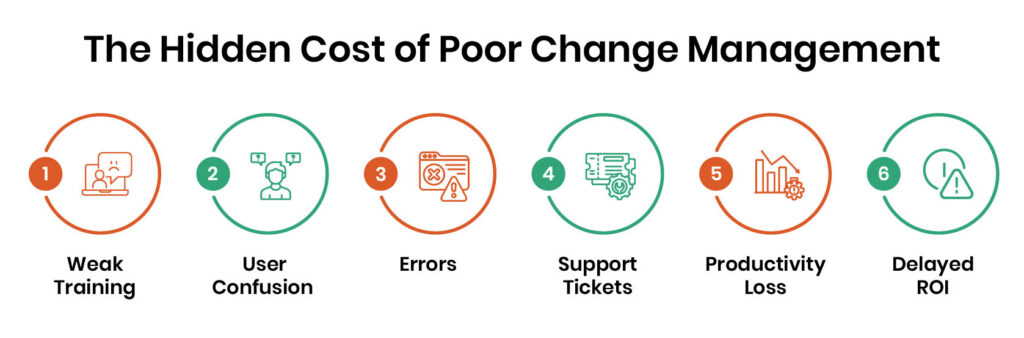
Adoption drops. Employees stick to the features they already know or fall back on old processes. Errors go up because people are unsure and improvising. Productivity takes a hit at exactly the point when you need it most.
And then the costs start compounding. More time spent on support tickets. More retraining. More manual corrections. What started as a technology initiative starts becoming a business problem.
4. What Successful CIOs Do Differently
| Focus Area | What Successful CIOs Do | Business Impact |
|---|---|---|
| Continuous Learning | Move beyond one-time training and support employees as they work | Better retention and more consistent adoption over time |
| Workflow Integration | Bring learning into everyday workflows so employees can learn while doing | Less friction and faster, more confident execution |
| Employee Experience | Design both systems and training with the user in mind, not just the process | Higher engagement and smoother adoption across teams |
| Data-Driven Decisions | Look at how people are actually using systems and fix what is not working | Ongoing improvement and smarter decision-making |
5. How Assima Train Supports Change Management
The speed and complexity of modern business are beyond the capabilities of traditional training systems.
Assima Train adopts an alternative strategy. It emphasizes real-world performance rather than learning completion. Our platform replicates real systems using simulation-based learning, allowing staff members to perform practical duties in a secure setting before ever interacting with the live system. This increases self-assurance and lowers the initial error rate.
Additionally, it offers in-app, real-time coaching that guides users through tasks while they work. Errors are decreased, and IT teams have less work to do in providing support.
One useful benefit is that Assima Train does not rely on sandbox environments, making it easier to scale across big teams.
6. Best Practices for Change Management in 2026
Based on what works in complex enterprise environments, these are the practices that consistently make a difference:
- Continuous Approach: Treat change as an ongoing process, not a one-time initiative
- Workflow Alignment: Align training with real workflows, not just system features
- Adoption Tracking: Measure how users actually interact with systems
- Data-Driven Improvement: Use insights to continuously improve training and support
- Ongoing Support: Go beyond initial training and support employees consistently
- In-Flow Guidance: Help employees while they work, not just before they start
When these are done well, organizations become more adaptable. They handle change faster, with less disruption and better outcomes.
Conclusion
Managing change has never been easy. However, the bar has shifted. Implementing a system and calling it finished is no longer sufficient. Whether individuals can utilize it, continue to use it, and adjust as circumstances change is the true question.
Real outcomes are being seen by CIOs who prioritize ongoing enablement over one-time training. They are tackling the right issue, not because they have larger budgets or greater resources.
Organizations are not transformed by technology. Individuals do. Furthermore, the transformation can never succeed if you are not making an investment to help individuals perform.
This is the exact area where enterprise teams are benefiting greatly from solutions like Assima Train.