
Key Highlights
- The entire healthcare workforce must be prepared to ensure a successful EHR migration.
- Customize Epic training to each clinician's area of expertise, duties, and key workflows to increase practical preparation.
- Make workflow differences clear so that practitioners can adopt new practices in place of old ones.
- Develop competency prior to cutover and offer continuing assistance to help clinicians adjust and regain productivity.
Introduction
Transferring patient records is not the difficult aspect of a Cerner-to-Epic conversion. It aids medical professionals in forgetting their long-standing methods.
Epic is replacing Oracle Health in major health systems across the United States. In September 2025, Intermountain Health launched Epic across 33 hospitals, while Northwell Health and UPMC have been moving forward with extensive, multi-year Epic implementations. These initiatives draw attention to a significant technological problem in healthcare: upgrading an Electronic Health Record (EHR) system necessitates retraining a whole workforce while maintaining patient care.
Clinicians have used electronic health records before. They are already familiar with managing patient data, placing orders, reviewing findings, and recording encounters. They have learned to carry out these tasks in a specific framework, which presents a challenge. It’s possible that familiar actions will no longer function the same way when the company transitions platforms.
This means that the Cerner to Epic conversion is more than just a technical data-transfer exercise, it’s a workforce retraining challenge. In order to meet a set, go-live schedule, clinicians must actively unlearn old habits while learning new workflows.
The true question for CIOs, CMIOs, CNIOs, and EHR transition executives in health systems is not just whether the new platform is ready. The question is whether others who are anticipated to utilize it are also prepared. In order to safeguard patient care during the transition and prepare physicians for Epic, health organizations should consider these useful training principles.
The Transition from Cerner to Epic Is a Workforce Event
Why are EHR platforms being switched by health systems?
These changes are clearly the result of an industry trend. Consolidating disparate technological environments, enhancing clinical setting integration, facilitating information sharing, and creating a more uniform digital base throughout their enterprises are the goals of health systems.
Epic’s expanding reach can also be explained by market statistics. Oracle Health controlled 21.9% of the US acute-care EHR market in 2025, while Epic held 43.7%, according to KLAS Research data released by Fierce Healthcare in May 2026. Additionally, according to KLAS, Epic was chosen by both major health systems when they made enterprise-wide EHR purchases in 2025.
These numbers reflect market share rather than the caliber of any specific installation. Oracle Health is still being effectively used by many healthcare institutions. A company’s needs, current infrastructure, and long-term goals all influence the strategic choice to switch platforms. But the scope of these choices’ merits consideration.
Thirty-three hospitals in six states were included in Intermountain Health’s September 2025 shift. While UPMC has been attempting to unite a complicated ecosystem of several EHR systems, Northwell Health has been integrating over 30 core EHRs throughout its 28 hospitals and hundreds of ambulatory clinics.
This kind of organization’s change entails much more than just implementing new software. Support teams, administrative personnel, and thousands of clinicians must adjust to new methods of operation.
Where does planning migration fall short?
Plans for EHR migration appropriately provide data translation, interfaces, security, workflow setup, and system testing for a lot of consideration. A safe transition depends on these. However, creating educational materials, setting up classes, keeping track of attendance, and getting ready for launch can all be considered additional project milestones.
That method ignores an important difference. Even if a system is technically sound, users may nonetheless find it difficult to carry out daily chores. Therefore, a technically sound implementation and a workforce enablement plan that develops practical competency prior to the changeover are necessary for a successful EHR migration.
Why It's Challenging to Retrain Clinicians on a New EHR?
Unlearning is more difficult than starting from beginning
Consider a doctor who has been using Cerner for twelve years. They are aware of where to go for patient data, how to finish paperwork, and how to navigate well-known workflows without giving each step much thought.
It’s a valuable experience. However, it may potentially complicate the transition to Epic. It’s possible that the doctor’s old routines won’t be transferred to the new system. A task that used to need a well-known series of steps can now have a new workflow. When under duress, the physician can automatically search for an outmoded feature, adhere to an antiquated procedure, or anticipate a recognizable reaction from the interface.
This is the issue of unlearning. Training needs to go beyond simply outlining how Epic operates. It must assist clinicians in identifying which behaviors are still beneficial to them, which ones need to be modified, and how the new workflow should be carried out.
Experienced users are not always more difficult to educate, but when the new system is significantly different from the old one, prior experience may make learning more difficult.
The impact of clinical care on productivity decline
There will be a period of adjustment while switching EHRs. While they get used to the new technology, clinicians can take longer to record visits, place orders, or explore records. During an EHR transition, the American Medical Association (AMA) specifically advises planning for decreased clinical productivity, including lowering clinical volume during go-live where appropriate. Additionally, it warns that recovery may take longer than the first few weeks, depending on the organization and how it is implemented.
This results in fewer appointments, more demands on clinical teams, postponed administrative tasks, and more operating expenses for a hospital or health system. Promising that productivity won’t decline should not be the goal. Better planning and ongoing assistance should be used to make the interruption as short-lived and controllable as possible.
Patient safety cannot be neglected in medical field
EHR problems can have repercussions that go beyond annoyance or lost time. Hospital employees experienced problems with missing or erroneous information, trouble locating crucial information, and information being recorded into the incorrect patient record, according to research published in BMC Health Services Research. The results highlight the importance of usability, training, and support for safe clinical practice.
This does not imply that all training gaps result in clinical errors. It implies that during actual patient care, health systems shouldn’t let physicians learn new workflows by making mistakes. Early detection of learning gaps, practice opportunities, and support for real-world issues are the safest strategies.
Training Lessons for Health Systems Transitioning from Cerner to Epic
Clinician preparation is viewed as a fundamental implementation requirement rather than a last-minute task in an effective EHR change management plan. Health systems may make better plans with the aid of these six lessons.
Lesson 1: Don't Just Learn, Plan for Unlearning
Conventional Epic EHR training frequently concentrates on teaching the new system, including where to locate features, how to input data, and how to finish routine activities.
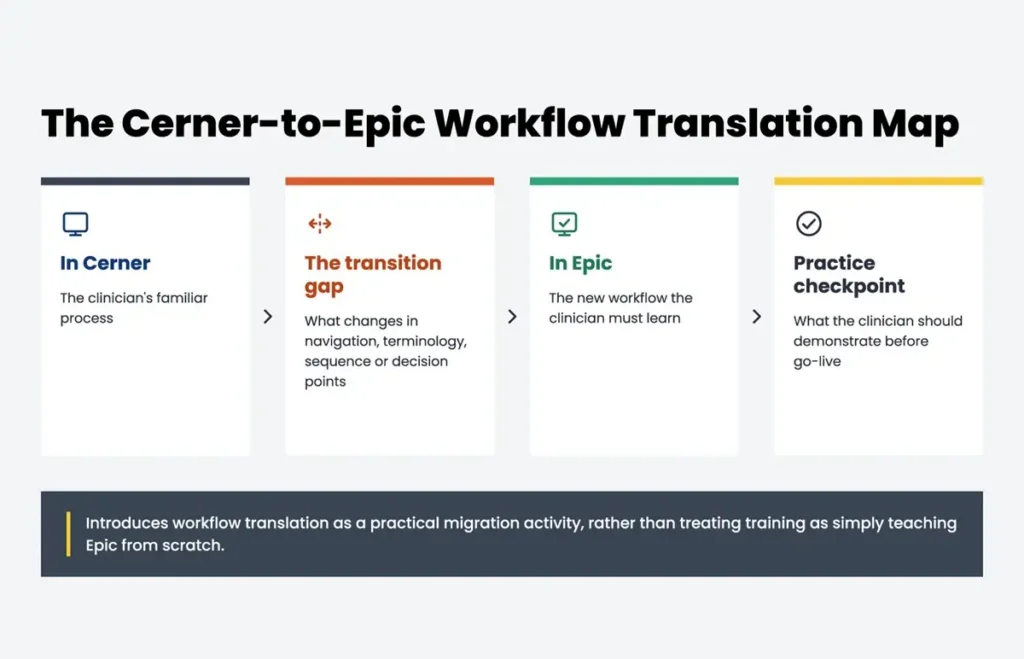
That is barely half of the work for professionals who are leaving Cerner. Training should clearly link well-known Cerner workflows to their Epic counterparts. The learning materials should clarify how the associated Epic workflow varies, for instance, if a physician has previously followed a specific order to evaluate outcomes and finish documentation.
Lesson 2: Make Training Role-Specific
All members of a healthcare workforce cannot be sufficiently prepared by a generic EHR course. The way a surgeon, ER nurse, hospitalist, and primary care physician engage with the system varies. They have different priorities, workflows, and time constraints.
These variations should be reflected in the training curriculum. For each function and expertise, start by mapping the most crucial workflows. Determine whether tasks are time-sensitive, frequent, or have significant consequences if completed poorly. Then, instead of requiring everyone to do the same system-wide tour, create learning pathways centered around those activities.
Incorporate critical but less regular workflows as well. Even while a practitioner is familiar with routine documentation, they might not know how to handle referrals, discharges, or exceptions. Role-specific training helps clinical education teams concentrate their attention where it is most needed and makes learning more meaningful.
Lesson 3: Allow Practice Before Cutover for Clinicians
Observing a demonstration is not the same as carrying out a workflow on your own. Clinicians must be given the chance to learn how to use the new EHR, make decisions, fix errors, and repeat tasks until they can do them with assurance. However, practice must be conducted in a setting that doesn’t compromise clinical operations or reveal real-time patient data. This is where EHR simulation that is realistic can be useful.
Learners can practice typical workflows using synthetic or anonymized data in a simulated Epic environment without performing exercises on actual patient records. Simulations also aid in preparing prior to the completion of the final production environment, depending on the implementation and training strategy.
Lesson 4: Assess Ability Rather Than Training Completion
Completing a course does not guaranty that a physician can carry out the necessary process on their own. Program administrators can determine who has taken part in training by looking at attendance records and learning management system completion rates. They don’t determine people’s ability to perform crucial activities reliably and accurately on their own.
Health systems should provide quantifiable competency requirements for important workflows prior to go-live. The results can then be used to direct specific remediation. Training teams can fill in the specific gaps if one group has trouble entering orders while another requires more practice with documentation. This is the distinction between proving that the workforce is prepared and merely stating that everyone attended training.
Lesson 5: Keep Up Your Training After Go-Live
After the new EHR is used as the system of recording, training shouldn’t stop. Classroom lessons and practice situations may not entirely anticipate the questions that arise during the first few weeks of actual clinical use. Clinicians come across new instances, notice variances in process, and require assistance putting what they have learned into practice.
However, the necessity of continuous assistance is frequently disregarded. Refresher training, access to knowledgeable support personnel, workflow-specific advice, and chances to deal with persistent issues should all be included in a useful post-go-live program. As the EHR is improved or updated, it ought to change as well. Even someone who was previously proficient may need to learn something new when a workflow is altered.
Switching to Epic? Book a demo and see how Assima builds clinician confidence before cutover.
Frequently Asked Questions
Let’s Answer Some of Your Questions.
Use realistic simulations, specialty-specific training, and old-to-new workflow comparisons to assist clinicians identify discrepancies and replace old behaviors before going live.
Simulation enables physicians to practice critical Epic workflows in a secure setting, identifying skill gaps and fostering practical confidence without the need for real patient records.
Instead of focusing only on course completion, evaluate clinicians on crucial, role-specific workflows. Prior to the shift, use competency results to pinpoint any gaps and offer focused practice.
Real-world clinical scenarios highlight issues that pre-go-live training can overlook. Clinicians can adjust, maintain proficiency, and regain productivity with the support of ongoing coaching, refresher courses, and peer support.