

Introduction
Key Highlights
- AI adoption is accelerating faster than workforce readiness.
- Agentic AI requires supervision, judgment, and accountability, not just tool skills.
- Informal training cannot prepare employees for high-stakes AI workflows.
- Realistic simulations build confidence in supervising and validating AI outputs.
- Role-based training prepares employees for their specific AI responsibilities.
- In-app guidance reinforces safe AI practices after deployment.
Adoption is accelerating. Readiness is not. The gap between the AI your bank bought and the capability of your workforce to use it safely is the risk that informal training will not fix.
Your bank has adopted agentic AI. Autonomous systems that act and decide with minimal human oversight are now inside your workflows. The board approved the investment, the vendor completed the deployment, and the pilot metrics impressed everyone in the room. Here is the question that determines whether the investment delivers: does your workforce know how to work with it?
The evidence is probably not. About two-thirds of banks rely on informal staff training to help employees use new AI models, according to American Banker’s April 2026 research on AI adoption in banking. At the same time, 57% of organizations say they lack the internal capabilities to take advantage of agentic AI. The pressure is only building: 44% of finance teams will deploy agentic AI in 2026, a more than 600% increase from the prior year.
Technology is not a bottleneck. People are. 45% of employees doubt AI accuracy and reliability. 64% worry the technology will cost them their jobs. Both fears slow adoption in ways that a vendor briefing and an internal FAQ page cannot fix. As Philip Bruno, chief strategy and growth officer at ACI Worldwide, told American Banker: “Teaching someone to use a new tool is straightforward. Retraining instincts built over 30 years is not.”
This article is about that gap. Agentic AI demands a new kind of workforce competency, because it changes what banking staff are being asked to do. For financial services training leaders, bank CIOs, Chief AI Officers, CHROs, and Heads of Transformation and L&D, here is what the readiness gap looks like and, more importantly, how to close it.
The Adoption-Readiness Gap Is Real, and Widening
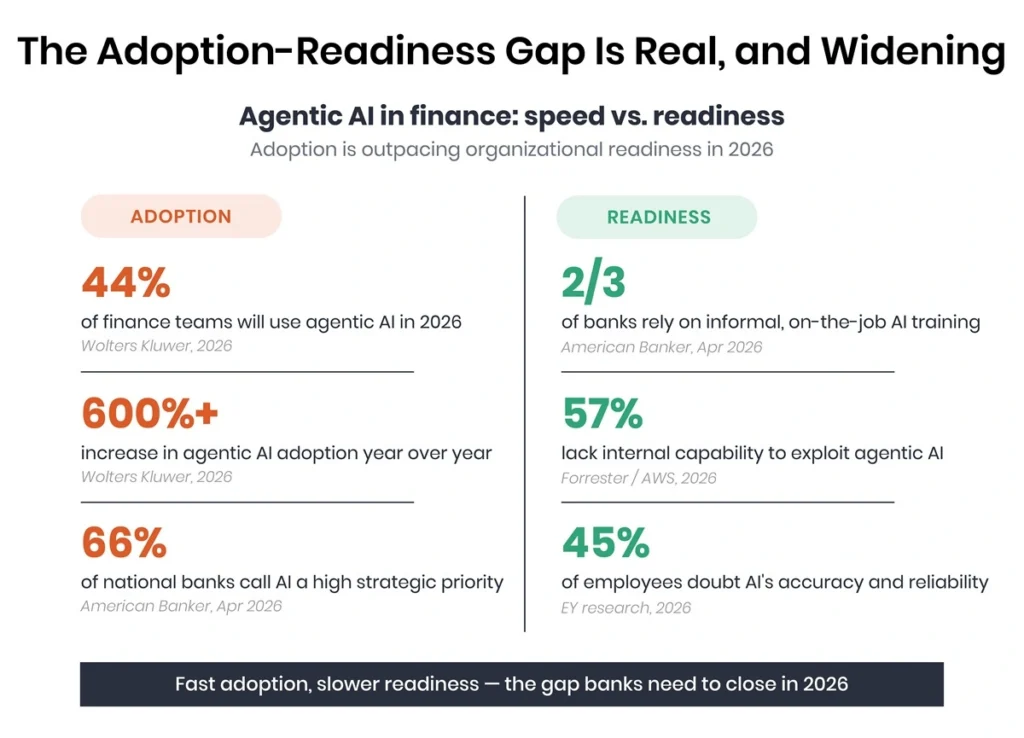
That gap matters because agentic AI is not passive software. It acts, decides, and initiates banking workflows autonomously in real time. A workforce that does not know how to supervise, validate, or override it is not merely under-utilizing the investment. It is also carrying a governance and operational risk that the technology platform itself cannot mitigate. Why banking transformation projects fail at user adoption almost always comes back to this: the technology arrives before the people are ready, and the gap between access and competency is where the ROI gets lost.
The Human Barriers Are Specific
The resistance is not vague in cultural friction. It is specific and measurable. 45% of employees doubt AI accuracy and reliability, which produces two distinct failure modes: staff who ignore the agent entirely (under-adoption, wasted investment) and staff who accept its outputs without review (over-trust, error exposure).
Both are operational risks, and informal training addresses neither. 64% of employees worry AI will take their jobs, and 45% actively resist change, slowing adoption further and driving avoidance behaviors that mandates alone cannot overcome. Structural barriers require structural solutions. Informal training is not one.
Why Informal Training Fails for Agentic AI Specifically
Learn-as-you-go training might be tolerable for a simple productivity tool where the cost of a mistake is low and the recovery is easy. Agentic AI operates in high-stakes banking workflows where errors carry financial, regulatory, and reputational consequences, and where a mistake by an under-supervised autonomous agent can compound before a human even notices.
Agentic AI also introduces new authentication and security risks that an internal learning curve can amplify, as American Banker’s research notes specifically. Informal training is not just a productivity gap in this context. It is a governance risk. That is why the two-thirds-informal statistic should land with urgency on the desks of CIOs and Chief Risk Officers, not just L&D teams. See also why 70% of bank transformations fail: the pattern is consistent, and informal enablement is always part of the story.
Why Agentic AI Is a New Kind of Training Challenge
The Human Role Shifts from Doing to Supervising
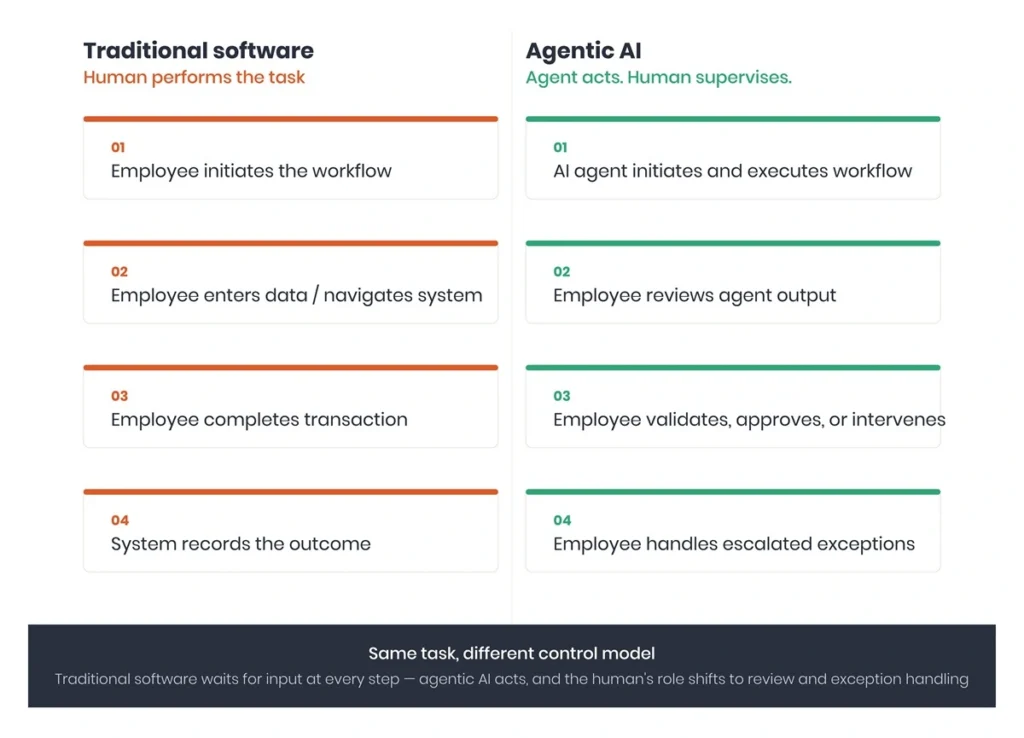
Here is the reframe that most AI content in 2026 misses entirely. Traditional software training teaches click-paths. The employee performs the task; the system is a tool. Log in, click here, enter this field, submit. Training mirrors that structure: here is where you navigate, here is what each field expects, here is the workflow sequence. The human is the actor, and training builds the actor’s capability.
Agentic AI changes that model fundamentally. The agent performs the task. It acts autonomously, pulling data, making recommendations, initiating next steps, and in many configurations executing them without human intervention. The employee’s job is no longer to do the task. It is to supervise the agent doing it, validate its output, decide when to trust the result and when to intervene, and handle the exceptions and edge cases the agent cannot resolve and escalates back to a human.
“Teaching someone to use a new tool is straightforward. Retraining instincts built over 30 years is not.” Philip Bruno, Chief Strategy and Growth Officer, ACI Worldwide, American Banker, April 2026”
This is not a variation of old competency. It is a new one that requires different skills, different instincts, and a different kind of training. Click-path training cannot build judgment. Role-plays and policy briefings cannot replace practice. The new competency forms through rehearsal in a realistic environment, repeated until the supervise-and-validate loop becomes instinctive rather than effortful.
The 4 New Competencies for Working with AI Agents in Banking
- Calibrated Trust:
When to Follow, When to Question Knowing which situations the agent handles reliably, and which require close human review. Neither blanket trust nor blanket skepticism protects the bank. Calibrated judgment does. - Output Validation:
Reviewing, Not Just Accepting Actively checking the agent’s work rather than treating it as authoritative. This matters for the 45% who doubt AI accuracy and for the opposite risk: over-trust in a plausible but wrong output. - Exception Handling:
Acting When the Agent Escalates The cases the agent cannot resolve and hands back to a human are typically the hard ones. Staff need practiced, confident responses to these escalations, not ad-hoc improvisation. - Accountability:
The Human Stays Responsible In banking, regulatory and compliance accountability does not transfer to the AI agent. Staff must understand where the agent ends, and their own accountability begins, and operate accordingly.
Notice what these four competencies have in common: none of them involves a click-path. None of them emerge from reading documentation. Each one requires repeated practice in realistic scenarios that include the difficult cases, the subtly wrong output, the unexpected escalation, the compliance edge case, until the right response becomes instinctive. That is a training design challenge that most banks have not yet confronted at any serious scale.
Retraining Instincts Takes More Than Awareness
Experienced banking staff carry decades of operational muscle memory around doing the task themselves. The mortgage approval process, the client verification sequence, and the reconciliation check: these are automatic, practiced, and reliable. Now they must learn to step back and let the agent act while staying alert enough to catch it when it goes wrong. That instinct reversal is a change management challenge as much as skills one. It does not happen through awareness. It happens through practice in a realistic environment until the new instinct competes with the old one and eventually replaces it.
How financial institutions build training that adapts fast, drives faster adoption and reduces support costs
How to Build Real Agentic-AI Readiness
The answer to informal training is not more informal training with better documentation attached. It is structured, scenario-based enablement built around the actual human-in-the-loop competencies that agentic AI demands. Here is what that looks like in practice for a banking workforce.
Practice the Human-in-the-Loop Workflow Safely
Banking staff need to rehearse the supervise, validate, and exception-handle loop before doing it live on real customer transactions, where a mistake means a real financial loss, a compliance breach, or a reputational incident. That requires a safe practice environment that replicates the AI-enabled system realistically enough to build new instincts without the production risk.
Build Judgment Through Realistic Scenarios
The training scenarios that matter for agentic AI are fundamentally different from the ones that matter for traditional software. That means including the hard cases: the agent producing a result that looks correct but contains a subtle error a human reviewer should catch. Practicing them repeatedly in a realistic environment is the only way to develop the reliable instinct they require.
Role-based training matters here, too. A compliance officer’s supervisory responsibilities differ from relationship managers, and both differ from an operations clerk. Each role works with the agent differently, sees different output types, and carries different accountability. One training path designed for a generic “AI user” does not prepare any of them well.
Reinforce in the Flow of Work, Then Measure What Matters
Structured simulation before go-live builds the initial competency. After go-live, staff encounter edge cases that training did not cover, time pressure compresses their review process, and the new supervisory habit competes with old instincts.
Assima In-App Search provides in-flow guidance directly inside the AI-enabled system, surfacing the right information at the specific decision points where supervisory judgment is required. That in-flow support is what sustains the new competency through the uncomfortable early weeks when the new instinct is still forming.
To be precise about Assima’s role in this: Assima is not an agentic-AI vendor. Assima trains your workforce to work with the AI tools your bank has already adopted, through simulation of the human-in-the-loop workflows, in-app reinforcement inside the live system, and measured proficiency at the supervisory competencies that determine whether agentic AI gets used safely and effectively. You bring the AI. Assima makes sure your people can actually work with it.
Readiness Is the Real AI Investment
Agentic AI is half the investment. The other half, the half that determines whether the first half delivers any return, is a workforce that can actually work with it safely, consistently, and at scale.
A powerful AI agent operating inside banking workflows without a trained human supervisor is not a productivity gain. It is a risk that happened to automate. The financial, regulatory, and reputational exposure from over-trusted, under-supervised autonomous AI outputs in high-stakes banking operations can dwarf the efficiency savings that justified the purchase. Banks that are deploying agentic AI faster than they are building the workforce readiness to use it are not ahead of the curve. They are in front of a governance problem they have not yet named.
The banks that generate real ROI from agentic AI will be those that treat workforce readiness as a formal program phase. Not a launch event. Not a briefing campaign. A deliberate, structured enablement effort that builds the supervise-and-validate competency before scaling the AI to the full workforce, that measures whether the competency has actually formed, and that sustains it as the AI evolves. The technology changes fast. The human judgment required to use it safely needs to be built once and maintained continuously, not assumed and hoped for.
Enablement is not a cost added to the AI project. It is what protects the AI investment and converts it from a promising pilot into production value across the institution. Use the ROI Calculator to quantify what that enablement investment delivers in measurable terms and see how the systems training platform builds the workforce readiness your agentic AI needs.
Build the Workforce Readiness Your Agentic AI Needs
Frequently Asked Questions
Let’s Answer Some of Your Questions.
For most banks, not yet. About two-thirds rely on informal training to help staff use new AI models, and 57% of organizations say they lack the internal capability to take advantage of agentic AI, even as 44% of finance teams adopt it in 2026. The gap is widening because adoption is racing ahead of readiness. Agentic AI also demands a new competency that informal training does not build: staff must supervise, validate, and handle exceptions from an autonomous agent, not just operate a tool. That requires practiced judgment, not briefings and documentation.
Traditional software training teaches a click-path: the human performs the task and the software is the tool. With agentic AI, the AI performs the task autonomously, so the human role shifts to supervising the agent, validating its output, and handling escalated exceptions. That requires judgment and oversight rather than keystrokes: knowing when to trust the agent, when to intervene, how to verify its work, and how to remain accountable for regulatory outcomes even when the agent acted. Click-path training does not build these competencies. They have to be practiced in realistic scenarios until the new instinct replaces the old one.
Four core competencies: calibrated judgment about when to trust the agent and when to question it; active output validation rather than blind acceptance or avoidance; confident exception handling when the agent escalates a case it cannot resolve; and a clear understanding of personal accountability for regulatory and compliance outcomes even when the agent acted autonomously. These are oversight and judgment skills, not tool-operation skills. They matter specifically because 45% of employees already doubt AI reliability, creating both over-trust and disuse risks that informal training does nothing to address.
Let them practice the human-in-the-loop workflow safely before doing it live. Simulation provides a realistic environment to rehearse supervising the agent, validating its output, and handling escalations on anonymized scenarios that mirror the live AI-enabled system, including the hard cases where over-trusting the agent would cause harm. Reinforce with in-app guidance at the decision points where supervisory judgment is needed. Measure whether staff can correctly supervise and escalate rather than just measuring attendance. Use early-adopter champions to model the new way of working. Industry experts recommend exactly this combination: experimental sandboxes plus champions.
No, and the distinction matters. Assima is not an agentic-AI vendor. Assima is the platform that trains your workforce to actually use the AI tools your bank has adopted. It simulates the new human-in-the-loop workflows so staff can practice supervising, validating, and handling exceptions from AI agents safely. It reinforces the new way of working with in-app guidance inside the live AI-enabled system and measures proficiency at the supervisory tasks that determine whether agentic AI is used safely and effectively. You bring the AI. Assima makes sure your people can work with it.