


Introduction
Key Highlights
- Employees should be equipped to operate with confidence on both new and legacy systems.
- After launch, keep tracking and helping with user performance to promote long-term adoption.
- Start training early instead of waiting for the system to be finalized.
- Use realistic simulations with anonymised data for secure and practical practice.
Upgrades to core systems are frequently likened to replacing an aircraft’s engine while it is in flight. Data transfer, integrations, testing, and technology selection are the main topics of discussion. However, training the individuals who will use the new system on a daily basis is a crucial component that frequently gets significantly less attention.
1. Training Begins Before the New System Is Ready
How to Get Past It
Organisations can develop training from the staging or pre-production environment instead of waiting for the production system to be finalized. Learning could advance alongside implementation thanks to the realistic, interactive practice settings created by contemporary simulation-based training platforms, which can be updated as the system changes.
2. Time Restrictions Before Go-Live
One of the final tasks planned for a core system update is frequently training. Employees have little time to become familiar with completely new procedures because implementation teams are preoccupied with testing, cutover tasks, and final changes by the time the system is ready. Users are more stressed and find it more difficult to remember information as a result of this hurried approach.
Financial institutions face an even bigger challenge. It is challenging to remove staff from customer-facing duties for extended classroom sessions because banks and financial service providers operate around the clock. It is rarely possible to extend the training timetable due to set go-live dates and regulatory requirements.
How to Get Past It
The secret is to make learning more flexible and to begin training earlier. Instead of depending just on instructor-led workshops, self-paced, role-based simulation training enables staff members to practice whenever it suits their schedules.
Companies should assess competency in addition to course completion. Before going live, requiring users to prove they can accomplish crucial jobs reduces errors, increases confidence, and guarantees that the workforce is genuinely ready for the new system’s launch.
3. Training Can't Use Sensitive Financial Information
Highly sensitive data, such as customer names, account information, transaction histories, and financial records, is stored in core banking and financial systems. There are serious privacy, security, and compliance risks when using this data in a training setting. However, training using fictitious or unrealistic data frequently falls short of preparing workers for real-world situations.
Finding the ideal mix between practical training and data security is a persistent problem for financial institutions. Organizations must handle consumer data extremely carefully, particularly during significant system transitions, in accordance with regulations like GDPR and industry security requirements.
How to Get Over It
Using simulation-based training with synthetic or anonymised data is the optimal strategy. This allows staff members to rehearse actual business procedures in a secure setting without disclosing private client data.
Financial institutions can enhance user confidence, support compliance efforts, and lower the risks associated with training on live data by developing realistic training scenarios that replicate production systems.
4. Coordinating New and Legacy Systems
A lot of financial organizations need time to transition to a new core system. Instead, in order to reduce risk and guarantee business continuity, they run the new and legacy systems concurrently. This strategy facilitates a more seamless changeover, but it also poses a significant training problem.
Employees need to know which procedures should be finished in the new system and which belong in the old one. Confusion, mistakes, and slower operations can result from switching between two separate interfaces and workflows, especially in high-volume settings like branches, call centers, and back-office teams.
How to Get Past It
Training ought to take the transition’s reality into account. Organizations should train staff to work confidently across both systems until the migration is finished, rather than only the new platform.
Users can practice common tasks, comprehend system-specific procedures, and learn when to use each platform by using simulation-based training, which can replicate both settings. This enhances operational precision, lessens misunderstanding during the parallel run, and speeds up team adaptation throughout the migration process.
5. Maintaining User Trust Following Go-Live
Go-live marks the start of a new method of operation rather than the conclusion of a fundamental system update. Employees will still have to deal with new workflows, infrequent transactions, and novel situations even after thorough training. Small errors can quickly impact compliance, customer service, and productivity in the absence of continuous support.
The months after go-live are particularly crucial for financial organizations. Organizations need to know where users are having trouble as new hires join and current employees adjust to changing procedures so they can fix problems before they become more serious operational concerns.
How to Get Past It
After go-live, training shouldn’t end. Refresher training, in-app assistance, and ongoing learning enable workers to complete jobs with assurance while lowering need on support personnel.
Monitoring user struggles after go-live is as crucial. L&D and transformation teams can provide targeted support where it’s most required by using analytics that pinpoint common errors, frequently requested help information, or challenging workflows. This data-driven strategy increases long-term competency, boosts user adoption, and optimizes the return on investment for the core system.
Conclusion
One of the trickiest projects a financial organization may take on is a core system overhaul. Data transfer, integrations, and technology are crucial, but they are not the whole picture. The ability of staff to use the new system accurately and confidently from the start is the true test of success.
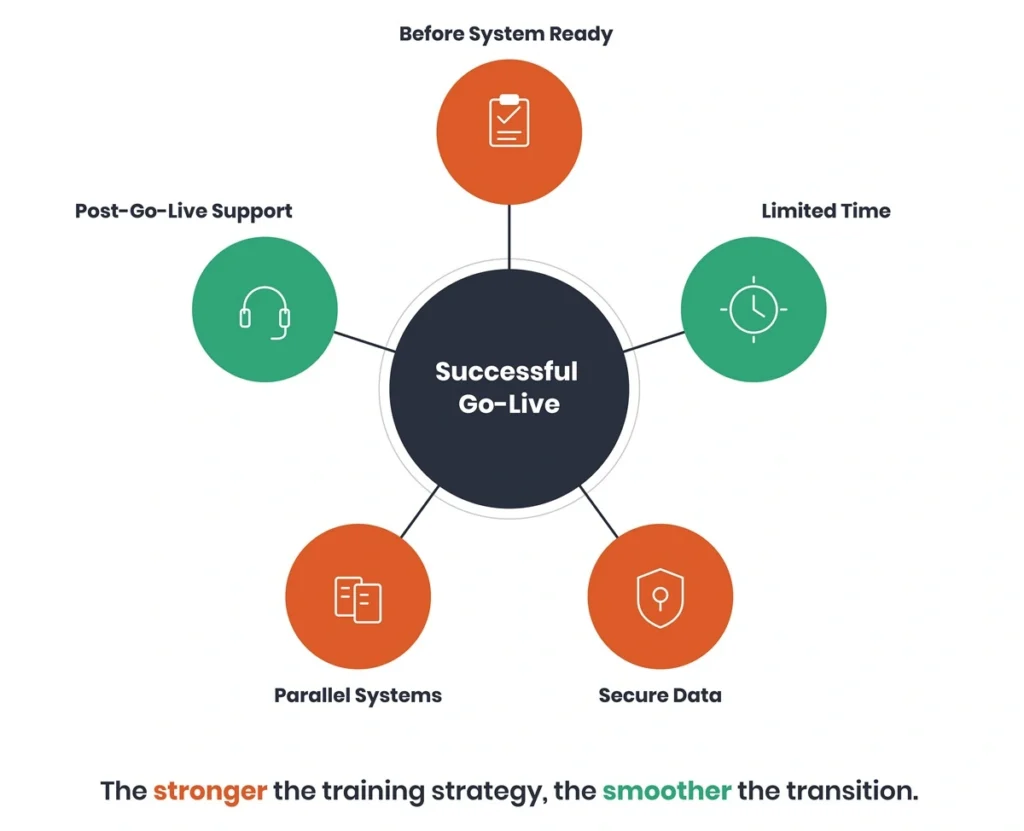
Adoption may be impacted if the five issues raised, training before the system is ready, time constraints before to go-live, safeguarding sensitive data, managing parallel systems, and post-go-live user support are not resolved. Organizing training concurrently with the implementation, as opposed to later, lowers risk and gets staff ready for a more seamless transition.
Financial institutions can improve user preparedness, reduce interruption, and guarantee that their core system upgrade yields the long-term value intended by combining flexible learning, realistic simulation-based training, and continuous performance support.